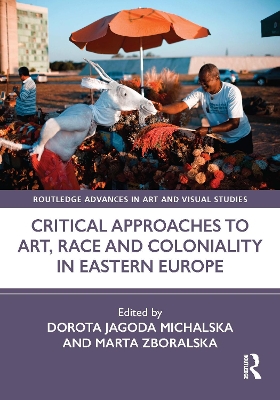
Building on recent scholarship that challenges the supposed historical isolation of Eastern European art from the colonial matrix of power, this book critiques the sometimes uncritical application of established Western postcolonial and decolonial theories to the region's visual production.
Instead, it advocates for more nuanced, historically grounded methodologies sensitive to Eastern Europe's specific circumstances as a capitalist (semi)periphery and an area shaped by multiple competing empires. Moving beyond Cold War binaries, the essays collectively argue that the region's volatile historical positionalities destabilise rigid theoretical divides between coloniser and colonised, challenge normative understandings of whiteness and indigeneity, and highlight the divergent political trajectories of post-socialism and post-colonialism in artistic practice. Conceptualised as a critical intervention, the volume amplifies voices from the (semi)periphery to make a significant methodological contribution to debates in the global history of art, foregrounding the variegated nature of colonialism itself.
The book will be of interest to scholars working in art history, colonialism and postcolonialism studies, and Eastern European studies.
Building on recent scholarship that challenges the supposed historical isolation of Eastern European art from the colonial matrix of power, this book critiques the sometimes uncritical application of established Western postcolonial and decolonial theories to the region's visual production.
Introduction SECTION I: A Materialist Critique
1. Between Empires:
Uneven and Combined Development in the Context of Yugoslav Art
2. Decolonial
Erasures: Undoing Soviet Modernity
3. Plovdivs Bratska Mogila as a Microcosm
of the 1960s and 1970s in Bulgaria and the Socialist World
4. Does the Post-
in Postcolonial mean the same as the Post- in Postsocialist Art? SECTION II:
A Transcultural Critique
5. Imperialism, Colonialism and Ukrainian Identity:
The Case of Mykhailo Boichuks School of Monumental Art 6.Who owns
modernism?: Indigenous agents among Polish, Jewish, and Ukrainian
entanglements in interwar Lviv
7. Like Ghosts and Phantoms: Colonialism,
Racialized Vision and the Status of Blackness in Interwar Poland
8. The
Spatial Practice of the Avant-garde: Ilia Zdanevich 1912-1919 POSTSCRIPT: Art
and Liberation
9. Decolonization and Revolution in Ukraine 2000-Present
Dorota Jagoda Michalska is a Fellow at the Institute for Advanced Studies, Central European University in Budapest, Hungary.
Marta Zboralska is Leverhulme Early Career Fellow at Ruskin School of Art, University of Oxford, and Bowra Junior Research Fellow at Wadham College.