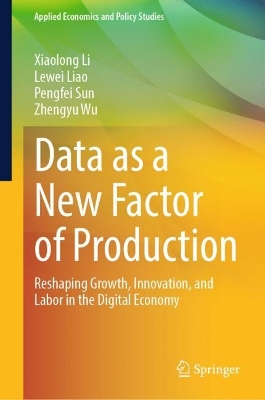
This book offers a groundbreaking exploration of how data, empowered by artificial intelligence, is reshaping traditional economic paradigms. Through a richly interdisciplinary lens, it analyzes the disruptive potential of data as a core production factoralongside labor, capital, and landhighlighting its non-rivalrous nature, exponential returns to scale, and transformative impact on productivity, employment, and institutional design. Bridging theoretical modeling and real-world case studies, the volume reveals how data-driven innovation transcends sectoral boundaries, from manufacturing to public governance. It examines how leading economies strategically deploy AI and data to redefine global competitiveness, while also addressing critical issues such as data monopolies, regional inequality, and algorithmic ethics. Intended for scholars, policymakers, and industry practitioners in digital economics, public policy, and technology governance, this book delivers cutting-edge insights with accessible depth. It balances global comparisons with in-depth analysis of Chinas digital infrastructure, AI regulation, and data market reformoffering a timely contribution to the global conversation on digital transformation. Key Features: Introduces a novel conceptual framework positioning data as a primary production factor. Combines theoretical rigor with empirical detail and forward-looking policy recommendations.