Muutke küpsiste eelistusi

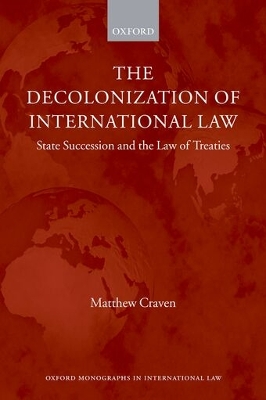
Decolonization of International Law: State Succession and the Law of Treaties [Pehme köide]

(Professor of International Law, School of Oriental and African Studies, University of London)
  • Formaat: Paperback / softback, 306 pages, kõrgus x laius x paksus: 234x156x16 mm, kaal: 479 g
  • Sari: Oxford Monographs in International Law
  • Ilmumisaeg: 01-Oct-2009
  • Kirjastus: Oxford University Press
  • ISBN-10: 0199577889
  • ISBN-13: 9780199577880
  • Pehme köide
  • Hind: 61,80 €*
  • * hind on lõplik, st. muud allahindlused enam ei rakendu
  • Tavahind: 77,25 €
  • Säästad 20%
  • Raamatu kohalejõudmiseks kirjastusest kulub orienteeruvalt 3-4 nädalat
  • Kogus:
  • Lisa ostukorvi
  • Tasuta tarne
  • Tellimisaeg 2-4 nädalat
  • Lisa soovinimekirja
  • Formaat: Paperback / softback, 306 pages, kõrgus x laius x paksus: 234x156x16 mm, kaal: 479 g
  • Sari: Oxford Monographs in International Law
  • Ilmumisaeg: 01-Oct-2009
  • Kirjastus: Oxford University Press
  • ISBN-10: 0199577889
  • ISBN-13: 9780199577880
The issue of state succession continues to be a vital and complex focal point for public international lawyers, yet it has remained strangely resistant to effective articulation. The formative period in this respect was that of decolonization which marked for many the time when international law 'came of age' and when the promises of the UN Charter would be realized in an international community of sovereign peoples. Throughout the 1990s a series of territorial adjustments placed succession once again at the centre of international legal practice, in new contexts that went beyond the traditional model of decolonization: the disintegration of the Soviet Union, Yugoslavia, and Czechoslovakia, and the unifications of Germany and Yemen brought to light the fundamentally unresolved character of issues within the law of succession.

Why have attempts to codify the practice of succession met with so little success? Why has succession remained so problematic a feature of international law? This book argues that the answers to these questions lie in the political backdrop of decolonization and self-determination, and that the tensions and ambiguities that run throughout the law of succession can only be understood by looking at the relationship between discourses on state succession, decolonization, and imperialism within the framework of international law.

Muu info

Winner of Winner of the Inaugural European Society of International Law Book Prize 2008.
Table of Cases
ix
Table of Treaties
xiii
Introduction 1(6)
Critical Diagnostics
7(86)
Introduction
7(16)
The Themes of Succession
23(6)
A Brief History
29(23)
Succession, Identity, and Continuity
52(28)
Three Notions of Territorial Sovereignty
61(3)
Two Notions of Succession
64(3)
Continuity and Succession
67(2)
The Point of Differentiation
69(6)
From Status to Relations
75(5)
Bedjaoui, O'Connell, and the `End' of Succession
80(10)
Conclusions
90(3)
Codification and Decolonization 1950-1974
93(114)
The Move to Codification
94(2)
Initial Steps: The International Law Commission Sub-committee
96(9)
The International Law Association
105(8)
A Change in Focus: The Waldock Reports
113(7)
The Law of Treaties and Beyond
120(11)
Devolution Agreements
122(6)
Unilateral Declarations
128(3)
New States
131(16)
Treaties providing for Succession
132(2)
A Right of Participation
134(7)
The Legal Nexus
141(6)
Semi-Sovereignty: Mandates, Trusteeships and Protectorates
147(8)
Other Categories of Succession
155(18)
Unions of States
157(9)
The Dissolution of States
166(7)
Dispositive Treaties
173(21)
Boundary Treaties
176(11)
Territorial Agreements
187(7)
Final Moves: The Vienna Conference
194(4)
Reception and Reflection
198(3)
Conclusions
201(6)
New Beginnings, New Ends
207(52)
Introduction
207(6)
Beyond Decolonization
213(3)
The Perils of Formalism: Continuity, Personality, and Identity
216(15)
Treaty Continuity and Automatic Succession
231(13)
Functional Differentiation
244(12)
Conclusions
256(3)
Conclusions 259(9)
Select Bibliography 268(19)
Index 287
Matthew Craven is Professor of International Law, School of Oriental and African Studies, University of London