Muutke küpsiste eelistusi

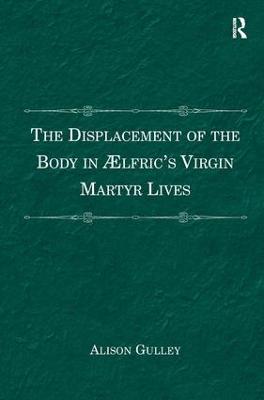
Displacement of the Body in Ælfric's Virgin Martyr Lives [Kõva köide]

  • Formaat: Hardback, 160 pages, kõrgus x laius: 234x156 mm, kaal: 460 g
  • Ilmumisaeg: 28-Jan-2014
  • Kirjastus: Routledge
  • ISBN-10: 1409442144
  • ISBN-13: 9781409442141
  • Kõva köide
  • Hind: 164,25 €*
  • * hind on lõplik, st. muud allahindlused enam ei rakendu
  • Tavahind: 219,00 €
  • Säästad 25%
  • Raamatu kohalejõudmiseks kirjastusest kulub orienteeruvalt 3-4 nädalat
  • Kogus:
  • Lisa ostukorvi
  • Tasuta tarne
  • Tellimisaeg 2-4 nädalat
  • Lisa soovinimekirja
  • Formaat: Hardback, 160 pages, kõrgus x laius: 234x156 mm, kaal: 460 g
  • Ilmumisaeg: 28-Jan-2014
  • Kirjastus: Routledge
  • ISBN-10: 1409442144
  • ISBN-13: 9781409442141
The Displacement of the Body in Ãlfric's Virgin Martyr Lives addresses 10th-century Old English hagiographical translations, from Latin source material, by the abbot and grammarian Ãlfric. The vitae of Agnes, Agatha, Lucy, and Eugenia, and the married saints Daria, Basilissa, and Cecilia, included in Ãlfric's s Old English Lives of Saints, recount the lives, persecution, and martyrdom of young women who renounce sex and, in the first four stories, marriage, to devote their lives to Christian service. They purport to be about the primacy of virginity and the role of the body in attaining sanctity. However, a comparison of the Latin sources with Ãlfric's versions suggests that his translation style, characterized by simplifying the most important meanings of the text, omits certain words or entire episodes that foreground suppressed female sexuality as key to sainthood. The Old English Lives de-emphasize the physical nature of faith and highlight the importance of spiritual purity. In this volume, Alison Gulley explores how the context of the Benedictine Reform in late Anglo-Saxon England and Ãlfric's commitment to writing for a lay audience resulted in a set of stories depicting a spirituality distinct from physical intactness.

Arvustused

'[ The book] is both accessible to undergraduates approaching the theological debates of the tenth century and a study that contributes to an under-studied area of Anglo-Saxon sanctity. For this reason Gulley's book will certainly be of interest to scholars of hagiography.' Notes and Queries

Acknowledgements vii
List of Abbreviations
viii
1 Introduction: The Function of Aelfric's Hagiography
1(14)
2 The Ideal of Castitas and the Environment of Aelfric's Virgin Martyr Legends
15(22)
3 Marital Imagery, Marian Allusion, and Circumscribed Virginity in Aelfric's Life of Agnes
37(14)
4 Private Lives and Public Contexts in Aelfric's Lives of Agatha and Lucy
51(16)
5 Cross-dressing, Sex-Change, and Womanhood in Aelfric's Life of Eugenia
67(16)
6 "Let us hold firmly to the beautiful treasure": Teaching, Learning, and Salvation in the Passio of Chrysanthus and Daria
83(16)
7 Conversion and Marital Vocation in the Passiones of Julian and Basilissa and Cecilia and Valerian
99(20)
8 Conclusion
119(12)
Bibliography 131(14)
Index 145
Alison Gulley is Associate Professor of English at Appalachian State University in Boone, NC, USA.