Muutke küpsiste eelistusi

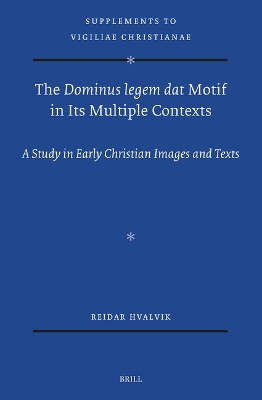
Dominus legem dat Motif in Its Multiple Contexts: A Study in Early Christian Images and Texts [Kõva köide]

  • Formaat: Hardback, 572 pages, kõrgus x laius x paksus: 235x155x41 mm, kaal: 1072 g
  • Sari: Vigiliae Christianae, Supplements 187
  • Ilmumisaeg: 06-Mar-2025
  • Kirjastus: Brill
  • ISBN-10: 9004718419
  • ISBN-13: 9789004718418
  • Kõva köide
  • Hind: 137,56 €*
  • * hind on lõplik, st. muud allahindlused enam ei rakendu
  • Tavahind: 171,95 €
  • Säästad 20%
  • Raamatu kohalejõudmiseks kirjastusest kulub orienteeruvalt 3-4 nädalat
  • Kogus:
  • Lisa ostukorvi
  • Tasuta tarne
  • Tellimisaeg 2-4 nädalat
  • Lisa soovinimekirja
  • Formaat: Hardback, 572 pages, kõrgus x laius x paksus: 235x155x41 mm, kaal: 1072 g
  • Sari: Vigiliae Christianae, Supplements 187
  • Ilmumisaeg: 06-Mar-2025
  • Kirjastus: Brill
  • ISBN-10: 9004718419
  • ISBN-13: 9789004718418
"In this book, Dominus legem dat, labeled the most debated motif in early Christian art, is dealt with in all its different contexts, particularly Roman sarcophagi, where it most often occurs. In light of concurrent Roman funerary art, it offers a new understanding of the function of biblical motifs on sarcophagi, and a number of contemporary Christian texts are presented as a key for the interpretation of the so-called "traditio legis" composition. This first, richly illustrated monograph on the motif argues that it originated in Old St. Peter's Basilica, substantiated by a broad discussion of its historical and theological context. A catalog of all occurrences is included"--

This book is the first major monograph on the most debated topic in early Christian art, dealing with the Dominus legem dat motif in all its contexts, particularly Roman sarcophagi, illuminated by concurrent Roman funerary art and early Christian literature.
Preface

List of Illustrations, Photo Credits and Tables

Abbreviations


Introduction

1Dominus legem dat

2Biblical Images on Early Christian Sarcophagi

3The Research Questions of this Study

4Outline of the Study


1 Context: The Early Christian Sarcophagi and Roman Funerary Art

1.1The Rhetorical Nature of Pagan/Classical and Christian Roman Sarcophagi

1.2The Images on Christian Sarcophagi

1.3Summing up


2 Context: Biblical Images in Early Christian Funerary ArtTheir Sources and
Significance

2.1The Repertoire of Early Christian Funerary Images: The Most Common
Images

2.2Images and Texts

2.3Listings of Biblical Heroes in Writings Known and Used in Rome in the
Third and Fourth Centuries

Excursus: Christian Writings Known in Rome in the Third and Fourth
Centuries

2.4Funerary Images and Funerary Orations

2.5From Texts to ImagesSome Challenges

2.6Funerary Images Conveying Belief in the Resurrection of the Dead

2.7Theological Reflections and Pragmatic Reasons for the Choice of Images

2.8Summing up


3 Dominus legem dat: Defining the Motif

3.1Terminology

3.2Some Preliminary Considerations

3.3The Motif: Core Elements and Additional Elements


4 History of Research

4.1First Period: 1594 to ca.1850

4.2Second Period: ca.18501950

4.3Third Period: Second Half of the Twentieth Century

4.4Fourth Period: Twenty-First Century

4.5Summing up


5 The Dominus legem dat Sarcophagi

5.1The Layout of the Sarcophagi

5.2The Motifs Found together with Dominus legem dat

5.3City-gate Sarcophagi where Dominus legem dat Covers the Whole Front and
the Adjacent Motifs

5.4Sarcophagi where Dominus legem dat Is One of Several Motifs on the
Front

5.5The Design of Dominus legem dat when It Is the Sole Motif on the Front

5.6Interpreting the Dominus legem dat Motif on the Basis of Sarcophagi 160


6 Interpreting Dominus legem dat on the Basis of Texts

6.1Occurrences of the Inscription

6.2The Idea of a (New) Law of Christ in Early Christianity

6.3The Inscription outside the Dominus legem dat Scene

6.4Interpreting the Dominus legem dat on the Basis of Texts and Sarcophagus
Images


7 Interpreting Dominus legem dat in a Specific Context: The Mosaic in San
Giovanni in Fonte

7.1San Giovanni in Fonte

7.2The Mosaic in the Dome of the Baptistery

7.3The Dominus legem dat Motif in San Giovanni in Fonte

7.4The Apostles Peter and Paul


8 The Lamb on the Mount, the Sheep Coming out from Two Cities, and the River
Jordan

8.1The Position of the Lamb and the Sheep

8.2The Divine Lamb (Agnus Dei) on the Mount

8.3The Sheep

8.4The Cities/City Gates

8.5Jerusalem and Bethlehem

8.6The River Jordan

8.7The Origin of the Various Versions


9 The Assumed First Version of the Dominus legem dat Motif

9.1The Location of Roman Sarcophagi with a Dominus legem dat Motif

9.2Versions of the Dominus legem dat Reflecting an Earlier Monumental
Model

9.3Indirect Evidence from a Roman Apse Mosaic and from Saint Augustine

9.4Possible Later Copies of the Apse in St. Peters

9.5Summing up


10 Dominus legem dat in Its Historical and Theological Context

10.1The Origin of the Old St. Peters Basilica

10.2The Possible Theological Background for the Choice of the Motif in St.
Peters Basilica


Conclusion


Appendix: Catalog of All Occurrences of the Dominus legem dat Motif

Bibliography

Indices
Reidar Hvalvik, Dr. theol., is Professor emeritus in New Testament Studies at MF Norwegian School of Theology, Religion and Society; affiliated to the Norwegian Institute in Rome in 20062007. His education includes art history, and his publications cover early Christian literature and art.