Muutke küpsiste eelistusi

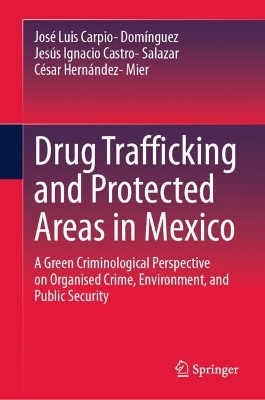
Drug Trafficking and Protected Areas in Mexico: A green criminological perspective on Organised Crime, Environment, and Public Security [Kõva köide]

  • Formaat: Hardback, 218 pages, kõrgus x laius: 235x155 mm, 58 Illustrations, color; 3 Illustrations, black and white
  • Ilmumisaeg: 02-May-2026
  • Kirjastus: Springer Nature Switzerland AG
  • ISBN-10: 3032182174
  • ISBN-13: 9783032182173
Teised raamatud teemal:
  • Kõva köide
  • Hind: 100,34 €*
  • * hind on lõplik, st. muud allahindlused enam ei rakendu
  • Tavahind: 133,79 €
  • Säästad 25%
  • Raamatu kohalejõudmiseks kirjastusest kulub orienteeruvalt 3-4 nädalat
  • Kogus:
  • Lisa ostukorvi
  • Tasuta tarne
  • Tellimisaeg 2-4 nädalat
  • Lisa soovinimekirja
  • Formaat: Hardback, 218 pages, kõrgus x laius: 235x155 mm, 58 Illustrations, color; 3 Illustrations, black and white
  • Ilmumisaeg: 02-May-2026
  • Kirjastus: Springer Nature Switzerland AG
  • ISBN-10: 3032182174
  • ISBN-13: 9783032182173
Teised raamatud teemal:
This book provides an interdisciplinary exploration of the convergence between drug trafficking and environmental conservation within Protected Areas in Mexico. Bridging environmental studies, green criminology, and political geography, it examines how criminal groups exploit these territories for the production, processing, and transit of narcotics, posing significant challenges to public security, environmental conservation, and social justice.


Through a critical analysis of geographical, social, cultural, environmental, economic and governmental factors, the book addresses the historical context of drug trafficking in Mexico, the impact of policies such as the Mexican War on Drugs, and the emergence of new illicit economic markets in protected areas. By incorporating testimonies from environmental inspectors, it highlights from a green criminological perspective, the complexities of managing environmental conservation in regions under the influence of organized crime.


Drug Trafficking and Protected Areas in Mexico is a timely contribution that emphasizes the need for integrative approaches to understanding the nexus of public security and environmental protection. It challenges traditional disciplinary boundaries by foregrounding the intricate links between ecological sustainability, governance, and the socio-economic dynamics of organized crime.
Chapter
1. Mexican History of Natural Protected Areas.
Chapter
2.
Geography of Natural Protected Areas.
Chapter
3. Legislation and management
of Protected Natural Areas.
Chapter
4. The Rise of Drug Trafficking in
Mexico.
Chapter
5. Pax Narcotica: Government, Organized Crime (1980-2000).-
Chapter
6. Environmental conservation and the prelude to the Mexican war on
drugs (2000-2006).
Chapter
7. Drug Trafficking in Protected Areas: During
and After the Mexican War on Drugs (2007-2012).
Chapter
8. Geographical
Distribution of Drug Trafficking in Protected Areas.
Chapter
9. New Illicit
Markets and Crimes in Natural Protected Areas.
Dr. José Luis Carpio-Domínguez is a graduate in Criminology from the Northwestern University of Chihuahua, Mexico. He holds a Masters in Criminology and Forensic Sciences from the Universidad Autónoma de Tamaulipas. PhD in Social Sciences with a focus on Sustainable Development from the Social Research Institute of the Univerisdad Autónoma de Nuevo León. Member of the Mexican Society of Criminology, Member of the National System of Researchers of Mexico (SECIHTI-Level I), Member of the Green Criminology Specialist Group of the International Union for Conservation of Nature (IUCN). He is Professor in the Criminology Department of the Law Faculty at the Universidad Autónoma de San Luis Potosí.He develops scientific research in green criminology with topics related to different forms of environmental crime, socio-environmental conflicts, as well as the interrelation between public security and the environment.


Dr. Jesús Ignacio Castro-Salazar is an Environmental Engineer from the Universidad de Guanajuato, Master in Integrated Environmental Management from El Colegio de la Frontera Norte, and PhD in Social Sciences with a focus on Sustainable Development from the Social Research Institute of the Universidad Autónoma de Nuevo León. He has worked as an inspector in the Federal Environmental Protection Agency. He collaborates on socio-environmental and energy projects applied in rural and indigenous communities in Mexico. He is a Member of the National System of Researchers of Mexico (SECIHTI-Level I) and a Member of the Green Criminology Specialist Group of the International Union for Conservation of Nature. He is Professor at the Tecnológico Nacional de Mexico/Instituto Tecnológico Superior de Abasolo. His main lines of research are environmental public policy and administration; sociology and environmental legislation; green criminology.


César Hernández-Mier holds a Bachelor's degree in Medicine from the Universidad Autónoma de Querétaro; Specialization in Forensic Medicine at the Universidad Autónoma del Estado de Mexico, based at the Attorney General's Office of the State of Mexico; Master's Degree in Forensic Medicine from the University of Valencia in Spain. Currently, he is Professor in the Criminology Department of the Law Faculty at the Universidad Autónoma de San Luis Potosí, His main lines of research are human identification and human rights.