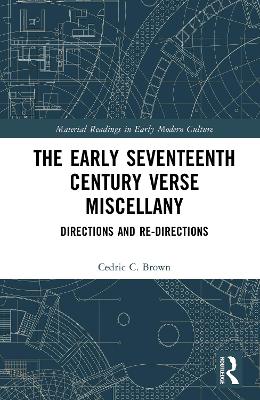
"A deeply researched study of the social transmission and adaptation of poetry texts originating in pre-Civil War England, traced through the seventeenth century and sometimes beyond. Both manuscript and printed miscellanies are used, as well as other forms of publication, and case studies unusually span elite, popular and provincial audiences. As far as possible, texts are placed according to their original contexts and functions ("Directions") then followed through various answerings, parodies, cooptings and social, commercial and political adaptations ("Re-directions"). Case studies choose examples which have not been fully researched, so that a large amount of new material is presented from poets writing in a variety of environments. Results are sometimes startling and often amusing, giving a vivid sense of how poems were read and used in material exchange and providing a picture of literary activity far removed from what traditional, canonical literary history has often assumed"-- Provided by publisher.
A deeply researched study of the social transmission and adaptation of poetry texts originating in pre-Civil War England, traced through the seventeenth century and sometimes beyond. Both manuscript and printed miscellanies are used, as well as other forms of publication, and case studies unusually span elite, popular and provincial audiences. As far as possible, texts are placed according to their original contexts and functions (“Directions”) then followed through various answerings, parodies, co-optings and social, commercial and political adaptations (“Re-directions”). Case studies choose examples which have not been fully researched, so that a large amount of new material is presented from poets writing in a variety of environments. Results are sometimes startling and often amusing, giving a vivid sense of how poems were read and used in material exchange and providing a picture of literary activity far removed from what traditional, canonical literary history has often assumed.
An individually researched study, with abundant new material, of the social transmission and adaptation of poetry from pre-Civil War England, traced through that century and beyond. Both manuscript and printed miscellanies are used, with other publication forms.
Acknowledgements
List of illustrations
Chapter 1: Why Directed and Re-directed Texts?
Chapter 2: Songs: performances, provocations, and opportunistic responses
Chapter 3: William Browne writes death, and networks in Oxford
Chapter 4: William Brownes later friendships and opportunities; redirections
in a new reign
Chapter 5: The courtier poet Aurelian Townshend treads on eggshells; young
Katherine Philips understands
Chapter 6: The development of Strodes performative identity
Chapter 7: The popular Strode: three stories of direction and re-direction
Chapter 8: Pastoral pictures, topographies, and working under Laud
Chapter 9: Leonard Wheatcroft, Derbyshire artisan, church clerk, in dialogue
with Thomas Randolph and the gentry
Chapter 10: Final words: challenges and delights
Appendix 1: William Strode and Elizabeth Lucy/Ferrers/Cromwell a quiet
friendship to discover?
Appendix 2: Merton College and the scribe of Folger MS V.a.345
Appendix 3: Harley MS 6931, Devon politics, and the socio-religious
complexities of poetry collecting in 1630s Christ Church
Index
Cedric C. Brown, Emeritus Professor of English at the University of Reading, subsequently Professorial Research Consultant at the University of Plymouth, was formerly a well-known Miltonist and the founder Editor of the very long-running interdisciplinary book series, Early Modern Literature in History, which has now passed 100 titles. With regard to the present project, he also published frequently on occasional poetry of all kinds. There are also connections with his Friendship and its Discourses in the Seventeenth Century (2016).