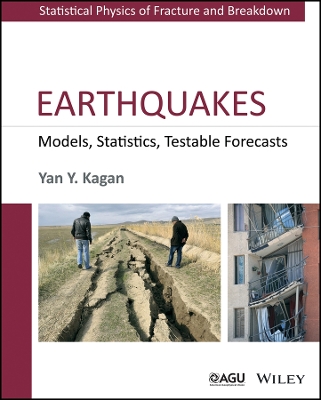
This book is the first comprehensive and methodologically rigorous analysis of earthquake occurrence. Models based on the theory of the stochastic multidimensional point processes are employed to approximate the earthquake occurrence pattern and evaluate its parameters. The Author shows that most of these parameters have universal values. These results help explain the classical earthquake distributions: Omori's law and the Gutenberg-Richter relation.
The Author derives a new negative-binomial distribution for earthquake numbers, instead of the Poisson distribution, and then determines a fractal correlation dimension for spatial distributions of earthquake hypocenters. The book also investigates the disorientation of earthquake focal mechanisms and shows that it follows the rotational Cauchy distribution. These statistical and mathematical advances make it possible to produce quantitative forecasts of earthquake occurrence. In these forecasts earthquake rate in time, space, and focal mechanism orientation is evaluated.
Preface xiii Acknowledgments xvii List of Abbreviations xix List of
Mathematical Symbols xxi PART I MODELS 1 1 Motivation: Earthquake science
challenges 3 2 Seismological background 6 2.1 Earthquakes 6 2.2 Earthquake
catalogs 8 2.3 Description of modern earthquake catalogs 11 2.4 Earthquake
temporal occurrence: quasi-periodic, Poisson, or clustered? 14 2.5
Earthquake faults: one fault, several faults, or an infinite number of
faults? 16 2.6 Statistical and physical models of seismicity 18 2.7
Laboratory and theoretical studies of fracture 19 3 Stochastic processes and
earthquake occurrence models 21 3.1 Earthquake clustering and branching
processes 21 3.2 Several problems and challenges 24 3.3 Critical
continuum-state branching model of earthquake rupture 26 PART II STATISTICS
31 4 Statistical distributions of earthquake numbers: Consequence of
branching process 33 4.1 Theoretical considerations 34 4.2 Observed
earthquake numbers distribution 43 5 Earthquake size distribution 54 5.1
Magnitude versus seismic moment 54 5.2 Seismic moment distribution 56 5.3
Is 1ØM2? 60 5.4 Seismic moment sum distribution 80 5.5 Length of
aftershock zone (earthquake spatial scaling) 86 5.6 Maximum or corner
magnitude: 2004 Sumatra and 2011 Tohoku mega-earthquakes 90 6 Temporal
earthquake distribution 96 6.1 Omori s law 96 6.2 Seismic moment release
in earthquakes and aftershocks 97 6.3 Random shear stress and Omori s law
107 6.4 Aftershock temporal distribution, theoretical analysis 110 6.5
Temporal distribution of aftershocks: Observations 116 6.6 Example: The New
Madrid earthquake sequence of 1811 12 121 6.7 Conclusion 123 7 Earthquake
location distribution 125 7.1 Multipoint spatial statistical moments 125
7.2 Sources of error and bias in estimating the correlation dimension 127
7.3 Correlation dimension for earthquake catalogs 141 7.4 Conclusion 145 8
Focal mechanism orientation and source complexity 146 8.1 Random stress
tensor and seismic moment tensor 147 8.2 Geometric complexity of earthquake
focal zone and fault systems 150 8.3 Rotation of double-couple (DC)
earthquake moment tensor and quaternions 154 8.4 Focal mechanism symmetry
159 8.5 Earthquake focal mechanism and crystallographic texture statistics
163 8.6 Rotation angle distributions 167 8.7 Focal mechanisms statistics
170 8.8 Models for complex earthquake sources 177 PART III TESTABLE
FORECASTS 183 9 Global earthquake patterns 185 9.1 Earthquake time-space
patterns 185 9.2 Defining global tectonic zones 187 9.3 Corner magnitudes
in the tectonic zones 188 9.4 Critical branching model (CBM) of earthquake
occurrence 190 9.5 Likelihood analysis of catalogs 197 9.6 Results of the
catalogs statistical analysis 204 10 Long- and short-term earthquake
forecasting 206 10.1 Phenomenological branching models and earthquake
occurrence estimation 206 10.2 Long-term rate density estimates 207 10.3
Short-term forecasts 215 10.4 Example: earthquake forecasts during the
Tohoku sequence 218 10.5 Forecast results and their discussion 224 10.6
Earthquake fault propagation modeling and earthquake rate estimation 226 11
Testing long-term earthquake forecasts: Likelihood methods and error diagrams
229 11.1 Preamble 229 11.2 Log-likelihood and information score 230 11.3
Error diagram (ED) 235 11.4 Tests and optimization for global
high-resolution forecasts 247 11.5 Summary of testing results 250 12 Future
prospects and problems 253 12.1 Community efforts for statistical seismicity
analysis and earthquake forecast testing 253 12.2 Results and challenges 254
12.3 Future developments 256 References 260 Index 281
Yan Kagan grew up and was educated in Moscow, Russia. In 1974 he came to UCLA, and working with Leon Knopoff, David Jackson, Peter Bird, and Frederick Schoenberg applied his mathematical/statistical model to seismicity analysis. Since 1999 these results have been used to produce daily earthquake forecasts for several seismically active regions and currently for the whole Earth. The performance and predictive skill of these forecasts is now being tested by several research groups.