Muutke küpsiste eelistusi

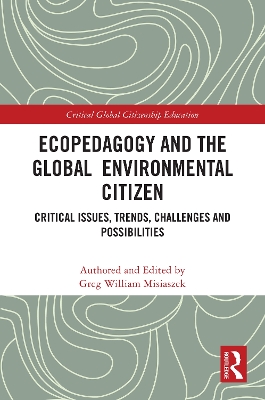
Ecopedagogy and the Global Environmental Citizen: Critical Issues, Trends, Challenges and Possibilities [Pehme köide]

Edited by (Beijing Normal University, China)
  • Formaat: Paperback / softback, 250 pages, kõrgus x laius: 229x152 mm, kaal: 453 g, 1 Line drawings, black and white; 1 Illustrations, black and white
  • Sari: Critical Global Citizenship Education
  • Ilmumisaeg: 22-Jun-2026
  • Kirjastus: Routledge
  • ISBN-10: 1032713461
  • ISBN-13: 9781032713465
  • Pehme köide
  • Hind: 47,80 €*
  • * hind on lõplik, st. muud allahindlused enam ei rakendu
  • Tavahind: 63,74 €
  • Säästad 25%
  • See raamat ei ole veel ilmunud. Raamatu kohalejõudmiseks kulub orienteeruvalt 3-4 nädalat peale raamatu väljaandmist.
  • Kogus:
  • Lisa ostukorvi
  • Tasuta tarne
  • Tellimisaeg 2-4 nädalat
  • Lisa soovinimekirja
  • Formaat: Paperback / softback, 250 pages, kõrgus x laius: 229x152 mm, kaal: 453 g, 1 Line drawings, black and white; 1 Illustrations, black and white
  • Sari: Critical Global Citizenship Education
  • Ilmumisaeg: 22-Jun-2026
  • Kirjastus: Routledge
  • ISBN-10: 1032713461
  • ISBN-13: 9781032713465
This edited volume collates over a decade of Greg William Misiaszeks work on ecopedagogy, with a new focus on insights and possibilities for global citizenship education (GCE) scholarship. Rooted in critical theories and originating from Paulo Freires popular education models of Latin America, ecopedagogy is centered on understanding the struggles of, and the connections between, human acts of environmental violence, social injustices, and Natures unsustainability. The book brings together diverse understandings of ecopedagogy, introduces key concepts of teaching for local-to-planetary citizenship, and explains how both are essential for socio-environmental justice and planetary sustainability. Grouped into three parts, it includes new, detailed introductions, with crucial GCE threads explored throughout the chapters. This includes discussions of how non-critical teaching for (environmentally) sustainable development that opposes critical GCEs essence instills anti-environmentalism, rather than countering it. As a comprehensive and fresh curation of Misiaszeks work on timely and critical topics, it will appeal to academic scholars, educational researchers, teachers, and social/environmental movement leaders/participants, among others, who have interests in GCE, environmental sustainability, sustainable development, environmental teaching, and social-environmental justice.
Part 1: Introduction: Critically Teaching Development with
Local-to-Planetary Citizenships
1. Ecopedagogy: Teaching Critical Literacies
of 'Development,' 'Sustainability,' and 'Sustainable Development'
2. An
Ecopedagogical, Ecolinguistical Reading of the Sustainable Development Goals
(SDGs): What We Have Learned from Paulo Freire
3. Environmental Education
through Global and Local Lenses: Ecopedagogy and Globalizations in
Appalachia, Argentina, and Brazil Part 2: Introduction: Ecopedagogical
Teaching and Literacy within Global Citizenship
4. Countering Post-Truths
through Ecopedagogical Literacies: Teaching to Critically Read Development
and Sustainable Development
5. Six Critical Questions for Teaching
Justice-Based Environmental Sustainability (JBES) in Higher Education
6.
Ecopedagogical Literacy of a Pandemic: Teaching to Critically Read the
Politics of COVID-19 with Environmental Issues
7. 'Hard spaces' of Global
Citizenship Education: A Comparative Analysis through Ecopedagogical,
Linguistic, and Feminist Lenses
8. Critically Countering Appropriations of
Global Citizenship Education in the India Context: Hard, Gated, and
Unmentionable Part 3: Introduction: Non-anthropocentric Teaching with
Local-To-Planetary Citizenship
9. Ecopedagogy: Freirean Teaching to Disrupt
Socio-Environmental Injustices, Anthropocentric Dominance, and
Unsustainability of the Anthropocene
10. De-Distancing Us from the Rest of
Earth: Ecopedagogical Analysis and Approaches
11. COVID-19 Foreshadowing
Earths Environmental Tipping Point: Educations Transformation Needed to
Avoid the Ledge
Greg William Misiaszek is Associate Professor at Beijing Normal University, China, and Associate Director of the Paulo Freire Institute at UCLA, USA.