Muutke küpsiste eelistusi

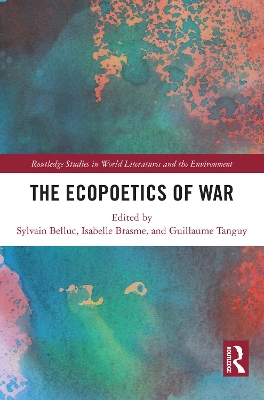
Ecopoetics of War [Pehme köide]

Edited by , Edited by , Edited by
  • Formaat: Paperback / softback, 210 pages, kõrgus x laius: 229x152 mm, kaal: 410 g, 8 Halftones, black and white; 8 Illustrations, black and white
  • Sari: Routledge Studies in World Literatures and the Environment
  • Ilmumisaeg: 22-May-2026
  • Kirjastus: Routledge
  • ISBN-10: 1032588845
  • ISBN-13: 9781032588841
Teised raamatud teemal:
  • Pehme köide
  • Hind: 48,81 €*
  • * hind on lõplik, st. muud allahindlused enam ei rakendu
  • Tavahind: 65,09 €
  • Säästad 25%
  • See raamat ei ole veel ilmunud. Raamatu kohalejõudmiseks kulub orienteeruvalt 3-4 nädalat peale raamatu väljaandmist.
  • Kogus:
  • Lisa ostukorvi
  • Tasuta tarne
  • Tellimisaeg 2-4 nädalat
  • Lisa soovinimekirja
  • Formaat: Paperback / softback, 210 pages, kõrgus x laius: 229x152 mm, kaal: 410 g, 8 Halftones, black and white; 8 Illustrations, black and white
  • Sari: Routledge Studies in World Literatures and the Environment
  • Ilmumisaeg: 22-May-2026
  • Kirjastus: Routledge
  • ISBN-10: 1032588845
  • ISBN-13: 9781032588841
Teised raamatud teemal:
The Ecopoetics of War explores the interrelationality of human and nonhuman entities in the context of conflict, as recorded in literature and culture. This collection of essays demonstrates the specific and fertile role of literature in representations of war, as it foregrounds the manifold ways in which the borders between human and nonhumanincluding flora,fauna, and technologybecome porous, thus questioning traditional onto-epistemological and ethical categories.

Bringing together British, American, and postcolonial studies, The Ecopoetics of War covers a variety of historical periods, geographical areas, and literary genres. Interdisciplinary in its outlook, it intertwines war studies, ecocriticism, literary theory, philosophy, and cultural studies. By analyzing the stylistic and discursive strategies devised by writers to translate the sensory experience of the battlefield, the contributors shed light on the unique capacity of literature to foreground the entanglement of human and nonhuman in the context of armed conflict, and thus unveil an ecopoetics of war.

This collection will interest scholars of literature, specialists of war studies and ecocriticism, and any reader interested in such issues such as ecowar, ecocide, the Anthropocene, or environmental justice. It can inspire interdisciplinary teaching or research projects, especially in the current context of global environmental crisis.
Introduction

Sylvain Belluc, Isabelle Brasme, and Guillaume Tanguy

PART I

Distributive Agency, Shared Vulnerability, and Decomposition

1 Ambrose Bierces Civil War Stories and Essays: The Bitterness of a Cynic
or the Insight of a Neo-Materialist?

Marie-Odile Salati

2 Between Safety and Conflict: War and Nature in a Few Poems of the First
World War

Laure-Hélène Anthony-Gerroldt

3 Fantasized Muddy Landscapes: William Faulkners World War I

Frédérique Spill

PART II

Resilience, Recomposition, and Reconsideration

4 Plotting the Blitzscape: from Representation to Composition in Rose
Macaulays The World My Wilderness (1950)

Clémence Laburthe-Tolra

5 Knocking on Delville Wood: The Destruction of Natural Elements During World
War I and The Construction of a South African Memory

Gilles Teulié

6 A Prophetic Vision of the Past: The Nature of War in Patrick Chamoiseaus
Biblique des Derniers Gestes (2002)

Carine Mardorossian

7 The Dissenting Ecology of War Writing: Capitalocene and Ecocide in the Iraq
War Fiction of Phil Klay, Kevin Powers, and Roy Scranton

Julien Brugeron

PART III

Technopoetics

8 The Corpse in the Garden: War and Nature in American Literature, from Walt
Whitman to James Ellroy

Benoît Tadié

9 Knights on Wheels: Chivalry and Horsepower in the American Ambulance Corps

Daniel Bowman

10 Submarine Optics in Marianne Moore and Elizabeth Bishop

Rachel Murray
Sylvain Belluc is Senior Lecturer in British History and Literature at Nîmes University and Researcher at Paul Valéry Montpellier 3 University, France.

Isabelle Brasme is Professor of British Literature at the University of Burgundy, France.

Guillaume Tanguy is Senior Lecturer in American Literature at Paul Valéry Montpellier 3 University, France.