Muutke küpsiste eelistusi

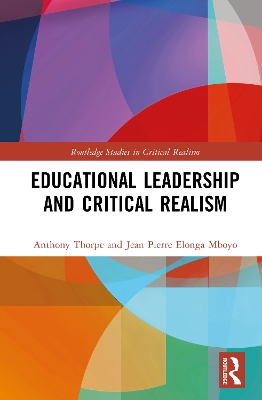
Educational Leadership and Critical Realism [Kõva köide]

(Teesside University, UK), (University of Roehampton, London, UK)
  • Formaat: Hardback, 170 pages, kõrgus x laius: 234x156 mm, kaal: 500 g, 6 Line drawings, black and white; 6 Illustrations, black and white
  • Sari: Routledge Studies in Critical Realism
  • Ilmumisaeg: 18-Sep-2025
  • Kirjastus: Routledge
  • ISBN-10: 1032583800
  • ISBN-13: 9781032583808
  • Kõva köide
  • Hind: 159,19 €*
  • * hind on lõplik, st. muud allahindlused enam ei rakendu
  • Tavahind: 212,25 €
  • Säästad 25%
  • Raamatu kohalejõudmiseks kirjastusest kulub orienteeruvalt 3-4 nädalat
  • Kogus:
  • Lisa ostukorvi
  • Tasuta tarne
  • Tellimisaeg 2-4 nädalat
  • Lisa soovinimekirja
  • Raamatukogudele
  • Formaat: Hardback, 170 pages, kõrgus x laius: 234x156 mm, kaal: 500 g, 6 Line drawings, black and white; 6 Illustrations, black and white
  • Sari: Routledge Studies in Critical Realism
  • Ilmumisaeg: 18-Sep-2025
  • Kirjastus: Routledge
  • ISBN-10: 1032583800
  • ISBN-13: 9781032583808

Adopting a critical realist approach to educational leadership, this book shows how applied theory can contribute to the development of mechanisms allowing for the effective leadership of organisations. Through an examination of pertinent theories and debates in educational leadership and critical realist thought, it moves to offer demonstrations of practical uses of critical realism that include the transformation of reflective practice, the development and practice of leadership, and the formulation as well as the enactment of policy. Considering the role that realist thought can play in the resolution of educational crises in sub-Saharan Africa and bridging the gap between research and practice, the authors argue that change is possible and that it can be initiated from within the field of educational leadership. Centred on a vision of social justice for human flourishing instead of operating within narrow and mechanistic pre-occupations, Educational Leadership and Critical Realism will appeal to scholars across the social sciences, as well as to practitioners and policy-makers in the field of education.


Adopting a critical realist approach to educational leadership, this book shows how applied theory can contribute to the development of mechanisms allowing for the effective leadership of organisations.

Arvustused

"This book is a significant addition to the emergent discourse on critical realism. In particular, the authors make a compelling case for adopting critical realism as a framework for transformative and emancipatory research and practice of educational leadership. Theorists, policymakers, practitioners and students of educational leadership (and allied disciplines), will find the book of immense value".

Professor Benedicta Egbo, Professor Emeritus of Education, University of Windsor, Ontario, Canada.

Thorpe and Elonga Mboyos contribution to educational professionals is to enable researchers and teachers to think and practise in ways that are for education but also educative regarding how we learn about what it actually means to do leading and leadership. Notably critical realism provides the opportunity to shift away from corporate technologies about what works, towards the values that underpin the contested issues of inclusive pedagogy, assessment and the curriculum. This book is a clear statement that change is actually about and for education rather than about turning schools into private businesses.

Professor Helen Gunter, Professor Emerita, The Manchester Institute of Education, University of Manchester, UK.

At a time when educational leadership is increasingly prone to fads, fetishes and populism, this book provides a very welcome addition to more critical studies in educational leadership by advancing the ideas of critical realism. This book provides an outstanding and much needed exploration of how critical realism can better develop key themes and ideas in the field of educational leadership by putting the theory upfront in its analysis. This book is very highly recommended for scholars of educational leadership but also has important implications for practising educators worldwide.

Professor Richard Niesche, School of Education, UNSW SYDNEY, Australia.

Part One: Educational leadership and critical realism: context, theories
and debates
1. Introduction: the context for educational leadership and
critical realism
2. Why critical realism has not featured more in educational
leadership
3. Critical realist theoretical underpinnings and key tenets Part
Two: Applied critical realism in educational leadership practice and research
4. Critical realism and the practice of day-to-day leading
5. Critical
realist reflexivity in educational leadership literature and practice
6.
Critical realist lens for policy development and enactment
7. Framing the
DRCs education systems: an Ubuntu and critical realist vision for education
development in sub-Saharan Africa
8. Leadership development for emancipation
9. Conclusion: critical realism and educational leadership research.
Anthony Thorpe is an Honorary Research Fellow in the School of Education at the University of Roehampton, London, where he previously led the PhD and professional doctorate programmes and established the MA in Education Leadership and Management.

Jean Pierre Elonga Mboyo is Senior Lecturer at Teesside University, Middlesbrough, UK. Fellow of Higher Education, he teaches across the undergraduate and postgraduate levels after a professional career spanning more than a decade as a secondary school teacher.