Muutke küpsiste eelistusi

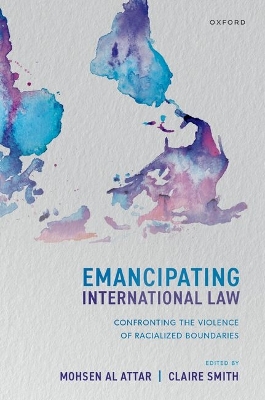
Emancipating International Law: Confronting the Violence of Racialized Boundaries [Kõva köide]

Volume editor (PhD Student, University of Amsterdam), Volume editor (Reader in International Law, Head of the Department of International Studies, and Associate Dean for the School of Humanities and Social Sciences, Xi'an Jiaotong-Liverpool University)
  • Formaat: Hardback, 528 pages, kõrgus x laius x paksus: 240x165x35 mm, kaal: 930 g
  • Ilmumisaeg: 07-May-2026
  • Kirjastus: Oxford University Press
  • ISBN-10: 0198935579
  • ISBN-13: 9780198935575
  • Kõva köide
  • Hind: 142,80 €*
  • * hind on lõplik, st. muud allahindlused enam ei rakendu
  • Tavahind: 178,50 €
  • Säästad 20%
  • Raamatu kohalejõudmiseks kirjastusest kulub orienteeruvalt 3-4 nädalat
  • Kogus:
  • Lisa ostukorvi
  • Tasuta tarne
  • Tellimisaeg 2-4 nädalat
  • Lisa soovinimekirja
  • Formaat: Hardback, 528 pages, kõrgus x laius x paksus: 240x165x35 mm, kaal: 930 g
  • Ilmumisaeg: 07-May-2026
  • Kirjastus: Oxford University Press
  • ISBN-10: 0198935579
  • ISBN-13: 9780198935575
While mainstream international legal scholarship has long treated race as a peripheral concern-or a historic injustice to be remembered but not redressed-this volume argues that racialisation is foundational to the discipline, underpinning its doctrines, epistemes, and interlocutors. Emancipating International Law explores the many ways racial hierarchy, systemic oppression, and global white supremacy shape international law. Bringing together leading and emerging scholars, the collection moves beyond qualifying whether international law is racist to explore how racial hierarchies are embedded in its structures and continue to evolve through legal and institutional practice.

Divided into five sections, the book begins by situating international law's racialised boundaries within its colonial, capitalist, and chauvinist afterlives, exposing how white ignorance and race-thinking underpin legal norms, from sovereignty to jus cogens. It then examines racial stratification across legal institutions, including investment law, refugee law, and the Genocide Convention. The third section extends this critique to human rights, revealing the ways in which even an emancipatory paradigm can bolster racial injustices. The penultimate section unpacks racial hierarchies in disparate societies, including Brazil, India, and Japan, as well as the frontiers of nation-states. The volume concludes with a powerful discussion of the role of activism and alternative epistemologies in racial justice struggles, and the limits of international law's capacity for anti-racist transformation.

Aimed at scholars, practitioners, and students of international law, critical legal studies, and anti-colonial theory, this book advances an understanding of international law that is aimed at dismantling its racialised structures.

This is an open access title available under the terms of a CC BY-NC-ND 4.0 International licence. It is free to read on Oxford Scholarship Online and offered as a free PDF download from OUP and selected open access locations.

Emancipating International Law reveals how racial hierarchy, systemic oppression, and global white supremacy are embedded into current legal structures. This book seeks to contribute to the anti-racist struggle by advancing an understanding of international law aimed at dismantling its racialised structures and challenging legal orthodoxy.
Mohsen al Attar and Claire Smith: Beyond Silence: Confronting Racial
Hierarchies in International Law Part I. Situating International Law's
Racism Problem 1: Mohsen al Attar: The Racialized Epistemology of
International Law: From White Ignorance to Black Dignity 2: Folúkẹ'&
Ifejola Adébísí: Disrupting International Law's Colonial Afterlives of Human
Property: Educating for a World Beyond Racial Capitalism and Unending
Apartheids 3: Jason Haynes: Racialized Extractivism: A Tale of Fetishism,
Narcissism, Primitive Accumulation, and Expropriation 4: Harrison Otieno
Mbori: The Inequalities of Sovereign Equality 5: Sarah Riley Case and
Frédéric Mégret: The Colour of Jus Cogens Part II. The Tools, Techniques,
and Technologies of Legalized Racial Inequality 6: Shahab Saqib: Race as
Citizenship Personified: Illuminating the Ghosts of Racial Discrimination in
International Law 7: Dimitrios A Kourtis: A Racialized Existence: Lessons
from Palestine and the Genocide Convention 8: Faisal al-Asaad: Settler
Colonialism, Race, and International Law: Lessons from the Frontier 9: Jinan
Bastaki: Survive the Journey Only to Succumb to International Refugee Law 10:
Nciko wa Nciko: How the UN Guiding Principles on Internal Displacement Fail
Climate and Racial Justice: Time for the Kampala Convention? Part III. A
Right to be Free From Racism 11: Raghavi Viswanath: The Intersection of Race
and Economic, Social, and Cultural Rights 12: Tess Sheldon, Ruby Dhand, and
Roxanne Mykitiuk: Racialized Ableism and the Need for Intersectional
Discourse and Action 13: Paulina Jimenez Fregoso: De-essentializing Race:
Intersectionality as a Feminist Approach in International Human Rights Law
14: Karla Schröter: Colonial Fantasies in the European Court of Human Rights
Part IV. Antiracism in the Pluriverse 15: Suraj Girijashanker: Indian
Approaches to Racism and Related Forms of Subordination under International
Law: A Question of Interest Convergence 16: Saul Takahashi: Japan:
International Law as the Outward Looking Weapon 17: Henrique Weil Afonso:
Decolonial Fissures: Looking from and Beyond Brazil's Colour Lines 18: Yang
Han: Norm Entrepreneurship at the UN: Addressing Racial Equality Across
Borders and the South-North Divide Part V. Taking the Struggle(s) Forward
19: Darryl Li: From Captives to Enslaved: International Law and the Making of
the (Non)Human 20: Kamya Vishwanath: Bodies of Knowledge: Re-framing
Emancipation in International Law through Dalit Praxis 21: Radha D'Souza:
Racism, (Neo)Colonialism, and International Law: A Field in Search of a
Philosophy? 22: E Tendayi Achiume, Asl)iÜ Bâli, and S Priya Morley:
Conceptualizing Race and Resisting Racism in International Law 23: Claire
Smith: Unburdening White Women: Antiracist Feminist Praxis as Revolution 24:
Dylan Asafo: The Slow and Benevolent Violence of International Law: An
Oceanian Perspective
Mohsen al Attar is a Reader in International Law, Head of the Department of International Relations, and Associate Dean at Xi'an Jiaotong-Liverpool University. His research explores the power dynamics inherent in international law and the potential for other universals to emerge. His previous appointments were at the University of Auckland, Queen's University Belfast, Warwick University, and University College London.

Claire Smith is an international lawyer specialising in accountability for gross violations of human rights and international crimes. She is a PhD candidate at the University of Amsterdam researching the role of actors in the epistemological construction of victim participation at the International Criminal Court. She obtained her LLM (with distinction) from the University of Essex and a Bachelor of Laws from the University of Otago.