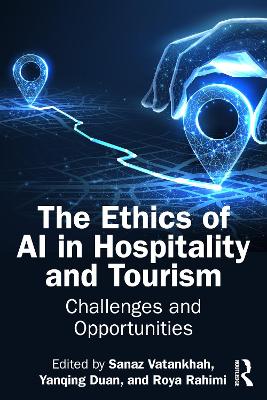
This innovative and timely book critically explores ethical and governance issues and debates relating to the use of AI in the hospitality and tourism industries.
This innovative and timely book critically explores ethical and governance issues and debates relating to the use of AI in the hospitality and tourism industries.
The hospitality and tourism sectors are at the forefront of technological advancements, with AI playing a pivotal role in transforming customer engagement, operational strategies, and decision-making processes. Recent innovations, particularly in generative AI applications such as chatbots, content creation, and predictive analytics, have revolutionized how services are delivered and experienced. However, these advancements come with ethical challenges, including: privacy concerns in personalized marketing, biases in decision-making algorithms, the lack of transparency in AI-driven processes, issues of equity, diversity, and inclusion (EDI) and disparities and perpetuate systemic biases. The book aims to help businesses, researchers, and policymakers tackle these challenges and adopt responsible AI practices.
This important and topical volume offers academics, researchers, and policymakers an interdisciplinary exploration of ethical complexities of AI in the tourism and hospitality industries and strategies to foster inclusivity and mitigate these issues.
1. Introduction: Ethics of AI in Hospitality and Tourism and Strategic
Research Agenda.
2. Organizational Alignment and AI Ethics in Tourism.
3. DEI
and AI in Hospitality Employment Practices: Ethical Considerations in terms
of Diversity, Equity and Inclusion in Al-Powered Hiring and Workforce
Transformation.
4. Corporate Digital Responsibility in Tourism and
Hospitality: Ethical Challenges and Strategies for AI Implementation.
5.
Responsible AI Governance in Tourism.
6. Linking Explainable AI and
Responsible AI in Hospitality and Tourism.
7. Generative AI for Content
Creation: Opportunities and Ethical Concerns.
8. Ethical Design of AI
Systems, Perceived Trustworthiness, Customer Trust, And Brand Commitment: The
Case of Airline Passengers.
9. Algorithmic Bias and Equity in AI Applications
for Tourism and Hospitality.
10. AI, Ethics, and the SDGs: Are We Innovating
Sustainably in the Tourism and Hospitality Industry?
Sanaz Vatankhah is Senior Lecturer in Business Management and Strategy and the Deputy Director of Business and Management Research (BMRI) at the University of Bedfordshire. Her research interests focus on sustainable business models, ethical AI implementation, and empowering women-led entrepreneurship. She leads internationally funded projects and has published extensively in leading journals, including Journal of Business Research, Tourism Management, Journal of Applied Health Psychology, and The Service Industries Journal.
Yanqing Duan is Professor of Information Systems and Director of the Business and Management Research Institute at the University of Bedfordshire Business School. Her research interests include the use of emerging ICTs, especially AI, and their impact on organisational performance, innovation, decision-making, and knowledge transfer. She has over 250 refereed publications in journals, book chapters, and conference proceedings.
Roya Rahimi is Professor of Marketing and Leisure Management at the University of Wolverhampton and a senior fellow of the Higher Education Academy. She leads major research and industry-facing initiatives, contributes to multiple international academic networks, and serves on several journal editorial boards, advancing scholarship and professional practice across marketing, tourism, and digital transformation. Her portfolio includes steering high-profile sector collaborations, shaping research capacity, and driving impactful, interdisciplinary projects within the United Kingdom and internationally.