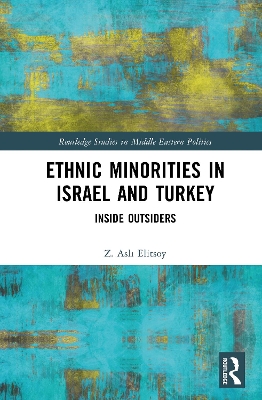
Ethnic Minorities in Israel and Turkey: Inside Outsiders
offers a compelling comparative analysis of state- minority relations, revealing how national identity is constructed and contested through the lens of two of the region’s most enduring ethnic conflicts.
Through extensive fieldwork and elite interviews, this book investigates how Israeli and Turkish political elites have responded to the political mobilization of their largest minorities – Palestinians and Kurds. It traces the historical trajectories of nation-building, examines the securitization of minority rights, and explores the ways in which demands for autonomy, recognition, and equal participation are interpreted as existential threats to national unity. Drawing on the ethnic boundary-making framework, the chapters analyse how divergent strategies – exclusion in Israel and forced assimilation in Turkey – have shaped patterns of inclusion and exclusion, with particular attention to the symbolic role of trans-border kinship, collective rights, and political representation. By highlighting the narratives of political elites, this book illuminates how ethnic minorities come to be treated as “inside outsiders,” navigating the tensions between national loyalty and ethnocultural affiliation.
Essential reading for scholars of comparative politics, nationalism, Middle East studies, and ethnic relations, this book deepens our understanding of how contested identities are negotiated in the modern nation-state.
Ethnic Minorities in Israel and Turkey: Inside Outsiders offers a compelling comparative analysis of state-minority relations, revealing how national identity is constructed and contested through the lens of two of the region’s most enduring ethnic conflicts.
Contents
List of Tables
List of Abbreviations
Acknowledgments
1. Introduction
1.1 Ethnic boundaries and minority politics in Israel and Turkey
1.2 The ethnic boundary-making approach: A framework for analyzing
majority-minority relations
1.3 Methodology
1.4 The structure of the book
2. Ethnic Boundary-Making Approach to Ethnicity and Nation-Building
2.1 The formation of minorities: Nation-building or nation-destroying?
2.2 Us and them: Ethnic boundary-making as a nationalist project
2.3 Defining national belonging: Boundary-making strategies in Israel and
Turkey
2.4 The impact of contextual factors on boundary-making strategies
3. State-Minority Relations in Israel and Turkey: Historical Trajectories of
Boundary-Making
3.1 Defining the boundaries of Israeli national identity: State policies
toward Palestinian citizens
3.2 Defining the boundaries of Turkish national identity: State policies and
the Kurdish question in Turkey
4. Challenging Ethnic Hierarchies: Palestinian and Kurdish Mobilization for
Collective Rights
4.1 Palestinian political mobilization and minority demands in Israel
4.2 Kurdish political mobilization and minority demands in Turkey
5. Palestinian Citizens as a Security Dilemma: Israeli Political Elites
Perspectives on Palestinian Citizens and Minority Rights
5.1 Constructing Israeliness: Elite views on national identity and the
boundaries of belonging
5.2 The paradox of equality
5.3 Citizenship, security, and the politics of recognition
a) Incorporation without integration: The more we meet, the better we are
b) Citizenship without sovereignty: The rejection of Palestinian collective
rights
c) Trans-border ethnic relations and the Palestinian minority as a security
dilemma
6. The Kurdish Question as an External Plot: Turkish Political Elites
Perspectives on Kurdish Citizens and Minority Rights
6.1 Defining the boundaries of Turkishness: Who is a Turk?
6.2 The political elite and the Kurdish question: A legacy of denial
6.3 External influence, national security, and Turkeys Kurdish question
a) The Turkish-Kurdish coexistence narrative
b) Recognition without collective rights
c) The Kurdish question as an external plot
d) Transnational insecurities: What happens beyond the border does not stay
beyond the border
7. Inside-Outsiders: Trans-border homeland minorities and ethnic boundaries
7.1 Israel and Turkey: Ethnic vs. Civic State?
7.2 Inconsistency between discourse and practice: Individual citizenship
rights vs. collective national rights
7.3 Challenging the hierarchical ordering of ethnic categories: Palestinian
and Kurdish demands for equalization
7.4 Trans-border ethnic ties as an external factor influencing
boundary-making strategies in the social field
8. Conclusion
INDEX
Z. Asl Elitsoy received her Ph.D. in Political Science from Bilkent University and holds an M.A. in Middle Eastern Studies from Tel Aviv University. She is currently a Marie Skodowska-Curie Postdoctoral Fellow at the Department of Cross-Cultural and Regional Studies, University of Copenhagen. Her research is based on extensive fieldwork in Turkey and Israel with a focus on ethnicity, nationalism, minority politics, and migration. Her work has been published in international academic journals such as Security Dialogue, New Perspectives on Turkey, and Journal of Balkan and Near Eastern Studies.