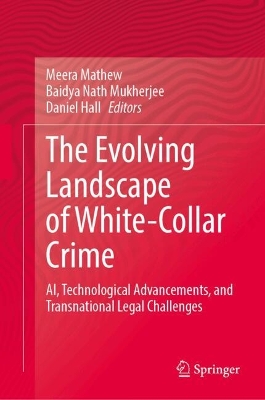
This book examines the evolving landscape of white-collar crime in the digital age, where artificial intelligence, financial technologies, and transnational legal complexities are reshaping corporate misconduct. It explores how AI-driven tools, while enhancing fraud detection and regulatory compliance, simultaneously enable sophisticated financial crimes, creating new challenges for enforcement and policy development.
Drawing on contemporary case studies and comparative legal analysis, the book critically assesses emerging threats such as algorithmic manipulation, cryptocurrency fraud, and regulatory arbitrage. It highlights jurisdictional conflicts, corporate liability frameworks, and the shifting dynamics of global enforcement strategies. Key topics include the role of whistleblowers in exposing financial misconduct, the intersection of corporate crime and environmental fraud, and the impact of lobbying on financial regulations.
By integrating perspectives from legal scholars, policymakers, forensic experts, and law enforcement professionals, this work offers a comprehensive examination of modern economic crime. It provides policy recommendations aimed at strengthening legal safeguards, enhancing regulatory cooperation, and addressing the challenges posed by rapidly advancing technology.
Essential reading for academics, legal practitioners, compliance officers, and financial crime investigators, this book equips readers with the analytical tools needed to navigate the complexities of contemporary white-collar crime.
Part I. Foundations of Corporate and Transnational White-Collar Crime:
Conceptual, doctrinal, and liability frameworks.
Chapter
1. Corporate Crime
in Global Value Chains: Addressing Transnational Liability through Legal
Convergence and Soft Law Governance.
Chapter
2. Invisible Harm: White Collar
Crime as a Catalyst for Human Rights Violations.
Chapter
3. Reforming
Corporate Criminal Liability:
Lessons from International Case Studies.
Chapter
4. Conceptualizing
Transnational Corporate Criminal Liability in GVCs: Integrating Failure to
Prevent and Due Diligence.- Part II. Artificial Intelligence, Automation, and
Emerging Regulatory Paradigms: AI as both a tool and a risk factor in
white-collar crime.
Chapter
5. Comparative Perspectives On Ai As A
Regulatory Tool: Implications For Crime Prevention And Compliance Systems.-
Chapter
6. AI AND THE AUTOMATION OF ECONOMIC CRIMES ETHICAL AND LEGAL
CHALLENGES .
Chapter
7. AI AND THE CHANGING LANDSCAPE OF FINANCIAL CRIMES:
UNDERSTANDING EMERGING THREATS AND BUILDING STRATEGIC RESPONSES.
Chapter
8.
Financial Crime and Big Data: The Regulatory Cat-and-Mouse Game A Case
Study on the Collapse of Credit Suisse.- Part III. Financial Crimes,
Cryptocurrency, and Illicit Economic Networks: Digital finance, fraud, and
enforcement challenges.
Chapter
9. CRYPTOCURRENCY, FINANCIAL FRAUD, AND
REGULATORY CHALLENGES.
Chapter
10. Regulatory and Criminological
Perspectives on Cash and Cryptocurrency in Illicit Transactions.
Chapter
11.
From Innovation to Evasion: Patterns of Crypto Crime and the Regulatory
Response in India.
Chapter
12. Revisiting McDowell and the future of Tax
Avoidance Law. Is it time to overrule McDowell?.- Part IV. Corporate
Accountability, Labour, and Global Compliance Pressures: Corporate
responsibility in a globalised economy.
Chapter
13. Corporate Criminal
Liability for Severe Labour Violations in Vietnam under Global Integration
Pressures .
Chapter
14. From Sustainability to Greenwashing: Comparative
Perspectives on Corporate Responsibility in India and the EU.- Part V.
Sustainability, Environmental Crime, and the Future of Corporate Governance:
Environmental harm, transnational enforcement, and forward-looking reforms.-
Chapter
15. White Collars, Red Waters: The Convergence of White-Collar Crime
and Commercial Whaling, and the Challenges of Transnational Environmental
Laws.
Chapter
16. TOWARDS A SUSTAINABLE AND ACCOUNTABLE CORPORATE FUTURE.
Meera Mathew, LLM, PhD is currently working as an Associate Professor and HoD at Mar Gregorios College of Law, Trivandrum - Affiliated to Kerala University. Before this, she was working as Associate Professor at the School of Law - CHRIST (Deemed to be University) - Delhi NCR and as an Assistant Professor (senior grade) at Symbiosis Law School, NOIDA, the constituent of Symbiosis International (Deemed University). She is a gold medalist, did the five-year integrated law of B.S.L, L.L.B from I.L.S College, Pune University, and completed her LLM from Indian Law Institute, New Delhi, with first rank. She pursued Ph.D. from the Indian Law Institute, and one of her chapters as a working paper had been referred to in the Indian Law Commissions Consultation Paper about Sedition. Further, she also presented research papers at Stanford University (USA), Glasgow University (Scotland), Maltepe University (Turkey), and Howard University of Kwazulu Natal (South Africa). Before joining academics, she worked as a Legal Associate at Infosys, Bangalore (Legal Division), where she was involved in reviewing Software Licensing Agreements inked by the company. She also worked as a Junior Advocate and fought for cases concerning human rights. Moreover, she is a visiting faculty at CBI Academy, for the Diploma Program of the Indian Law Institute and Indian Institute of Mass Communication. Her areas of interest are technology law, media law, criminal law, women, justice & human rights. She has many national and international journal (SCOPUS indexed) publications to her credit.
Baidya Nath Mukherjee, PhD, LLM, is an academic, solicitor, practitioner, and researcher specializing in Constitutional Law, Criminal Law, and Police Studies, with over seven years of educational experience. He has made significant contributions to discussions on police accountability, judicial interventions in policing, and wrongful convictions. Beyond academia, he actively collaborates with law enforcement agencies, having trained Sub-Inspectors and Investigating Police Officers in India. His expertise also includes organizing legal seminars, conferences, and publishing books. Committed to police reforms and the administration of justice, he examines frameworks that balance law enforcement efficiency with human rights protection while advocating for independent oversight, enhanced training, and legislative reforms. His interdisciplinary approach combines legal analysis, criminology, and public policy to shape effective and accountable policing models.
Professor Daniel Hall is an academician with over 25 years of experience in law and public policy. He has been a Professor of Law at Miami University since 2003 and previously served as an Associate Professor at the University of Toledo and the University of Central Florida. His career also includes legal practice as an Assistant Attorney General for the Federated States of Micronesia and as a Law Clerk for the U.S. District Court for the Southern District of Indiana. A prolific author, Professor Hall has published extensively on criminal law, constitutional law, administrative law, and legal education. His notable books include Criminal Law and Procedure, Administrative Law: Bureaucracy in Democracy, and Constitutional Law: Governmental Power and Individual Freedoms. His research has appeared in leading peer-reviewed journals, addressing topics such as organizational justice, legal education, and law enforcement policy. Professor Hall has also contributed to legal encyclopedias and policy discussions, making a significant impact on both academic and professional legal circles.