Muutke küpsiste eelistusi

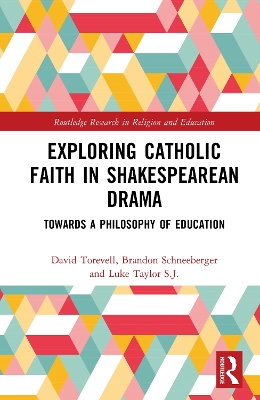
Exploring Catholic Faith in Shakespearean Drama: Towards a Philosophy of Education [Kõva köide]

  • Formaat: Hardback, 226 pages, kõrgus x laius: 229x152 mm, kaal: 600 g, 2 Tables, black and white; 9 Halftones, black and white; 9 Illustrations, black and white
  • Sari: Routledge Research in Religion and Education
  • Ilmumisaeg: 30-Mar-2025
  • Kirjastus: Routledge
  • ISBN-10: 1032741864
  • ISBN-13: 9781032741864
  • Kõva köide
  • Hind: 159,19 €*
  • * hind on lõplik, st. muud allahindlused enam ei rakendu
  • Tavahind: 212,25 €
  • Säästad 25%
  • Raamatu kohalejõudmiseks kirjastusest kulub orienteeruvalt 3-4 nädalat
  • Kogus:
  • Lisa ostukorvi
  • Tasuta tarne
  • Tellimisaeg 2-4 nädalat
  • Lisa soovinimekirja
  • Raamatukogudele
  • Formaat: Hardback, 226 pages, kõrgus x laius: 229x152 mm, kaal: 600 g, 2 Tables, black and white; 9 Halftones, black and white; 9 Illustrations, black and white
  • Sari: Routledge Research in Religion and Education
  • Ilmumisaeg: 30-Mar-2025
  • Kirjastus: Routledge
  • ISBN-10: 1032741864
  • ISBN-13: 9781032741864

This pioneering study investigates the connection between Shakespeare and Catholic education. Its authors contend that Shakespeare’s plays explore Catholic understandings of human life in ways that remain relevant for Catholic educational institutions today.

Through chapters focusing on ethical and existential themes – love, desire, the body, marriage, virginity, evil, finitude, jealousy, and lies – the authors demonstrate Shakespeare’s wide-ranging engagement with early modern Catholic belief and practice. At the same time, they argue that Shakespeare’s treatment of Catholic faith, through imaginative literature rather than magisterial discourse, and dramatically rather than didactically, provides a pedagogical model for contemporary teachers.

The first volume to trace the relationship between a philosophy of Catholic education and Shakespearean drama, it will appeal strongly to all those working in Catholic educational settings, particularly those tasked with strengthening the mission of their institution, as well as to scholars and researchers of literacy education, religious education, and to those interested in the dynamic between education and drama.


This pioneering study investigates the connection between Shakespeare and Catholic education. Its authors contend that Shakespeare’s plays explore Catholic understandings of human life in ways that remain relevant for Catholic educational institutions today.
Arvustused

This volume represents a major contribution to our appreciation of the place of Shakespeareand, indeed, all great literaturein the formation and training of students, especially Catholics, who live in a post-secular world. The authors masterfully combine careful and original readings of Shakespeares major works with insights into their application to human life and the question of God. This exciting collection brings cutting-edge scholarship into conversation with the daily challenges faced by educators who hope to speak religiously to all students, from the skeptical to the devout.

Rev. Prof. Brian Dunkle, S.J., Ph.D. Boston College Clough School of Theology and Ministry

This is a book about big themes and profound questionswho are we, whats right, and who are we called to be. Anyone who has taught literature knows how Shakespeare can move students to think deeply about all the things that make being human so complicatedfrom love and desire to jealousy and lies. The authors of this volume provide a great service by putting all that into conversation with the richness of the Catholic tradition. I can imagine teachers, not only in Catholic institutions but in all schools committed to the humanities, finding this book especially helpful.

Dean Rev. Prof. Mick McCarthy, S.J., Ph.D. Boston College Clough School of Theology and Ministry

1. Introduction
2. Section One: Anthropology
3. Macbeths Body: An
Anatomy of Evil
4. Education and the Body: Twelfth Night and the Incarnation
5. Who do Students think they are? Nothing(ness) and Identity in King Lear
6.
Section Two: Ethics
7. The Passion which causes Evil: Examining Envy and its
Siblings in Shakespeares Othello
8. How Studying King Richard III Might
Assist Students in Recognising Deception in Themselves and Others
9. Section
Three: Vocation
10. On St Swithins Day: Star-Crossed Lovers and Cosmic
Mysteries in Romeo and Juliet and One Day
11. Yielding many Scholars: The
Virtue of Virginity in Measure for Measure and Pericles
12. Sacrifice as a
Means to Knowing: Marriage and Sacramental Grace in The Merchant of Venice
and Cymbeline
13. Section Four: Pedagogy
14. Education and Conversion Towards
the Good: A Benedictine Framework and Shakespearean Soliloquies
15. Ignatian
Pedagogy and Recognition: from the Bible to Shakespeare
16. Conclusion
David Torevell is Honorary Senior Research Fellow at Liverpool Hope University, UK & Visiting Professor at Mary Immaculate College, Limerick, Ireland.

Brandon Schneeberger is Assistant Professor of English at Montreat College in North Carolina, where he teaches a variety of literature and writing courses.

Luke Taylor SJ has taught literature internationally, in both tertiary and secondary institutions. He holds a doctorate in Comparative Literature from Harvard University (2013).