Muutke küpsiste eelistusi

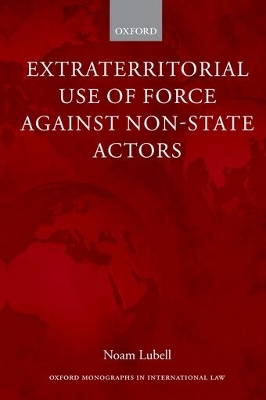
Extraterritorial Use of Force Against Non-State Actors [Pehme köide]

(Lecturer, Irish Centre for Human Rights, National University of Ireland, Galway)
  • Formaat: Paperback / softback, 312 pages, kõrgus x laius x paksus: 234x171x18 mm, kaal: 474 g
  • Sari: Oxford Monographs in International Law
  • Ilmumisaeg: 18-Aug-2011
  • Kirjastus: Oxford University Press
  • ISBN-10: 0199641226
  • ISBN-13: 9780199641222
  • Pehme köide
  • Hind: 69,36 €*
  • * hind on lõplik, st. muud allahindlused enam ei rakendu
  • Tavahind: 86,70 €
  • Säästad 20%
  • Raamatu kohalejõudmiseks kirjastusest kulub orienteeruvalt 3-4 nädalat
  • Kogus:
  • Lisa ostukorvi
  • Tasuta tarne
  • Tellimisaeg 2-4 nädalat
  • Lisa soovinimekirja
  • Formaat: Paperback / softback, 312 pages, kõrgus x laius x paksus: 234x171x18 mm, kaal: 474 g
  • Sari: Oxford Monographs in International Law
  • Ilmumisaeg: 18-Aug-2011
  • Kirjastus: Oxford University Press
  • ISBN-10: 0199641226
  • ISBN-13: 9780199641222
This book analyses the primary relevant rules of international law applicable to extra-territorial use of force by states against non-state actors. Force in this context takes many forms, ranging from targeted killings and abductions of individuals to large-scale military operations amounting to armed conflict. Actions of this type have occurred in what has become known as the 'war on terror', but are not limited to this context. Three frameworks of international law are examined in detail. These are the United Nations Charter and framework of international law regulating the resort to force in the territory of other states; the law of armed conflict, often referred to as international humanitarian law; and the law enforcement framework found in international human rights law. The book examines the applicability of these frameworks to extra-territorial forcible measures against non-state actors, and analyses the difficulties and challenges presented by application of the rules to these measures.

The issues covered include, among others: the possibility of self-defence against non-state actors, including anticipatory self-defence; the lawfulness of measures which do not conform to the parameters of self-defence; the classification of extra-territorial force against non-state actors as armed conflict; the 'war on terror' as an armed conflict; the laws of armed conflict regulating force against groups and individuals; the extra-territorial applicability of international human rights law; and the regulation of forcible measures under human rights law. Many of these issues are the subject of ongoing and longstanding debate. The focus in this work is on the particular challenges raised by extra-territorial force against non-state actors and the book offers a number of solutions to these challenges.

Arvustused

This book is an important contribution to the discourse on how contemporary international law can react to the challenge of Non-State Actors participating in armed conflicts. Lubell is the first author to bring together the area of international law that regulates the resort to force in the territory of other States, IHL and IHRL with respect to the extraterritorial forcible measures against Non-State Actors in one book. As such, the book serves both as a primer for those who want to familiarize themselves with the system of international law concerning armed conflicts, and -- more particularly -- as an attempt to apply the international law system to Non-State Actors...it is a worthwhile read for students and scholars studying the use of force in international law, and practitioners working in this area. * Hadassa A. Noorda, University of Amsterdam * This is a balanced and cogent work on a very topical aspect of the international law on the use of force. The author covers all relevant dimensions: the jus ad bellum, international humanitarian law and international humanrights law. The writing is clear, the use of sources andanalysis rigorous and convincing. * Sir Michael Wood * [ A]n exceptionally impressive work. Its hallmarks are obvious research, analytical rigour, clear exposition and common-sense. It is an important contribution to what continues to be a problematic area of international humanitarian law and should be much referred to by lawyers working in this field. * Modern Law Review * Lubell writes with an impressive attention to actual and historical state practice...[ T]his is an impressive book with a useful place on the bookshelf for the practicing public international lawyer as well as the academic. * Lawfare blog * The author is to be commended for providing a great deal of clarity to the parameters of the legal debates...Lubell's study makes a substantial contribution...through the well-argued analysis of the current state of international law...The work provides an excellent base for further engagement with these difficult issues. * Legal Studies *

Table of Cases
xvii
List of Abbreviations
xxi
Introduction 3(22)
1 Background
3(3)
2 The legal frameworks
6(5)
3 Structure
11(2)
4 Definitions
13(12)
4.1 Extraterritorial
13(1)
4.2 Forcible measures
14(1)
4.3 Non-state actors
14(6)
4.4 Terrorism
20(5)
PART I THE INTER-STATE RELATIONSHIP: EXTRATERRITORIAL USE OF FORCE AND SELF-DEFENCE AGAINST NON-STATE ACTORS
Chapter 1 The Possibility of Self-Defence Against Non-State Actors
25(18)
1 Introduction
25(1)
2 The prohibition on the use of force
25(4)
3 Self-defence against non-state actors
29(1)
4 Can non-state actors be responsible for an `armed attack'?
30(6)
5 The territorial state
36(7)
Chapter 2 The Parameters of Self-Defence
43(26)
1 Necessity
43(5)
2 The scale of the initial armed attack
48(7)
3 Pre-emptive or anticipatory self-defence
55(8)
4 Proportionality of the action taken in self-defence
63(6)
Chapter 3 Measures Taken Outside the Self-Defence Framework
69(16)
1 Countermeasures
70(1)
2 Necessity
71(1)
3 Hot pursuit
72(1)
4 Piracy
73(1)
5 An alternative paradigm and its difficulties
74(11)
Part I Conclusion
81(4)
PART II INTERNATIONAL HUMANITARIAN LAW
Chapter 4 Force Against Non-State Actors as Armed Conflict
85(27)
1 The definition of armed conflict
86(2)
2 The link between armed conflict and armed attack
88(4)
3 The division into international and non-international armed conflict
92(2)
4 International armed conflict
94(5)
5 Non-international armed conflict
99(13)
5.1 The threshold for determination of non-international armed conflict
105(2)
5.2 Identifying the parties to the conflict
107(5)
Chapter 5 Non-Traditional Models of Armed Conflict
112(23)
1 The global `war on terror' as an armed conflict
112(9)
2 The need for a new category of conflict?
121(14)
2.1 A new phenomenon
122(3)
2.2 The need for new rules?
125(6)
2.3 Tie rules for new types of conflict
131(4)
Chapter 6 Status of Individuals and the Regulation of Force
135(32)
1 Individual status, categories, and distinction
135(20)
1.1 Combatants
137(2)
1.2 Civilians
139(1)
1.3 Direct participation
140(3)
1.4 Unlawful combatants / unprivileged belligerents
143(4)
1.5 The categorization of members of non-state groups
147(8)
2 IHL regulation of the conduct of fighting
155(12)
2.1 Large-scale military operations
156(3)
2.2 Small-scale operations against individuals
159(5)
Part II Conclusion
164(3)
PART III INTERNATIONAL HUMAN RIGHTS LAW
Introduction
167(2)
Chapter 7 The Principal Practices and Primarily Affected Rights
169(24)
1 Killings
169(9)
2 Torture and other ill-treatment
178(4)
3 Abductions and liberty and security of person
182(5)
4 Derogation
187(6)
Chapter 8 Extraterritorial Applicability of Human Rights Law
193(43)
1 The scope of application of the ICCPR
195(12)
2 The conditions for extraterritorial applicability of human rights law
207(20)
2.1 The meaning of `within their jurisdiction'
207(6)
2.2 Authority and control over individuals
213(14)
3 A contextual approach
227(4)
4 Regional---espacejuridique
231(1)
5 Non-treaty-based extraterritorial human rights obligations
232(4)
Chapter 9 Concurrent Applicability of International Humanitarian Law and International Human Rights Law
236(26)
Part III Conclusion
248(1)
Concluding
Chapter
249(1)
1 Israel---Hezbollah 2006
250(4)
2 Targeted killings in Yemen and strikes in Pakistan
254(5)
3 Concluding comments
259(3)
Bibliography 262(21)
Index 283