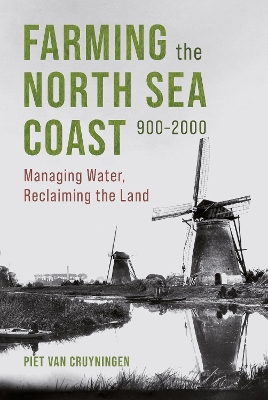
"The author opens a powerful dialogue between agricultural history on the one hand and environmental history on the other... a brilliant and provocative synthesis of a thousand years of coastal farming." Tim Soens, University of Antwerp, Belgium.
The fascinating story of how the North Sea coast has been farmed is ever changing. Long before the industrial revolution, the inhospitable fens and marshes of the low-lying coastal wetlands on both sides of the Sea had been transformed into one of the most productive agricultural regions in Europe. Agriculture in the coastlands reached its apogee during the eighteenth and nineteenth centuries, as is witnessed by the many impressive farm buildings established then. However, more recently, it has become clear that lowland farming and even the physical existence of the lowlands are in jeopardy, owing to rising sea levels and problems of drainage.
This book offers a history of farming and water management on the North Sea coast, assessing the forces driving - and inhibiting - agricultural progress more broadly. It examines the ways in which farmers in the past dealt with the two main constraints on their decision-making: the natural environment and the human environment of institutional rules and customs regulating behaviour. It looks in particular at how setbacks were overcome, and how farming practices were improved which then raised the money with which to finance the maintenance of dykes, canals, and sluices.
Arvustused
This ambitious work uses a comparative approach to examine the relationship between water management institutions and economic development and productivity across diverse regions. Synthesizing insights from agricultural and environmental history with theory from political science, economics, and geography, 10 richly sourced and clearly written chapters reflect the author's "nine years of voracious reading" described in the introduction. * CHOICE *
List of Illustrations
Preface
Glossary
Introduction
1. The Great Reclamation: Transformation of the Wetlands, c. 900 - 1300
2. Pioneering in the Wetlands: Water Management and Agriculture, c. 1100 - 1300
3. Sinking Land and Disastrous Floods: Water Management, c. 1300 - 1550
4. Surviving in Times of Adversity: Agriculture in the Late Middle Ages, c. 1300 - 1550
5. The Second Reclamation: Urban Capital in the Countryside, c. 1500 - 1700
6. Risen from the Waves: Agriculture after the Second Reclamation, c. 1550 - 1700
7. State and Steam: Water Management, c. 1700 - 1880
8. The Apogee of Lowland Farming, c. 1700 - 1880
9. Nature Tamed? Water Management, c. 1880-1980
10. The Indian Summer of Lowland Farming, c. 1880-1980
Conclusion
Epilogue: the North Sea Lowlands after 1980
Bibliography
Index
PIET van CRUYNINGEN is a Senior Researcher in the Economic and Environmental History Group at Wageningen University & Research.