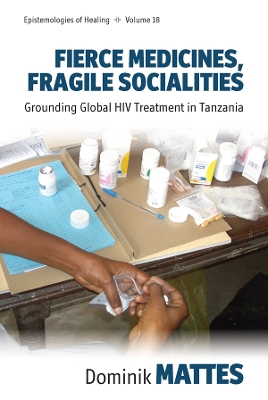
Set in Tanga, a city on the Tanzanian Swahili coast, Dominik Mattes examines the implementation of antiretroviral HIV-treatment (ART) in the area, exploring the manifold infrastructural and social fragilities of treatment provision in public HIV clinics as well as patients’ multi-layered struggles of coming to terms with ART in their everyday lives. Based on extensive ethnographic fieldwork, the book shows that, notwithstanding the massive rollout of ART, providing treatment and living a life with HIV in settings like Tanga continue to entail social, economic, and moral challenges and long-term uncertainties, which contradict the global rhetoric of the “normalization of HIV”.
Arvustused
Dominik Mattess stunning new book will remain relevant for those interested in why and how vertical global health interventions often fail (and how they might succeed). This book effectively illustrates how to translate the global to the local and the structural to the personal. Mattes also provides a blueprint for ethnographic research that aims to examine a problem from multiple, often contradictory, angles. Fierce Medicines, Fragile Socialities is a must read for those interested in HIV/AIDS, global health interventions, and ethnographic methods. Medical Anthropology Quarterly
This is an important contribution to existing research on HIV and its treatment in Africa. The book is unique in combining perspectives on providing, and on living, life with HIV treatment. The observations are acute, and the case studies of patients and families are illuminating. Susan Reynolds Whyte, University of Copenhagen
List of Illustrations
Acknowledgments
Note on Transliteration
List of Abbreviations
Introduction
Chapter
1. Exploring ART in Tanga
Chapter
2. Antiretroviral Treatment as a Global Mobile Force
Chapter
3. Translating Global Technology into Local Health Care Practice
Chapter
4. Generating Treatment Adherence: Neoliberal Patient
Subjectivities, Biomedical Truth Claims, and Institutional Micropolitics
Chapter
5. Diverging Trajectories of Reconstitution: Living with ARVs and
the Pursuit of Normalcy
Chapter
6. Cohesion and Conflict: Living a Social Live on ARVs within
Kin-Based Networks of Solidarity
Chapter
7. HIV (Self-)Support Groups: Competition, Bureaucracy, and the
Limitations of Biosociality
Chapter
8. The Blood of Jesus, Witchcraft, and CD4 Counts: HIV/AIDS and ART
in the Context of Traditional and Religious Healing
Conclusion
References
Index
Dominik Mattes is a postdoctoral researcher at the Collaborative Research Center Affective Societies and the Institute of Social and Cultural Anthropology, Freie Universität Berlin, Germany. His research interests include medical anthropology, critical global health, anthropology of religion, as well as anthropology of affect and emotion.