Muutke küpsiste eelistusi

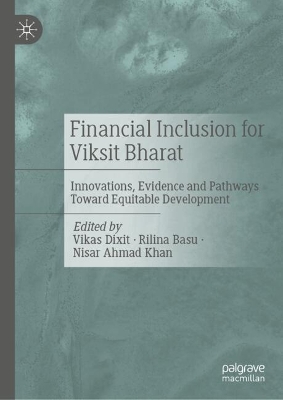
Financial Inclusion for Viksit Bharat: Innovations, Evidence and Pathways Toward Equitable Development [Kõva köide]

Edited by , Edited by , Edited by
  • Formaat: Hardback, kõrgus x laius: 210x148 mm, Approx. 225 p.
  • Ilmumisaeg: 22-Feb-2026
  • Kirjastus: Springer Nature
  • ISBN-10: 9819208068
  • ISBN-13: 9789819208067
  • Kõva köide
  • Hind: 141,22 €*
  • * hind on lõplik, st. muud allahindlused enam ei rakendu
  • Tavahind: 188,29 €
  • Säästad 25%
  • Raamatu kohalejõudmiseks kirjastusest kulub orienteeruvalt 3-4 nädalat
  • Kogus:
  • Lisa ostukorvi
  • Tasuta tarne
  • Tellimisaeg 2-4 nädalat
  • Lisa soovinimekirja
  • Formaat: Hardback, kõrgus x laius: 210x148 mm, Approx. 225 p.
  • Ilmumisaeg: 22-Feb-2026
  • Kirjastus: Springer Nature
  • ISBN-10: 9819208068
  • ISBN-13: 9789819208067
This interdisciplinary edited volume offers a timely and authoritative exploration of how inclusive finance can serve as a transformative lever in Indias journey toward becoming a developed nation by 2047.  drive equitable growth in India and beyond. It brings together eleven contributions from leading academics, policymakers, and practitioners, offering conceptual, empirical, and policy-oriented insights. The book expands conventional debates by foregrounding marginalized groupssuch as persons with disabilities, women, smallholder farmers, the elderly, and informal workersas central to financial inclusion. It combines global and national perspectives with grassroots evidence, examining topics including Indias G20-driven digital finance diplomacy, digital public infrastructure (Aadhaar, UPI, PMJDY, DBT), financial innovation for financial inclusion and socioeconomic development, financial literacy for trust-building, retirement planning, disability-inclusive finance, post-pandemic gender gaps in digital finance, the role of FinTech in shaping access to informal credit, industrialization and digital financial inclusion for growth, crop insurance, and the role of microfinance in financial inclusion and economic development. 


Organized into three thematic sections, the volume situates Indias experience in the global discourse, examines national frameworks and life-stage needs, and highlights sectoral and regional pathways through surveys, econometric analysis, and case-based studies. A unique contribution is the pioneering of some important policy-oriented concepts, such as Disability Financial Inclusion Index, National Disability Financial Inclusion Strategy and National Financial Literacy Integration Mission. This timely resource will benefit scholars, students, regulators, practitioners, and international organizations by providing evidence-based recommendations and globally relevant strategies for advancing equity, empowerment, and sustainable financial inclusion. leading economists, policymakers, and field researchers to provide a comprehensive, evidence-based examination of financial inclusion across four thematic pillars: global frameworks and national strategies; life-cycle and demographic inclusion; community-driven models; and cross-country/regional insights. Emphasising on inclusion at the margins, rural women, persons with disabilities, informal workers, the elderly, and small farmers, this volume expands the boundaries of financial inclusion to address equity, participation, and trust. 


Drawing from a rich mix of empirical methods econometric modeling, structuralist macro frameworks, and grassroots-level fieldwork, it covers a wide range of underexplored topics: post-pandemic gender gaps in digital finance, the role of FinTech in informal credit, financial literacy for trust-building, SHG vs. MFI empowerment models, and India's leadership on Digital Public Infrastructure (DPI) and the G20 Financial Inclusion agenda. It also pioneers new tools like a proposed Disability Financial Inclusion Index. 


It is beneficial for scholars and students in economics, development studies, public policy, and finance, the book also serves as a practical guide for policymakers, regulators, development practitioners, and international agencies. Its policy recommendations are rooted in local realities from regions like the Sundarbans and Jalgaon, while offering globally relevant insights through SAARC-level and cross-country comparisons. 
Theme 1: Vision and Strategy for Inclusive Finance in the Era of Viksit
Bharat and G20.
Chapter 1: Enhancing Financial Inclusion in Developing
Countries: Addressing the Gaps.
Chapter 2: Long-Term Financial Inclusion for
Viksit Bharat: Sustained Literacy, Trust, and Access for All.- Theme 2:
Inclusion Across the Life Cycle and Social Groups.
Chapter 3: Retirement
Planning as a Pillar of Financial Inclusion: Securing the Golden Years in
Viksit Bharat.
Chapter 4: Gender and Self-Employment: Patterns of Financial
Inclusiveness in India.
Chapter 5: The Pandemic Divide: Gender Inequality in
Financial Inclusion in India.- Theme 3: Instruments, Innovations, and
Institutions for Financial Empowerment.
Chapter 6: Comparing the Empowerment
Outcomes of SHGs and MFIs in Rural Women: A Study in Kanpur and Lucknow
Clusters.
Chapter 7: Empowering Rural Women in India: The Impact of
Microfinance and Self-Help Groups: This chapter is tentative yet.
Chapter 8:
The Role of Microfinance in Financial Inclusion in Indian Sundarbans: An
Econometric Analysis.
Chapter 9: Retail Participation in Government
Securities Market: A Potential Game Changer for Vision Viksit Bharat.-
Chapter 10: Financial Technology and Informal Credit: A Structuralist Macro
Model.- Theme 4: Regional, Subnational, and Cross-Country Insights for
Comparative Inclusion.
Chapter 11: Industrialization, Digitalization, and
Growth: A Subnational Level Study.
Chapter 12: Bridging the Digital Divide:
An Analysis of Financial Vulnerability and Digital Financial Inclusion in
Rural and Urban Jalgaon, Maharashtra.
Chapter 13: Access to Credit-Linked
Crop Insurance in India: Does Farm Size Matter?.
Chapter 14: Financial
Innovation, Inclusion and Socio-Economic Development: An Experience from
Cross Country Analysis.
Chapter 15: Variation and Determinants of Social and
Financial Inclusion: A Dynamic Panel Data Analysis across SAARC Countries.-
Chapter 16: Conclusion.
Dr. Vikas Dixit is an Associate Professor of Economics at Jadavpur University, Kolkata. He has earned his B.Sc. (hons.) in Statistics, M.A. in Economics, and Ph.D. in Public Expenditure, all from Aligarh Muslim University, Aligarh. With over 157 years of teaching and research experience, his academic work spans public finance, development economics, fiscal policy, and inclusive growth. He has published widely in peer-reviewed journals (including Foreign Trade Review, the Indian Economic Journal and Journal of Public Affairs)  and edited volumes, from Springer, Regal, etc.,  with a particular focus on the efficiency and equity of public expenditure, intergovernmental fiscal transfers, and financial inclusionespecially for marginalized groups including persons with disabilities. He has led and collaborated on research projects funded by the ICSSR and NITI Aayog, and is currently the Principal Investigator of a major ICSSR-funded project on promoting financial inclusion for persons with disabilities in India. He has also co-organised national conferences and regularly contributes to curriculum development and doctoral supervision. He is a life member of the Indian Economic Association, The Indian Econometric Society, and the Bengal Economic Association. 


Dr. Rilina Basu (Banerjee) is an Associate Professor of Economics at Jadavpur University, Kolkata. With over 15 years of teaching and research experience across premier institutions, her expertise lies in open economy macroeconomics, financial structures, and development economics. She earned her Ph.D. from Jadavpur University for her thesis on Financial Structure and the Macroeconomy: Theory and Empirics.. She has published widely in leading journals such as the Foreign Trade Review, Journal of Developing Areas, and The Pakistan Development Review. Her recent research includes empirical and theoretical studies on financial innovation, macroeconomic volatility, and educational mobility. She has supervised doctoral and M.Phil. research in these areas and has presented extensively at national and international academic forums. She is collaborating with Dr. Vikas Dixit and others in the ongoing ICSSR-funded major research project on Promoting Financial Inclusion for Persons with Disabilities in India. In addition to her academic contributions, she has co-organized major conferences and workshops on development economics and applied econometrics. 


Dr. Nisar Ahmad Khan is Professor of Economics at Aligarh Muslim University (AMU), Aligarh, where he has taught since 1983. A distinguished scholar in the fields of monetary economics and development economics, he earned his B.A., M.A., M.Phil., and Ph.D. from AMU, and was awarded the prestigious Cambridge Commonwealth Scholarship to pursue a Diploma in Development Studies at the University of Cambridge, UK. He also served as a UNDP-appointed Professor of Economics at the Ethiopian Civil Service College, Addis Ababa (20042007). 


He has held several senior academic leadership roles, including Chairperson of the Department of Economics and Dean of the Faculty of Social Sciences at AMU. He has published extensively in national and international journals, many of them Scopus-indexed and has completed several research projects focusing on banking efficiency, financial regulation, and development finance. He has also supervised numerous Ph.D. scholars and delivered invited lectures at prominent institutions across India. His teaching portfolio spans macroeconomics, monetary theory, international economics, and financial markets at both undergraduate and postgraduate levels.