Muutke küpsiste eelistusi

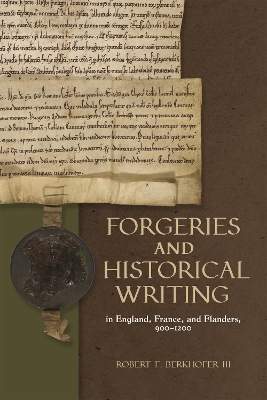
Forgeries and Historical Writing in England, France, and Flanders, 900-1200 [Pehme köide]

  • Formaat: Paperback / softback, 348 pages, kõrgus x laius: 234x156 mm, 4 b/w illus.
  • Sari: Medieval Documentary Cultures
  • Ilmumisaeg: 23-Jun-2026
  • Kirjastus: Boydell & Brewer
  • ISBN-10: 1837653909
  • ISBN-13: 9781837653904
Teised raamatud teemal:
  • Pehme köide
  • Hind: 29,58 €*
  • * hind on lõplik, st. muud allahindlused enam ei rakendu
  • Tavahind: 39,44 €
  • Säästad 25%
  • See raamat ei ole veel ilmunud. Raamatu kohalejõudmiseks kulub orienteeruvalt 3-4 nädalat peale raamatu väljaandmist.
  • Kogus:
  • Lisa ostukorvi
  • Tasuta tarne
  • Tellimisaeg 2-4 nädalat
  • Lisa soovinimekirja
  • Formaat: Paperback / softback, 348 pages, kõrgus x laius: 234x156 mm, 4 b/w illus.
  • Sari: Medieval Documentary Cultures
  • Ilmumisaeg: 23-Jun-2026
  • Kirjastus: Boydell & Brewer
  • ISBN-10: 1837653909
  • ISBN-13: 9781837653904
Teised raamatud teemal:
A close analysis of forgeries and historical writings at Saint Peter's, Ghent; Saint-Denis near Paris; and Christ Church, Canterbury, offering valuable access to why medieval people often rewrote their pasts.

What modern scholars call "forgeries" (be they texts, seals, coins, or relics) flourished in the central Middle Ages. Although lying was considered wrong throughout the period, such condemnation apparently did not extend to forgeries. Rewriting documents was especially common among monks, who exploited their mastery of writing to reshape their records.

Monastic scribes frequently rewrote their archives, using charters, letters, and narratives, to create new usable pasts for claiming lands and privileges in their present or future. Such imagined histories could also be deployed to "reform" their community or reshape its relationship with lay and ecclesiastical authorities. Although these creative rewritings were forgeries, they still can be valuable evidence of medieval mentalities. While forgeries cannot easily be used to reconstruct what did happen, forgeries embedded in historical narratives show what their composers believed should have happened and thus they offer valuable access to why medieval people rewrote their pasts.

This book offers close analysis of three monastic archives over the long eleventh century: Saint Peter's, Ghent; Saint-Denis near Paris; and Christ Church, Canterbury. These foci provide the basis for contextualizing key shifts in documentary culture in the twelfth century across Europe. Overall, the book argues that connections between monastic forgeries and historical writing in the tenth through twelfth centuries reveal attempts to reshape reality. Both sought to rewrite the past and thereby promote monks' interests in their present or future.

Arvustused

More powerfully than any previous commentator, Berkhofer has demonstrated the narrative qualities of charters and cartularies. [ ...] Let us hope that where he has trod, others will soon follow! * THE MEDIEVAL REVIEW (TMR) * An essential read for those interested in questions of authenticity in the European Middle Ages. * SPECULUM *

PART I: UNDERSTANDING MEDIEVAL FORGERIES
Introduction
1 Rethinking Medieval Forgeries

PART II: TWICE TOLD TALES
2 Forgeries and Histories at Saint Peter's, Ghent
3 Forgeries and Histories at Saint-Denis
4 Forgeries and Histories at Christ Church, Canterbury
Coda: Learning from Twice Told Tales

PART III: FORGERIES AND HISTORIES IN THE TWELFTH CENTURY
5 Perpetration, Detection, and Prevention of Forgeries
6 Plausible Narratives and Convincing (Hi)stories
Conclusion: Rewriting the Past

Bibliography
Index
Robert F. Berkhofer III is associate professor of medieval history at Western Michigan University in Kalamazoo, Michigan.