Muutke küpsiste eelistusi

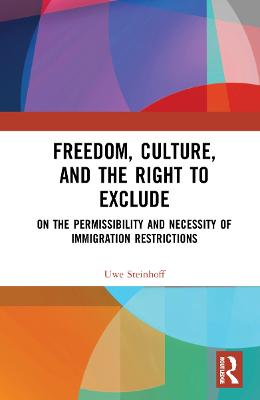
Freedom, Culture, and the Right to Exclude: On the Permissibility and Necessity of Immigration Restrictions [Kõva köide]

(The University of Hong Kong)
  • Formaat: Hardback, 158 pages, kõrgus x laius: 229x152 mm, kaal: 453 g
  • Ilmumisaeg: 14-Apr-2022
  • Kirjastus: Routledge
  • ISBN-10: 1032235535
  • ISBN-13: 9781032235530
  • Kõva köide
  • Hind: 159,19 €*
  • * hind on lõplik, st. muud allahindlused enam ei rakendu
  • Tavahind: 212,25 €
  • Säästad 25%
  • Raamatu kohalejõudmiseks kirjastusest kulub orienteeruvalt 3-4 nädalat
  • Kogus:
  • Lisa ostukorvi
  • Tasuta tarne
  • Tellimisaeg 2-4 nädalat
  • Lisa soovinimekirja
  • Raamatukogudele
  • Formaat: Hardback, 158 pages, kõrgus x laius: 229x152 mm, kaal: 453 g
  • Ilmumisaeg: 14-Apr-2022
  • Kirjastus: Routledge
  • ISBN-10: 1032235535
  • ISBN-13: 9781032235530
"This book argues that citizens have a moral right to decide by which criteria they grant migrants citizenship, as well as to control access to their territory in the first place. In developing and defending this argument, it critically engages numerous objections, thus providing the reader with a thorough overview of the current debate on the ethics of immigration and exclusion. The author's argument is based on a straightforwardly individualist and liberal starting point. One of the rights granted by liberalism is freedom of association, which also comprises the right not to associate with people with whom one does not want to associate. While this is an individual right, it can be exercised collectively like many other individual rights. Thus, people can decide to collectively organize into an association pursuing certain goals; and subject to certain provisos, this gives rise to legitimate claims to space and territory in which they pursue these goals. The author shows that this right is far-reachingand robust, which entails an equally far-reaching and robust right to exclude. Moreover, he demonstrates that large-scale immigration from illiberal cultures tends to severely compromise the way of life, the values, and the institutions of liberal democracies in ways routinely ignored by apologists of multiculturalism. Freedom, Culture, and the Right to Exclude will be of interest to scholars and advanced students working in applied ethics, political philosophy, political theory, and law"--

This book argues that citizens have a moral right to decide by which criteria they grant migrants citizenship. In developing this argument, it critically engages numerous objections, providing the reader with a thorough overview of the debate on the ethics of immigration and exclusion.

Acknowledgments viii
1 Introduction
1(5)
2 Exclusion and Justification: On Imagined Burdens and Irrelevant Questions
6(22)
2.1 Is the Burden of Proof on Those Who Defend Immigration Restrictions?
6(3)
2.2 Must Immigration Restrictions Be "justifiable to Everyone"? On the Veiled Partiality and Impracticality of a Mystifying Slogan
9(6)
2.3 Border Coercion and the Question of "Democratic Legitimacy": On Abizadeh's Argument against Current Regimes of Border Control
15(13)
3 "Cantilever Arguments," International Law, and the Protection of Culture: Turning the Tables on Defenders of Open Borders
28(18)
3.1 A First Cantilever Argument for the Right to Exclude and against International Freedom of Movement: Those Unlawfully Present in a State Do Not Have a Human Right to Internal Freedom of Movement Either
29(6)
3.2 The Right to Leave a State Does Not Entail the Right to Enter Another
35(2)
3.3 Properly Understanding "Freedom of Movement": On the Importance of Distinguishing the Limits of a Right from Its Overridability
37(3)
3.4 A Second Cantilever Argument for the Right to Exclude: The Protection of Cultures and Communities
40(2)
3.5 Conclusion
42(4)
4 Freedom of Association, Democracy, and the Right to Exclude
46(49)
4.1 The Basis of Exclusion: Individual Freedom of Association Collectively Exercised
47(3)
4.2 The Objection from the Alleged Gap between Membership Rights and Territorial Rights
50(6)
4.3 The Objection from Harmless "Mere Presence"
56(1)
4.4 The Objection that Freedom of Association Proves Too Much
57(1)
4.5 The Objection that States and (Other) Associations Differ in Relevant Respects
58(16)
4.6 The Objection that Immigration Restrictions are "Illiberal"
74(7)
4.7 The Objection that the Argument from Freedom of Association Cannot Distinguish between "Newcomers by Birth" and Newcomers by Travel
81(2)
4.8 The "But What about Colonialism and Global Injustice?" Objection
83(2)
4.9 Conclusion
85(10)
5 Enforcement and Resistance at the Border
95(22)
5.1 Mendoza and the Enforcement-Based "Indirect Argument" against a Right to Exclude
95(2)
5.2 Hosein and the Allegedly Very Limited Liability of Unauthorized Migrants to Defensive Force
97(8)
5.3 Hidalgo and the Alleged Far-Reaching Rights of Migrants to Resist Unjust Immigration Restrictions
105(5)
5.4 The Internal Burdens of Enforcement
110(2)
5.5 Conclusion
112(5)
6 Rehabilitating Allegedly Impermissible or Overblown Reasons for Exclusion: Race, the Cultural Protection of a Free Society, and Crime
117(31)
6.1 Race-Based and Racist Exclusion
118(6)
6.2 Exclusion on Cultural Grounds
124(4)
6.3 Reality Check: Culture, Liberal Values, and Crime
128(12)
6.4 Conclusion
140(8)
References 148(7)
Index 155
Uwe Steinhoff is Professor in the Department of Politics and Public Administration at the University of Hong Kong. He is the author of On the Ethics of War and Terrorism (2007), The Philosophy of Jürgen Habermas (2009), On the Ethics of Torture (2013), Self-Defense, Necessity, and Punishment (Routledge, 2019), and The Ethics of War and the Force of Law: A Modern Just War Theory (Routledge, 2021). He is also the editor of Do All Persons Have Equal Moral Worth? (2015).