Muutke küpsiste eelistusi

From Morocco to the Coast of England: The Story of the Dom van Keulen and its Remarkable Cargo [Pehme köide]

Edited by , Edited by
  • Formaat: Paperback / softback, 200 pages, kõrgus x laius: 297x210 mm, 125
  • Ilmumisaeg: 31-May-2026
  • Kirjastus: British Museum Press
  • ISBN-10: 0861592387
  • ISBN-13: 9780861592388
  • Pehme köide
  • Hind: 45,60 €*
  • * hind on lõplik, st. muud allahindlused enam ei rakendu
  • Tavahind: 57,00 €
  • Säästad 20%
  • See raamat ei ole veel ilmunud. Raamatu kohalejõudmiseks kulub orienteeruvalt 3-4 nädalat peale raamatu väljaandmist.
  • Kogus:
  • Lisa ostukorvi
  • Tasuta tarne
  • Tellimisaeg 2-4 nädalat
  • Lisa soovinimekirja
  • Formaat: Paperback / softback, 200 pages, kõrgus x laius: 297x210 mm, 125
  • Ilmumisaeg: 31-May-2026
  • Kirjastus: British Museum Press
  • ISBN-10: 0861592387
  • ISBN-13: 9780861592388
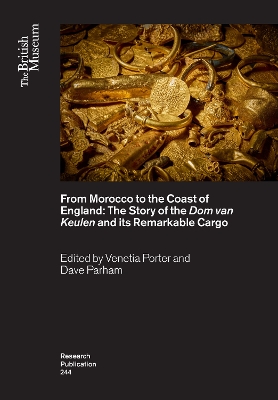
In 1994, the remains of a 17th-century shipwreck were discovered by divers off Salcombe Bay. The finds consisted of 400 gold coins of the Sa’dian sharifs of Morocco in addition to ingots, jewellery as well as other items including Dutch pewter and pottery - the majority of which are now in the British Museum collection. Although the ship does not survive in its entirety, divers discovered remnants of wood, rope and lead that were parts of its infrastructure. This finds from this shipwreck are significant for several reasons: the gold is clearly a bullion hoard and the number of Sa’dian coins offer great insight into the numismatic history of the period. In addition, such pieces of 16th-17th century Moroccan jewellery from this period rarely survive in datable contexts. Alongside these gold objects are objects which provide a fascinating insight into everyday life on board ship, including crockery, sea sickness pills, beans and copper coins.

Whilst there was much debate at the time of discovery about the origin and identity of the ship, it became clear from analysis of the objects that a Dutch origin was most likely. Research undertaken for this publication has revealed the likely identity of the ship – the Dom van Keulen, a Dutch trading ship which is reported to have sunk off the coast of Salcombe in 1633. This book therefore not only offers a detailed record of the find and the objects recovered, but also provides tangible evidence of a flourishing maritime trade in the 17th century, connecting Morocco, the Low Countries and Britain.

In 1994, the remains of a 17th-century shipwreck were discovered off Salcombe Bay. The finds consisted of 400 gold coins of the Sa’dian sharifs of Morocco in addition to ingots, jewellery and other items including Dutch pottery. The book presents these finds for the first time and reveals the identity of the Dutch trading ship - the Dom van Keulen.
Part 1: Contextual history

Introduction Venetia Porter

Chapter 1 The find and its circumstances Dave Parham

Chapter 2 The identification of the 17th-century designated wreck site at
Salcombe, Devon Ian Friel

Chapter 3 The gold trade Sam Nixon

Part 2: The finds

Chapter 4 Coins Cécile Bresc and Archie Williams

Chapter 5 Jewellery Sue La Niece and Jane Perry

Chapter 6 Composition of the Salcombe Bay gold and contemporary Moroccan
assay and refining practice: potential and reality Mike Cowell, Paul
Craddock and Maria Guerra

Chapter 7 Ships, timber, rope and botanical remains Caroline Cartwright
with contribution by Gwilym Lewis on the beans

Chapter 8 Contents of the ceramic pharmacy jar Rebecca Stacey

Chapter 9 The Salcombe clay pipe Peter Davey

Chapter 10 Pottery, pewter, sounding weight and tiles David Gaimster

Bibliography
Index
Venetia Porter is former Senior Curator for Islamic and Contemporary Middle East art at the British Museum. She was the lead curator for the Albukhary Foundation Gallery of the Islamic World, opened 2018, and her publications include Arabic and Persian Seals and Amulets at the British Museum (2011) and Artists Making Books: Poetry to Politics (2023). Dave Parham is an experienced archaeologist and diver who has directed maritime archaeological projects that range in date from the Bronze Age to the Second World War and in scope from strategic studies to extensive field investigations. He has worked extensively throughout the British Isles as well as the Baltic, Mediterranean, Indian Ocean and Arabian Sea. His research interests focus on the archaeology of seafaring and ship construction of all periods but can extend into underwater cultural heritage management on occasions