Muutke küpsiste eelistusi

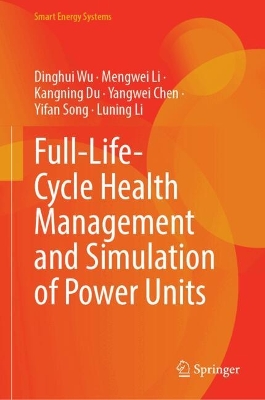
Full-Life-Cycle Health Management and Simulation of Power Units [Kõva köide]

  • Formaat: Hardback, 154 pages, kõrgus x laius: 235x155 mm, 25 Illustrations, color; 43 Illustrations, black and white
  • Sari: Smart Energy Systems
  • Ilmumisaeg: 02-Jul-2026
  • Kirjastus: Springer Verlag, Singapore
  • ISBN-10: 9819594332
  • ISBN-13: 9789819594337
  • Kõva köide
  • Hind: 133,04 €*
  • * hind on lõplik, st. muud allahindlused enam ei rakendu
  • Tavahind: 177,39 €
  • Säästad 25%
  • See raamat ei ole veel ilmunud. Raamatu kohalejõudmiseks kulub orienteeruvalt 3-4 nädalat peale raamatu väljaandmist.
  • Kogus:
  • Lisa ostukorvi
  • Tasuta tarne
  • Tellimisaeg 2-4 nädalat
  • Lisa soovinimekirja
  • Formaat: Hardback, 154 pages, kõrgus x laius: 235x155 mm, 25 Illustrations, color; 43 Illustrations, black and white
  • Sari: Smart Energy Systems
  • Ilmumisaeg: 02-Jul-2026
  • Kirjastus: Springer Verlag, Singapore
  • ISBN-10: 9819594332
  • ISBN-13: 9789819594337
This book presents a comprehensive framework for reliability modeling, health assessment, and life-cycle cost analysis of integrated power systems operating under complex mission profiles. Drawing on methods from reliability engineering, systems engineering, and probabilistic modeling, it introduces a rich set of analytical toolsincluding grey relational analysis, evidence theory, Monte Carlo simulation, fault tree analysis, Wiener-process-based degradation modeling, GO methodology, and Bayesian fusionto characterize equipment health states, mission reliability, and long-term maintenance costs. These methods are illustrated with detailed diagrams, simulation workflows, and practical case studies, offering readers both theoretical clarity and operational relevance.

A distinctive feature of the book is its emphasis on linking mission scenarios with component-level degradation mechanisms, enabling realistic prediction of system availability and mission success rates. The integration of multi-source data, mission-driven reliability metrics, and life-cycle cost optimization provides readers with a unified and actionable decision-support framework.

This book will be valuable for researchers and engineers in reliability and systems engineering, military and aerospace equipment analysts, advanced graduate students, and professionals involved in mission planning, equipment design, maintenance decision-making, or life-cycle management.
1. Introduction.-
2. Theoretical Foundations.-
3. Simulation Modeling of
Equipment Readiness Based on Health State.-
4. Simulation Modeling of Mission
Success Probability Based on Mission Reliability.-
5. Life Cycle Cost
Simulation Modeling Based on Multiple Mission Profiles.-
6. Summary and
Prospect.
Dr. Dinghui Wu received the Ph.D. degree in Control Science and Engineering with Jiangnan University, and now is a Visiting Fellow with the School of Computer, and electronic engineering, University of Denver, the US. His current research interests include energy optimization control technology, fault diagnosis of power systems and edge calculation. Since Nov. 2019, Dr. Wu has been in School of Internet of Things, Jiangnan University as a Professor.


Ms. Mengwei Li holds a master's degree from Beihang University, specializing in health management technology for special-purpose vehicles. She currently serves as an engineer at the China North Vehicle Research Institute.


Mr. Kangning Du obtained a Master's degree in Mechanical Engineering from Taiyuan University of Science and Technology in 2023. In 2023, he began pursuing a doctoral degree at Jiangnan University in China. His current research interests include reliability and health management.


Mr. Yangwei Chen obtained a bachelor's degree in engineering from Nanjing University of Science and Technology's Zijin College in 2024. In the same year, he began to pursue a master's program at Jiangnan University. His current research focus is on the study of reliability in dynamical systems.


Mr. Yifan Song obtained a bachelor's degree in engineering from Jiangnan University in 2024. Subsequently, he continued his studies for a master's degree at Jiangnan University. His research interests include maintenance decisions and system reliability modeling.


Mr. Luning Li obtained a bachelor's degree in engineering from Southeast University Cheng Xian College in 2023. Subsequently, he continued his studies for a master's degree at Jiangnan University. His research interests include Fault Diagnosis and Health Status Evaluation.