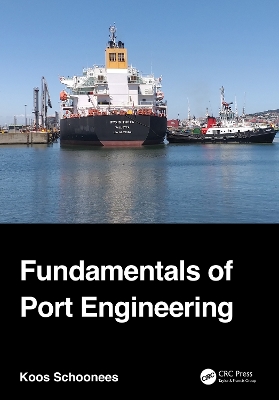
Port engineering primarily deals with the design, construction, operation, management, and maintenance of ports, overlapping with many other disciplines. This book provides an introductory text to prospective (graduate) port engineers and presents a wide variety of port subjects for practicing engineers. It covers almost all topics related to port engineering in a fundamental way, including dredging, marine aids to navigation, environmental issues, containers, liquid bulk, dry bulk, general cargo, multipurpose, roll-on/roll-off (Ro-Ro), fishing, and ferry terminals. Discussions are targeted at a conceptual design level.
Other features:
Aspects of port engineering are discussed, including shipping, maritime trade, environmental aspects (such as climate change), resilience of ports, nature-based solutions, and port management (such as security, equipment, slurry pumping, and so forth) Illustrates the design of port terminals Discusses site selection for a new port, the factors to be considered, and ways to compare different potential port sites Explores asset management and repair of marine structures Includes case studies from around the world, examples, and practical and user-friendly guidelines
1. Introduction.
2. Ports, Shipping, And Maritime Trade.
3.
Environmental Considerations.
4. Aspects of Port Management.
5. Port
Planning.
6. Ship Motions, Channels, And Harbor Areas.
7. Port Equipment and
Infrastructure.
8. Conceptual Design of Port Terminals.
9. Marine Aids to
Navigation.
10. Dredging.
11. Asset Management and Maintenance of Marine
Structures.
Koos Schoonees qualified as civil engineer at Stellenbosch University (SU), Stellenbosch, South Africa (SA) in 1978. He obtained a masters degree and a Ph. D., both in coastal engineering at SU. He is a professional engineer at the Engineering Council of SA as well as a member of the World Association for Waterborne Transport Infrastructure (PIANC) and the SA Institution of Civil Engineering. He acted as reviewer for many journals.
His career started at the Council for Scientific and Industrial Research in Stellenbosch. Later, he joined Entech, which became part of the worldwide WSP Group of consulting engineers. From 2015 to 2020, he occupied the Transnet National Ports Authority of South Africa (TNPA) Teaching Chair in Port and Coastal Engineering at SU as associate professor. He was responsible for the postgraduate training and supervision of port and coastal engineers. He retired in December 2021.
Koos has over 40 years of experience. He worked as a consulting engineer, a researcher, and as an academic. He worked on port design (e.g. layout and container and dry bulk terminals), dredging, breakwaters (including stability, toe rock and scour), beach stability, shore protection, sizes of various types of ships, marinas, sand bypassing, marine outfalls, fenders, specialist studies for environmental impact assessments, beach improvement schemes, recurve seawalls, physical and mathematical modelling, and coastal zone management. Apart from numerous contract and research reports, Koos is the author and co-author of 31 scientific journal and conference papers.
Koos has worked in numerous countries around the world (mainly in Southern Africa and the Middle East, where he was based in Abu Dhabi). He has undertaken study visits across the world.