Muutke küpsiste eelistusi

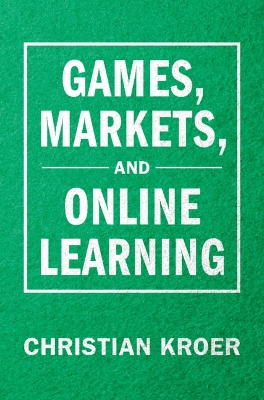
Games, Markets, and Online Learning [Pehme köide]

(Columbia University, New York)
  • Formaat: Paperback / softback, 250 pages, Worked examples or Exercises
  • Ilmumisaeg: 31-May-2026
  • Kirjastus: Cambridge University Press
  • ISBN-10: 1009711253
  • ISBN-13: 9781009711258
Teised raamatud teemal:
  • Pehme köide
  • Hind: 50,25 €
  • See raamat ei ole veel ilmunud. Raamatu kohalejõudmiseks kulub orienteeruvalt 3-4 nädalat peale raamatu väljaandmist.
  • Kogus:
  • Lisa ostukorvi
  • Tasuta tarne
  • Tellimisaeg 2-4 nädalat
  • Lisa soovinimekirja
  • Formaat: Paperback / softback, 250 pages, Worked examples or Exercises
  • Ilmumisaeg: 31-May-2026
  • Kirjastus: Cambridge University Press
  • ISBN-10: 1009711253
  • ISBN-13: 9781009711258
Teised raamatud teemal:
This book presents a modern introduction to the field of algorithmic game theory. It places a heavy emphasis on optimization and online learning (a subdiscipline of machine learning), which are tools that increasingly play a central role in both the theory and practice of applying game-theoretic ideas. The book covers the core techniques used in several majorly successful applications, including techniques used for creating superhuman poker AIs, the theory behind the 'pacing' methodology that has become standard in the internet advertising industry, and the application of competitive equilibrium from equal incomes for fair course seat allocation in many business schools. With its focus on online learning tools, this book is an ideal companion to classic texts on algorithmic game theory for graduate students and researchers.

Arvustused

'Nash's existence theorem tells us that every finite game has at least one (mixed) Nash equilibrium. But how might players reach such an equilibrium? Christian Kroer's Games, Markets, and Online Learning provides both the background necessary to study this question and the first textbook treatment of a range of modern and important topics, including convergence rates for self-play, security games and their applications, and the approximate fair division of indivisible goods.' Tim Roughgarden, Columbia University 'AI and optimization drive the Internet economy - think automated pricing and allocation through Uber, YouTube, Alibaba, Amazon, Tencent, and hundreds of other two-sided marketplaces. Generative AI increasingly relies on the same fundamental techniques to push the frontier of reasoning and agentic decision-making. In this book, Christian Kroer introduces that intersection of economic thinking, machine learning, and optimization - for the first time, and from the ground up. This is a foundational work for those looking to understand the modern technology-first economy.' John P. Dickerson, CEO, Mozilla AI 'This book presents an exciting panorama of recent results in market algorithms and mechanism design. It offers a comprehensive exposition, taking readers from the real-world motivations that make these problems relevant, through the underlying mathematical concepts, and into clear and polished proofs. An excellent read for staying at the forefront of these rapidly advancing fields.' Nicolas Stier-Moses, Meta Central Applied Science

Muu info

A modern introduction to algorithmic game theory focused on online learning and optimization.
Preface; Notation; Part I. Introductory Material:
1. Introduction and
examples;
2. Nash equilibrium introduction;
3. Auctions and mechanism design
introduction; Part II. Game Solving and Regret Minimization:
4. Regret
minimization and the minimax theorem;
5. Blackwell approachability and regret
matching;
6. Self-play via regret minimization;
7. Optimism and fast
convergence of self play;
8. Extensive-form games;
9. Stackelberg equilibrium
and security games;
10. Fixed-point theorems and equilibrium existence; Part
III. Fair Allocation and Market Equilibrium:
11. Fair division and market
equilibrium;
12. Computing Fisher market equilibrium;
13. Fair allocation
with indivisible goods;
14. Power flows and equilibrium pricing; Part IV.
Auctions and Internet Advertising Markets:
15. Internet advertising auctions:
position auctions;
16. Auctions with budgets and pacing equilibria;
17.
Pacing algorithms for budget management;
18. Demographic fairness; Appendix
A. Optimization background; Appendix B. Probability background; References;
Index.