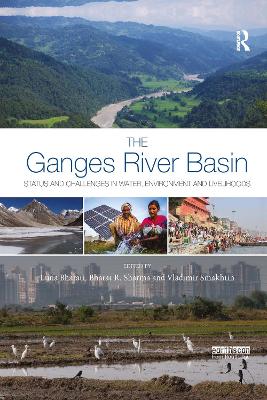
The Ganges is one of the most complex yet fascinating river systems in the world. The basin is characterized by a high degree of heterogeneity from climatic, hydrological, geomorphological, cultural, environmental and socio-economic perspectives. More than 500 million people are directly or indirectly dependent upon the Ganges River Basin, which spans China, Nepal, India and Bangladesh. While there are many books covering one aspect of the Ganges, ranging from hydrology to cultural significance, this book is unique in presenting a comprehensive inter-disciplinary overview of the key issues and challenges facing the region.
Contributors from the three main riparian nations assess the status and trends of water resources, including the Himalayas, groundwater, pollution, floods, drought and climate change. They describe livelihood systems in the basin, and the social, economic, geopolitical and institutional constraints, including transboundary disputes, to achieving productive, sustainable and equitable water access. Management of the main water-use sectors and their inter-linkages are reviewed, as well as the sustainability and trade-offs in conservation of natural systems and resource development such as for hydropower or agriculture.
Arvustused
"This book is a comprehensive treatment of the important aspects of the river, its basin and the millions of people inhabiting it. The scientific rigor and treatment of the varied subjects by the eminent researchers and authors from the three riparian countries India, Nepal and Bangladesh and those with international experience makes the chapters excellent pieces for understanding and appreciation of the complex issues related to this unique river system. I consider this book as an humble offering to the service of 'Ma Gange' and all those interested in its divinity, river science and technology, irrigation and hydropower, people, policies and governance and transboundary cooperation, and more importantly restoring its health and glory, shall find it very useful." From the Foreword by Ravi Chopra, People Science Institute, Dehradun, Uttarakhand, India
Foreword Ravi Chopra Part 1: Resources and Uses
1. Introduction Luna
Bharati, Bharat Sharma and Vladimir Smakhtin
2. Surface Water Resources
Sharad Kumar Jain, Marc A. Jeuland, Luna Bharati and Zahirul Haque Khan
3.
Groundwater Resources Dipankar Saha, Anwar Zahid, Surendra Raj Shreshtha and
Paul Pavelic
4. Climate Change and the Ganges Basin Marc A. Jeuland
5.
Managing Variability: Floods and Droughts Giriraj Amarnath, A.K.M. Saiful
Islam and M. S. Shrestha
6. Agriculture and Water Use: Implications for
Sustainable Intensification Bharat Sharma, Alok K. Sikka, Ram Pratap Sah and
Xueliang Cai
7. Hydropower: The Status and Challenges Dwarika N. Dhungel,
Santa Bahadur Pun, Sonali Mittra and M. Monirul Qader Mirza
8.
Water-Food-Energy Nexus: Challenges and Opportunities Christopher A. Scott,
Arica Crootof, Bhuwan Thapa and Rashmi Kiran Shreshtha
9. Ganges Water
Machine: One Solution to Basin Water Problems? Upali A. Amarasinghe and Lal
Mutuwatte Part 2: Environment
10. Environmental Flows: Keeping the Basin
Rivers Alive Vladimir Smakhtin and Luna Bharati
11. Ecosystem Services and
Conservation Assessment of Freshwater Biodiversity Asghar Nawab, Ravindra
Kumar Sinha, Paul M. Thompson and Subodh Sharma
12. Arsenic in the Eastern
Ganges Basin: Extent and Impact on Food Chain and Human Health Rajmohan
Natarajan, Dipankar Chakraborti and Sanmugam Prathapar
13. Ganges Water
Quality: Dirty Past, Promising Future Javier Mateo-Sagasta and Vinod Tare
Part 3: Governance and Livelihoods
14. Institutions and Policies Governing
Water Resources Management M. Dinesh Kumar, Dwarika N. Dhungel, M. Monirul
Qader Mirza and Diana Suhardiman
15. Poverty, Inequalities and Vulnerability
of the Rural Poor Upali A. Amarasinghe, Fraser Sugden and Floriane Clement
16. Gender, Agricultural Investment and Productivity in an Era of
Out-migration Fraser Sugden, Panchali Saikia, Niki Maskey-Amatya and Paras
Pokhrel
17. Can there be Progress on Transboundary Water Cooperation in the
Ganges? Mark Giordano, Dipak Gyawali, Ainun Nishat and Uttam Kumar Sinha
18.
Basin Water Challenges: An Agenda for Accelerated Reform Tushaar Shah,
Prachanda Pradhan and Golam Rasul
Luna Bharati is a Senior Researcher and the Head of the Nepal Program at the International Water Management Institute (IWMI).
Bharat R. Sharma is Scientist Emeritus (Water Resources) at IWMI, based in New Delhi, India.
Vladimir Smakhtin was Head of the Water Availability, Risk and Resilience Research Department at IWMI, Colombo, Sri Lanka. He is now the Director of the Institute for Water, Environment and Health (UNU-INWEH), based in Hamilton, Ontario, Canada.