Muutke küpsiste eelistusi

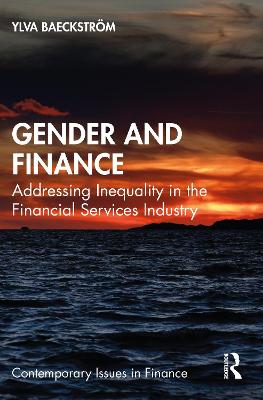
Gender and Finance: Addressing Inequality in the Financial Services Industry [Pehme köide]

  • Formaat: Paperback / softback, 124 pages, kõrgus x laius: 234x156 mm, kaal: 220 g, 2 Tables, black and white; 2 Line drawings, black and white; 5 Halftones, black and white; 7 Illustrations, black and white
  • Sari: Contemporary Issues in Finance
  • Ilmumisaeg: 25-Feb-2022
  • Kirjastus: Routledge
  • ISBN-10: 103205557X
  • ISBN-13: 9781032055572
Teised raamatud teemal:
  • Pehme köide
  • Hind: 54,89 €*
  • * hind on lõplik, st. muud allahindlused enam ei rakendu
  • Tavahind: 73,19 €
  • Säästad 25%
  • Raamatu kohalejõudmiseks kirjastusest kulub orienteeruvalt 3-4 nädalat
  • Kogus:
  • Lisa ostukorvi
  • Tasuta tarne
  • Tellimisaeg 2-4 nädalat
  • Lisa soovinimekirja
  • Raamatukogudele
  • Formaat: Paperback / softback, 124 pages, kõrgus x laius: 234x156 mm, kaal: 220 g, 2 Tables, black and white; 2 Line drawings, black and white; 5 Halftones, black and white; 7 Illustrations, black and white
  • Sari: Contemporary Issues in Finance
  • Ilmumisaeg: 25-Feb-2022
  • Kirjastus: Routledge
  • ISBN-10: 103205557X
  • ISBN-13: 9781032055572
Teised raamatud teemal:
This book examines the world of finance and the role of gender within it. It looks at the financial services industry, arguably the most powerful and remunerative sector that exists, and shows how it was created by men for men.

The author explains how historically women were excluded, how minimal progress has been made, and outlines how the sector still needs to change to function effectively in a modern, equal opportunities world. Addressing gender inequality in financial services is of utmost urgency and importance because of the extent to which it affects women in all stages of life. Womens exclusion in financial services is also mirrored by how men have been excluded from parenting through a similar set of societal expectations, government legislation and corporate policies. The author maintains that to succeed, we need to address both financial services and parenting. To do so we need regulatory support. Because of its power and dominance, the financial services industry has the opportunity to lead this change and to champion gender equal practices. These practices are economically beneficial to all participants, not only female employees and consumers. We all need these benefits as we rebuild our economies following the COVID-19 pandemic. The book makes an important contribution to the critical and increasing awareness of gender concerns. It presents insights drawn from original research and data about gender biases.

The book is an essential secondary text for a range of university courses, including economics, finance and accounting, business studies and gender related courses, as well as MBAs and Executive Education programmes that focus on gender in business. It is also a must read for policy makers, managers in financial services institutions and any other businesses that seek to attract the growing market of female consumers, employees and business leaders.
List of figures and tables
vi
Acknowledgements vii
Prologue viii
1 Gender inequality is in everything
1(13)
2 The prominence and dominance of financial services
14(10)
3 Women as consumers of financial services
24(13)
4 Women as employees in financial services
37(13)
5 Women do finance at least as well as men (despite the odds against them)
50(18)
6 A gendered professional and family life balance
68(13)
7 Actions to reduce gender bias and increase gender equality
81(12)
8 Conclusion: The win--win of taking gender out of financial services
93(5)
Glossary of terms 98(4)
References 102(18)
Index 120
Dr Ylva Baeckström is a researcher in finance at Kings College London and an experienced banker, entrepreneur and psychotherapist.