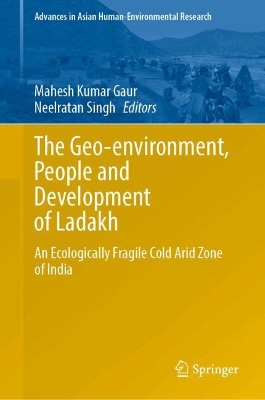
With a foreword by Padma Shri Dr. Shailesh Nayakrenowned Earth Scientist and former Secretary, Ministry of Earth Sciencesthis volume brings together a comprehensive body of contemporary research contributed by leading experts and institutions across India. It serves as an indispensable resource for researchers, policymakers, students, and practitioners seeking holistic and in-depth knowledge on the geo-environmental landscape of Ladakh.
Spanning four major thematic sectionsGeo-environment of Ladakh, Water and Agriculture Scenario, Population and Livelihoods, and Developmental Challenges and Solutionsthe book covers a broad spectrum of pressing issues: from glacier dynamics, tectonic stress, and groundwater crises to innovative climate-resilient agricultural practices, traditional knowledge systems, and disaster risk reduction strategies. The book presents a timely, multidisciplinary exploration into the fragile ecology, dynamic geology, and evolving human-environment interactions of one of Indias most remote and sensitive landscapesthe cold arid region of Ladakh.
The volume highlights emerging opportunities in cold-arid agriculture and horticulture, focusing on crop diversification, high-value fruit production, and the promotion of indigenous farming systems. Prospects for renewable energy development are discussed as viable alternatives to fossil-fuel dependence in high-altitude ecosystems. Furthermore, it explores innovative community-based solutions, such as ice stupas and biomass recycling, that blend tradition with modern science to enhance sustainability.
Combining scientific rigor with local contextual understanding, the book is an essential resource for researchers, policymakers, disaster managers, and development practitioners working in high-altitude regions. It also provides a valuable knowledge base for students and academics in the fields of geomorphology, climate science, geospatial technology, environmental planning, and Himalayan studies.
1 Geo-environment of Ladakh: The Cold Arid Zone of India.- 2 Mapping of
Geomorphic Features in and around Nubra-Shyok Valley Ladakh, India.- 3 The
Role of Geological Formations in Shaping the Northwestern Himalaya, India: An
Overview as Geosites of Ladakh.- 4 Ladakh: A Tapestry of Geological Legacy,
Cultural Heritage, and Environmental Transformation.- 5 Inter-annual Glacier
Velocities over the Rulung and Gyama Massifs, Ladakh (20002018) Using
ITS_LIVE Dataset: Controls of Climatic and Non-climatic Factors.- 6 Perceived
Climate Change and Observed Impact on Agriculture in Ladakh Region, India: A
Case Study of Suru Valley.- 7 Geospatial Database for Long-term Changes in
Climate and Biophysical Variables in Ladakh.- 8 Tectonic Stress Regimes and
Fault Dynamics in the Zanskar Region, NW Himalaya.- 9 Active Tectonics and
River Dynamics in the Zanskar Basin, NW Himalaya.- 10 Groundwater Challenges
and Solutions in Lasirmou Catchments, Phyang and Taru, Ladakh.- 11 Solving
Extreme Water Crisis through Community-driven Ice Stupa Project in Ladakh.-
12 Ensuring Water Security in Ladakh: Sustainable Management Approaches.- 13
Innovative Water Harvesting Techniques in Ladakh.- 14 Agricultural Land Use
and Food Security in Cold Arid Ladakh, India.- 15 Energy Budget of Single
Cropping Patterns in Livestock-dominated Agroecosystems of Ladakh.- 16
Indigenous Mountain Farming in Nubra Valley: Diversification in Cropping
Pattern.- 17 Prospects and Potential of Horticulture in Ladakh.- 18
Assessment of Soil Loss in Ladakh (20192023) using RUSLE Model in GEE.- 19
Fodder Plant Variability and Pastoralism in Ladakh Himalaya.- 20 The
Changpas' Pastoral Life and Livelihood in Ladakh.- 21 Traditional
Agroforestry in Ladakh: Its Potential and Prospects.- 22 Impact of Climate
Change on Agriculture of Cold Arid Himalayan Region.- 23 Resilience and
Adaptability to Climate Challenges in Cold Desert of Ladakh (India).- 24
Water Management in Ladakh (India): Traditional and Contemporary
Perspectives.- 25 Shifting Climates, Enduring Spirits: Ladakhs Struggle with
Climate Change.- 26 Human-Carnivore Conflicts in North-Eastern Kargil
Trans-Himalayas.- 27 Sustainable Water Management in Ladakh: Integrating
Traditional Wisdom and Modern Innovations in a Cold Arid Region.- 28
Landslide Hazard Assessment in the Trans-Himalayan Region of Ladakh:
Geoenvironmental Drivers and Climatic Influences.- 29 Disasters in Ladakh and
Their Mitigation.- 30 Agricultural Prospects under Cold Arid Conditions of
Ladakh.- 31 Livestock resources of the Indian Trans-Himalaya of Ladakh and
Their Potential.
Dr. Mahesh K. Gaur is a Principal Scientist at the ICAR-Central Arid Zone Research Institute (CAZRI), Jodhpur, India, with extensive experience in both hot and cold arid zones of India. His expertise focuses on aridlands geography, satellite remote sensing, GIS, and natural resource management, addressing drought, desertification, land degradation, and socio-economic issues in arid zones. He has completed several sponsored studies for prominent organizations, including ICAR, NRSC, SAC (ISRO), UGC, and ICARDA. A prolific author of over 10 books, 65 research papers, and 55 book chapters, he has received prestigious awards, including the Citizen Karamveer Award and recognitions from COSPAR, UGC and various academic institutions.
Dr. Neelratan Singh is a Senior Scientist at CSIR-CIMFR Research Center, Roorkee, India, holding a Ph.D. in Geology from the University of Delhi. His research spans applied geology, geotechnical investigations, tectonic geomorphology, active tectonics, river science, paleo-climate studies, and the application of GIS and remote sensing. Recipient of the SERB Young Scientist Award, he has published over 30 research papers and contributed significantly to geology, geomorphology, and infrastructure-related geotechnical studies.