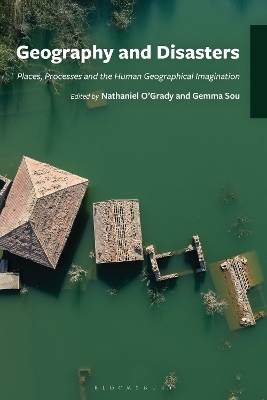
Drawing on global case studies, this is the first book to outline and elaborate on the ways that human geography has extended our understanding of disasters.
This volume explores the unique, creative, and critical ways human geography makes sense of disasters. Every chapter analyses disasters through the lens of a different theoretical framework common to geography, including assemblage theory, post-colonialism, urban political ecology, governmentality, affect theory and scale. The case studies in the collection range from hurricane risk in the Caribbean and volcano eruptions in Chile to floods in India and many more. Each chapter conceives of disasters as processes rather than individual events. Disasters are thus conceptualized as always-already entangled in the continual making and remaking of collective life.
Overall, the chapters present a “pluriversal” perspective that mirrors geography's methodological sensitivity to how disasters are shaped by the in-situ conditions in which they unfold. Following such a perspective, the volume both clarifies, and stays attuned to, the multiple, often cross-cutting, spatial and temporal registers upon which disasters are experienced. Each chapter also expands upon geography's appreciation for the materiality of disasters. Here, disasters are thought to arise from, but also actively contribute to, the material configuration and reconfiguration of space over time. This concern with materiality allows chapters to address the ways that politics is engrained into disasters. Providing inspiration for future scholars in geography and further afield, the collection is essential reading for those interested in developing more advanced understandings of disasters.
Drawing on global case studies, this is the first book to outline and elaborate on the ways that human geography has extended our understanding of disasters.
Arvustused
In a world where informed and meaningful disaster governance is as important as ever, OGrady and Sou have succeeded in producing a timely and thought-provoking volume that highlights valuable disaster research in geography to date and the central role that geographical thought will play moving forward. The skillfully curated chapters weave together new insights with foundational debates to highlight the importance of time, space and place in understanding and addressing disasters, risk politics, and theories of collective life. This go-to resource will surely energize the field of disaster geography by pushing key ontological and epistemological concepts in fresh and productive directions. * Gregory L. Simon, Professor of Geography and the Environment, University of Colorado, Denver, USA * Few works capture with such depth how disasters are made, governed, and remembered. This collection invites us to reimagine what it means to think and live with disaster, moving across worlds from the Himalayas to Latin America and the island constellations of the Caribbean and Pacific. It asks us to see disaster not as rupture but as relation, process, and possibility. The essays weave theory with lived experience, tracing the entanglements of power, place, and imagination. Together they offer a geography that listens to history, to place, and to the fragile, yet enduring ways people remake life from loss. * Stacy-ann Robinson, Associate Professor of Environmental Sciences, Emory University, USA *
Muu info
Drawing on global case studies, this is the first book to outline and elaborate on the ways that human geography has extended our understanding of disasters.
List of Figures
List of Tables
Notes on contributors
Introduction: Disaster Geographys Pasts and its Possible Futures
Nathaniel OGrady (University of Manchester, UK) and Gemma Sou (Monash
University, Australia)
1. Dissenting in Disasters: Lessons for the Disaster-Democracy Interface from
Nepals Dual Disasters
Nimesh Dhunghana (University of Manchester, UK)
2. Reframing Disasters through Urban Political Ecology: Reflections from
Two Latin American Cities
Ricardo Fuentealba (Universidad de O'Higgins, Chile) and Belén Desmaison
(Pontificia Universidad Católica del Perś, Peru)
3. The Plural Lives of Rubble: A Research Agenda for Disaster Geographies
Giovanna Gioli (Independent Scholar) and Amitangshu Acharya (IHE Delft
Institute for Water Education, The Netherlands)
4. Reassembling Disaster Geographies: Placing the Material and Discursives
Peter McGowran (King's College London, UK)
5. How the Production of Economic and Scientific Facts Constrains State
Sovereignty: A Postcolonial Critique of Sovereign Debt Disaster Clauses
John Hogan Morris (University of Nottingham, UK) and Sam Simkin (University
of Warwick, UK)
6. Plants for Recovery: Indigenous Womens Perspectives in a Post-Disaster
Resettlement: An Approach for Feminist Post-Disaster Geographies
Ana Julia Cabrera Pacheco (University of Edinburgh, Scotland), Diego Antonio
Reanda Sapalś (University of the Valley of Guatemala, Guatemala), Lisa
Mackenzie (University of Edinburgh, Scotland), and Teresa Amijos Burneo
(University of Edinburgh, Scotland)
7. The Affective Politics of Magma in Andean Worlds: Navigating
more-than-human Kinship with Volcanoes in Disaster Research
Francisca Vergara-Pinto (Andes Cordillera, Chile)
8. Geographies of Governance: Disaster response, territorial politics, and
the American Samoan Tsunami
Elissa Waters (Monash University, Australia)
9. Urban Disaster Risk and Risk Reduction as Multi-Scalar Configurations
Theresa Zimmermann (Freie Universität Berlin, Germany)
Conclusion: Human Geographies of Disaster and Our Current Conjuncture: Taking
Stock, Moving Forward
Nathaniel OGrady (University of Manchester, UK) and Gemma Sou (Monash
University, Australia)
Index
Nathaniel OGrady is Senior Lecturer in Human Geography and Disaster at the University of Manchester, United Kingdom.
Gemma Sou is Senior Lecturer in Human Geography at Monash University, Australia.