Muutke küpsiste eelistusi

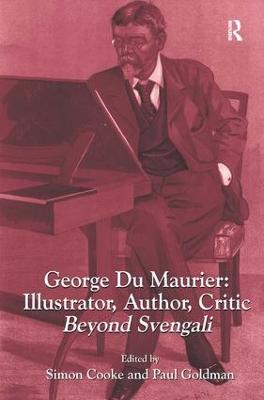
George Du Maurier: Illustrator, Author, Critic: Beyond Svengali [Kõva köide]

  • Formaat: Hardback, 290 pages, kõrgus x laius: 234x156 mm, kaal: 680 g
  • Ilmumisaeg: 11-Jan-2016
  • Kirjastus: Routledge
  • ISBN-10: 1472431596
  • ISBN-13: 9781472431592
  • Kõva köide
  • Hind: 169,31 €*
  • * hind on lõplik, st. muud allahindlused enam ei rakendu
  • Tavahind: 225,75 €
  • Säästad 25%
  • Raamatu kohalejõudmiseks kirjastusest kulub orienteeruvalt 3-4 nädalat
  • Kogus:
  • Lisa ostukorvi
  • Tasuta tarne
  • Tellimisaeg 2-4 nädalat
  • Lisa soovinimekirja
  • Formaat: Hardback, 290 pages, kõrgus x laius: 234x156 mm, kaal: 680 g
  • Ilmumisaeg: 11-Jan-2016
  • Kirjastus: Routledge
  • ISBN-10: 1472431596
  • ISBN-13: 9781472431592
Though well-known as the author of Trilby and the creator of Svengali, the writer-artist George Du Maurier had many other accomplishments that are less familiar to modern audiences. This collection traces Du Maurier’s role as a participant in the wider cultural life of his time, restoring him to his proper status as a major Victorian figure. Divided into sections, the volume considers Du Maurier as an artist, illustrator and novelist who helped to form some of the key ideas of his time. The contributors place his life and work in the context of his treatment of Judaism and Jewishness; his fascination with urbanization, Victorian science, technology and clairvoyance; his friendships and influences; and his impact on notions of consumerism and taste. As an illustrator, Du Maurier collaborated with Thomas Hardy, Elizabeth Gaskell and sensational writers such as M. E. Braddon and the author of The Notting Hill Mystery. These partnerships, along with his reflections on the art of illustration, are considered in detail. Impossible to categorize, Du Maurier was an Anglo-Frenchman with cultural linkages in France, England, and America; a social commentator with an interest in The New Woman; a Punch humourist; and a friend of Henry James, with whom he shared a particular interest in the writing of domesticity and domestic settings. Closing with a consideration of Du Maurier’s after-life, notably the treatment of his work in film, this collection highlights his diverse achievements and makes a case for his enduring significance.

Arvustused

'This is the first comprehensive critical assessment of George Du Mauriers multi-faceted career as illustrator, novelist, and producer of composite image/texts. Editors Simon Cooke and Paul Goldman have brought together an impressive group of specialists in art history, literature, and periodical studies to analyze Du Mauriers work in the context of the first mass media age. Persuasively situating Du Maurier as a major figure with a large and complex oeuvre, the essays examine what he contributed to nineteenth-century print culture in various genres of art and literature, including the interdisciplinary field of illustration studies. Mapping the continuities and disruptions in Du Mauriers visual and verbal art, this important book also points suggestively to new areas for scholars and students to pursue. Future work on Du Maurier will be built on the collections foundation of archival research, critical analyses, and interdisciplinary methodologies'. Lorraine Janzen Kooistra, Ryerson University, Canada

List of Figures
ix
Notes on Contributors xv
Acknowledgements xix
Introduction 1(16)
Simon Cooke
Paul Goldman
PART I DU MAURIER AS AN ARTIST AND ILLUSTRATOR
1 George Du Maurier as a Draughtsman and Illustrator
17(16)
Paul Goldman
2 `Splendacious' Effects: George Du Maurier and Early Sensation Fiction
33(18)
Mary Elizabeth Leighton
Lisa Surridge
3 Illustrating the Everyday: Illustration and Text in Gaskell's `Wives and Daughters'
51(16)
Alan Shelston
4 George Du Maurier's Illustrations for Thomas Hardy's `The Hand of Ethelberta' and `A Laodicean'
67(16)
Philip V. Allingham
5 `The Fountain of One's Own Originality': Du Maurier's Theories of Illustration and How he Applied Them to His Work
83(20)
Simon Cooke
PART II DU MAURIER AS A NOVELIST
6 Peter Ibbetson and Du Maurier's `French Voice'
103(12)
Anne Hall
7 Du Maurier's Paris: Peter Ibbetson, Haussmann and Industrial Memory
115(12)
Susan Zieger
8 Without Memory or Desire: the Model's Progress in Trilby
127(12)
Jane Desmarais
9 Mesmeric Celebrity, Art, and Authorship in Trilby
139(12)
Hilary Grimes
10 Indestructible Germs and Perishable Specks: The Golden Bridge between Science and Faith in The Martian
151(14)
Genie Babb
PART III IMAGE, TEXT, COMMENTARY
11 A Novel Reflection: George Du Maurier as a Social Commentator
165(16)
David Wootton
12 `My Pretty Woman': The Presentation of Women in George Du Maurier's Cartoons and Novels
181(16)
Leonee Ormond
13 Trilby's `Kitchen': the Displaced Domestic Spaces of George Du Maurier and Henry James
197(12)
Sara Thornton
14 Du Maurier and the `Oriental Israelite Hebrew Jew[ s]'
209(22)
Sarah Gracombe
PART IV CHANGING PERSPECTIVES: DU MAURIER'S `AFTER-LIFE'
15 Softening Svengali: Film Transformations of Trilby and Cultural Change
231(12)
Louise McDonald
Appendix: Books and Periodicals Illustrated or Co-illustrated by Du Maurier 243(4)
Works Cited 247(16)
Index 263
Simon Cooke, formerly of the Universities of Birmingham and Coventry, UK, is Assistant Editor for Book Illustration and Design at The Victorian Web. Paul Goldman is Honorary Professor in the Department of English, Communication, and Philosophy at Cardiff University, UK.