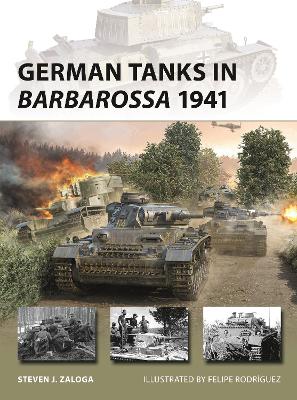
A detailed, illustrated study of Germany's Panzer forces that invaded the Soviet Union, explaining how and why they performed as they did. A detailed, illustrated study of Germany's Panzer forces that invaded the Soviet Union, explaining how and why they performed as they did.
Operation Barbarossa, Nazi Germany's huge and fateful invasion of the Soviet Union, was the culmination of nearly two years of European conquests. By the time of Barbarossa, Germany's Panzer forces had honed their Blitzkrieg methods of fast-moving warfare, but fighting across the wide expanses of eastern Europe would present them with their greatest challenge yet. While the Germans overran the Red Army at the start of the campaign, Barbarossa would end in failure.
Written by one of the world's experts on armoured warfare, and presenting newly uncovered data on the forces involved, this book explains the doctrine, organization, and technical capabilities of the Panzer forces, with a short overview on the armour of other Axis forces including Hungary, Romania, Slovakia, Finland, and Italy.
The speed and shock value of the Panzer divisions was essential for the Wehrmacht to prevail over the Red Army in a brief campaign of annihilation. Packed with archive photos and superb original tank illustrations, this book explains how problems with the Panzers were a significant reason for the eventual failure of Barbarossa.
Arvustused
Of particular interest to wargamers will be the eight tables of strengths and losses, by type, formation, and month, even distinguishing between 37-mm and 50-mm armed Pz IIIs * Miniature Wargames * I especially like the way the author presents tables of types of tanks used, tank strength from June to December 1941 and records of rank losses by each division. * Army Rumour Service * German Tanks in Barbarossa 1941 provides a concise yet informative examination of German armoured forces during a critical phase of the Second World War. * Maverick Scale Models *
Muu info
A detailed, illustrated study of Germany's Panzer forces that invaded the Soviet Union, explaining how and why they performed as they did.
CONTENTS
INTRODUCTION
DOCTRINE AND ORGANIZATION
TANKS OF GERMANYS ALLIES
-Romania
-Hungary
-Slovakia
-Italy
-Finland
TECHNICAL FACTORS
-PzKpfw IV during Operation Barbarossa
-PzKpfw III
-PzKpfw IV
-PzKpfw 38(t)
-PzKpfw II
-PzKpfw I
-Panzerjäger
THE CAMPAIGN
-Barbarossa unleashed
-Blitzkrieg bogs down
-On to Kiev
-Operation Taifun
BATTLE ANALYSIS
FURTHER READING
INDEX
Steven J. Zaloga received his BA in History from Union College and his MA from Columbia University. He has worked as an analyst in the aerospace industry for four decades, covering missile systems and the international arms trade, and has served with the Institute for Defense Analyses, a federal think tank. He is the author of numerous books on military technology and history. He lives in Maryland, USA. Felipe Rodrķguez is a renowned digital illustrator specializing in tank reconstructions.