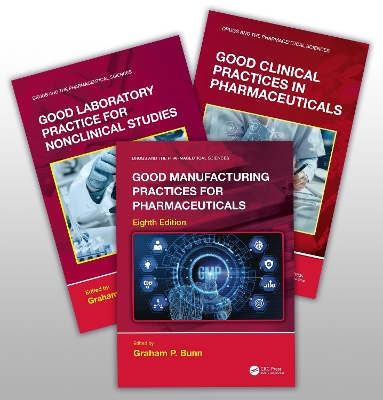
This Bundle brings together three books on GLP regulations: Good Laboratory Practice for Nonclinical Studies, Good Clinical Practices in Pharmaceuticals, and the new Eighth Edition of Good Manufacturing Practices for Pharmaceuticals. It is a valuable resource for those learning about good laboratory, clinical, and manufacturing practices.
This Bundle brings together three books on GLP regulations: Good Laboratory Practice for Nonclinical Studies, Good Clinical Practices in Pharmaceuticals, and the new Eighth Edition of Good Manufacturing Practices for Pharmaceuticals. It is a valuable resource for those learning about good laboratory, clinical, and manufacturing practices.
Good Laboratory Practice for Nonclinical Studies
The GLP regulations have been enacted since 1978 and are currently under a proposed FDA amendment to revise terminology and accommodate other changes relating to advances in technology related to the industry. This book provides a unique opportunity to access interpretation of the 21CFR58 regulatory requirements from leading industry experts with a vast knowledge and expertise in their fields. The approach used takes the regulations, provides interpretations and references to examples and regulatory actions. Data integrity and the use of electronic systems in compliance with 21CFR11 Electronic Records: Electronic Signatures are also discussed.
Key Features:
- Unique volume covering FDA inspections of GLP facilities
- Provides a detailed interpretation of GLP Regulations
- Presents the latest on electronic data management in GLP
- Describes GLP and computer systems validation
- Can be referenced repeatedly in supporting daily hands on implementation of the CFR requirements
Good Clinical Practices in Pharmaceuticals
Good clinical practice (GCP) is a set of internationally recognized ethical and scientific quality requirements that must be followed when designing, conducting, recording, and reporting trials that involve the participation of human subjects. Compliance with GCP assures patients and the public that the rights, safety, and wellbeing of people taking part in studies are protected and that research data is reliable.Presents details on GCP, the international ethical, scientific, and practical standard to which all clinical research is conducted.
Key Features:
- Provides the most up-to-date and best practices, techniques, and methodologies in good clinical practice.
- Discusses applicable laws and regulations supporting GCP compliance, quality and operations.
- Describes who is responsible for implementing and maintaining quality assurance and quality control systems to ensure that studies are conducted and data are generated, documented, and reported in compliance with the protocol.
Good Manufacturing Practices for Pharmaceuticals, Eighth Edition
This book provides insight into the world of pharmaceutical quality systems and the key elements that must be in place to change the business and organizational dynamics from task-oriented procedure-based cultures to truly integrated quality business systems that are self-detecting and correcting. Chapter flow has been changed to adopt a quality systems organization approach, and supporting chapters have been updated based on current hot topics including the impact of the worldwide supply chain complexity and current regulatory trends.
Key Features:
- Presents insight into the world of pharmaceutical quality systems.
- Analyzes regulatory trends and expectations.
- Includes approaches and practices used in the industry to comply with regulatory requirements.
- Discusses recent worldwide supply chain issues.
- Delivers valuable information to a worldwide audience regarding the current GMP practices in the industry.
Good Laboratory Practice for Nonclinical Studies. Introduction.
1.
Subpart A - General Provisions. i) Sec. 58.1 Scope. ii) Sec. 58.3
Definitions. iii) Sec. 58.10 Applicability to studies performed under grants
and contracts. iv) Sec. 58.15 Inspection of a testing facility.
2. Subpart B
- Organization and Personnel. i) Sec. 58.29 Personnel. ii) Sec. 58.31 Testing
facility management. iii) Sec. 58.33 Study director. iv) Sec. 58.35 Quality
assurance unit.
3. Subpart C Facilities. i) Sec. 58.41 General. ii) Sec.
58.43 Animal care facilities. iii) Sec. 58.45 Animal supply facilities. iv)
Sec. 58.47 Facilities for handling test and control articles. v) Sec. 58.49
Laboratory operation areas. vi) Sec. 58.51 Specimen and data storage
facilities.
4. Subpart D Equipment. i) Sec. 58.61 Equipment design. ii)
Sec. 58.63 Maintenance and calibration of equipment.
5. Subpart E - Testing
Facilities Operation. i) Sec. 58.81 Standard operating procedures. ii) Sec.
58.83 Reagents and solutions. iii) Sec. 58.90 Animal care.
6. Subpart F -
Test and Control Articles. i) Sec. 58.107 Test and control article handling.
ii) Sec. 58.113 Mixtures of articles with carriers.
7. Subpart G - Protocol
for and Conduct of a Nonclinical Laboratory Study. i) Sec. 58.120 Protocol.
ii) Sec. 58.130 Conduct of a nonclinical laboratory study.
8. Subpart J -
Records and Reports. i) Sec. 58.185 Reporting of nonclinical laboratory study
results. ii) Sec. 58.190 Storage and retrieval of records and data.
9.
Subpart K - Disqualification of Testing Facilities i) Sec. 58.200 Purpose.
ii) Sec. 58.202 Grounds for disqualification. iii) Sec. 58.204 Notice of and
opportunity for hearing on proposed disqualification. iv) Sec. 58.210 Actions
upon disqualification. v) Sec. 58.213 Public disclosure of information
regarding disqualification. vi) Sec. 58.217 Suspension or termination of a
testing facility by a sponsor. vii) Sec. 58.219 Reinstatement of a
disqualified testing facility.
10. Data Integrity: Paper and Electronic
21CFR11.
Good Clinical Practices in Pharmaceuticals. Preface. About the Editor. List
of Contributors. Introduction. 1 Regulatory Application Requirements. 2 An
overview of Good Clinical Practices. 3 Quality by Design, Critical to Quality
Factors - ICH E8 (R1). 4 Good Clinical Practice ICH E6 (R2 and R3). 5
Clinical Safety Data Management ICH E2A. 6 21 CFR 50 Informed Consent. 7 21
CFR 54 Financial Disclosure. 8 21 CFR 56 Institutional Review Boards. 9
Protected Health Information and Privacy in Clinical Trials (HIPAA). 10 Good
Pharmacovigilance Practices (GVP). 11 Data Integrity and 21CFR11 for GCPs. 12
Preparing for FDA inspections at sponsor/investigator sites. 13 Regulations
relating to the Placebo response in Clinical research.
Good Manufacturing Practices for Pharmaceuticals, Eighth Edition. Preface.
Contributors. About The Editor.
Chapter 1: Status and Applicability of U.S.
Regulations: CGMP.
Chapter 2: Quality Management Systems and Risk Management.
Chapter 3: Management Responsibility and Control.
Chapter 4: Organization and
Personnel.
Chapter 5: Finished Pharmaceuticals: General Provisions.
Chapter
6: Production and Process Controls.
Chapter 7: Records and Reports.
Chapter
8: Clinical Trial Supplies.
Chapter 9: Contracting and Outsourcing.
Chapter
10: Buildings and Facilities.
Chapter 11: Equipment.
Chapter 12: Control of
Components and Drug Product Containers and Closures.
Chapter 13: Holding and
Distribution.
Chapter 14: Returned and Salvaged Drug Products.
Chapter 15:
Active Pharmaceutical Ingredients.
Chapter 16: Pharmaceutical Excipient Good
Manufacturing Practices.
Chapter 17: Packaging and Labeling Control.
Chapter
18: Laboratory Controls.
Chapter 19: FDA Inspections of 503A Compounding
Pharmacies and 503B Outsourcing Facilities.
Chapter 20: CGMP Enforcement
Alternatives in the United States.
Chapter 21: FDA Inspection Process.
Chapter 22: FDA Pre-approval Inspections.
Chapter 23: Best Practices for the
Pharmaceutical Industry: FDA Guidance on Refusing an Inspection.
Chapter 24:
The Qualified Person in the Pharmaceutical Industry.
Chapter 25: Data
Integrity and Fundamental Responsibilities. Index
Graham P. Bunn has been the president of GB Consulting LLC, in Pennsylvania, since 2000 and provides regulatory compliance guidance and technical consulting services for pharmaceutical, biotechnology and other FDA related industries in quality systems, regulatory action (FDA483, Warning Letter, Consent Decree) remediations and training. Before founding GB Consulting LLC, Graham gained extensive good manufacturing practices (GMP) and FDA inspection experience through his work in the pharmaceutical industry with SmithKline Beecham PLC (GlaxoSmithKline PLC), Wyeth Pharmaceuticals (Pfizer), and Astra Merck Inc. (AstraZeneca PLC). His career experience includes management positions and responsibilities as a corporate compliance quality auditor and also in quality assurance, validation, and clinical trials manufacturing and packaging. He has developed and facilitated numerous highly interactive learning and training workshops worldwide including Aseptic Training Programs, Batch Record Reviews, QA on the Floor and aseptic training support for 503B Compounding Centers. Graham is the editor of Good Manufacturing Practices for Pharmaceuticals and author of several book chapters and journal articles. Graham received a BSc in pharmacy from Brighton University, England, and a MSc in quality assurance and regulatory affairs from Temple University, Philadelphia and is a member of the Regulatory Affairs Professional Society (RAPS).