Muutke küpsiste eelistusi

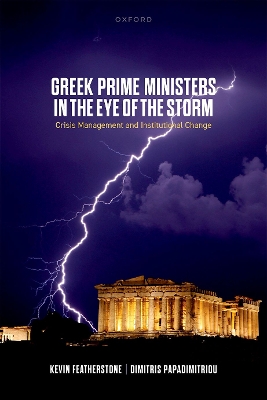
Greek Prime Ministers in the Eye of the Storm: Crisis Management and Institutional Change [Kõva köide]

(Professor of Political Science, University of Manchester), (Emeritus Professor, London School of Economics and Political Science)
  • Formaat: Hardback, 272 pages, kõrgus x laius x paksus: 240x164x24 mm, kaal: 554 g
  • Ilmumisaeg: 24-Jul-2025
  • Kirjastus: Oxford University Press
  • ISBN-10: 0198878613
  • ISBN-13: 9780198878612
  • Kõva köide
  • Hind: 93,12 €*
  • * hind on lõplik, st. muud allahindlused enam ei rakendu
  • Tavahind: 116,40 €
  • Säästad 20%
  • Raamatu kohalejõudmiseks kirjastusest kulub orienteeruvalt 3-4 nädalat
  • Kogus:
  • Lisa ostukorvi
  • Tasuta tarne
  • Tellimisaeg 2-4 nädalat
  • Lisa soovinimekirja
  • Formaat: Hardback, 272 pages, kõrgus x laius x paksus: 240x164x24 mm, kaal: 554 g
  • Ilmumisaeg: 24-Jul-2025
  • Kirjastus: Oxford University Press
  • ISBN-10: 0198878613
  • ISBN-13: 9780198878612
When, and how, might crises force institutions to change? Crisis management prompts expectations of exceptional behaviour, leaders raising their 'game', and of being empowered. The Greek crisis of 2009-18 was severe: threatening bankruptcy and Greece's exit from the euro. Yet, in a previous study of 2015, Featherstone and Papadimitriou identified key institutional weaknesses embedded within Greek governments: of poor central control and coordination, the very qualities needed in a crisis. So, how far did the crisis in Greece enable actors to overcome these critical weaknesses? What lessons were drawn, and when?

Exploring change in a crisis requires careful case study. Drawing on interviews with an extensive range of personnel, including each crisis Greek prime minister, the authors meticulously explore how the four prime ministers of the period handled the challenges of crisis management. In doing so, they apply an original analytical frame.

They then place the Greek case in a wider, comparative perspective, contributing to studies of crisis leadership, crisis management, core executives, and the utility of external loan conditionality. There are implications for the capacity to reform in particular domestic settings and the ability of external actors like the European Union to leverage such reform. In a heterogeneous Europe, these are issues of likely continuing importance.

In this volume, the authors consider how the Greek crisis of 2009-18 impacted on the 'core executive' of the government, how it empowered prime ministers, and centralized decision-making. This Greek case is then placed in a wider, analytical framework on crisis management.
List of Figures List of Tables List of Abbreviations Introduction 1:
Setting the Scene: The International and Domestic Politics of the Greek
Crisis 2: Prime Ministers, Crisis Management, and the Core Executive in
Greece 3: George Papandreou: Crossing the Rubicon 4: Lucas Papademos: The
Limits of Technocracy 5: Antonis Samaras: Janus-faced Crisis Management 6:
Alexis Tsipras: Reconciling the Irreconcilable 7: Crisis Management in
Athens: Comparing Our Cases 8: Lessons from Greece: The Wider Implications
Glossary of Terms List of Interviews Bibliography Index
Kevin Featherstone is Emeritus Professor in the European Institute and Professorial Research Fellow, Hellenic Observatory, at the London School of Economics and Political Science. He has held positions at the University of Stirling and the University of Bradford. He has been visiting professor at the University of Minnesota, New York University, Harvard, and the European University Institute. In 2021 he was made 'Grand Commander, Order of the Phoenix' of the Hellenic Republic, and in 2022 he became an honorary Greek citizen. He writes regularly in the international and Greek media.

Dimitris Papadimitriou is Professor of Political Science at the University of Manchester. He is the author/editor of seven books and numerous articles on modern Greece, European political economy, and the European Union's external relations. He was the Director of the Manchester Jean Monnet Centre of Excellence (2011-2022) and he is currently serving as Vice Dean in the Faculty of Humanities, University of Manchester. He has previously held visiting posts at the London School of Economics, Princeton University, and Yale University.