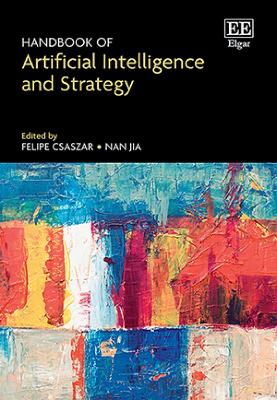
This pioneering Handbook explores how AI is transforming strategic management across theory, practice, and education. Bridging strategy, technology, ethics, and policy, it demonstrates the broad societal and business implications of this emerging technological advancement.
This pioneering
Handbook explores how AI is transforming strategic management across theory, practice, and education. Bridging strategy, technology, ethics, and policy, it demonstrates the broad societal and business implications of this emerging technological advancement.
Organized around four themes - theories, tools, teaching, and terrains - it collates diverse perspectives from leading scholars to examine AI’s multifaceted impact on strategy. It outlines contemporary shifts in fundamental strategic concepts, including capabilities and competition, to provide practical frameworks for implementing AI in decision-making and innovation. Chapters address the pedagogical challenges of cultivating future strategists, alongside broader issues of ecosystem and governance. Presenting concise summaries that translate research into actionable guidance, this Handbook challenges key assumptions and fosters open dialogue on AI’s evolving role in strategy.
With contributions ranging from theoretical extensions to empirical insights and teaching innovations, this is a necessary resource for scholars, students, and educators of business, management, innovation, and technology. It is also beneficial for practitioners looking to navigate the complexities of AI-driven strategic transformation in an era of rapid technological change.
Arvustused
A timely and insightful volume that captures strategy scholarship at a turning point. Csaszar and Jia have assembled leading thinkers who illuminate how AI reframes the foundations of strategy. This Handbook is an essential guide for scholars and executives navigating the emerging AI world. -- Rahul Kapoor, University of Pennsylvania, USA A timely, thoughtful, and thought-provoking compilation, this volume offers valuable insights for anyone wrestling with the implications of AI for the study and practice of strategy. -- Ron Adner, Dartmouth College, USA
Contents
1 Editors introduction: artificial intelligence and strategy: charting new
frontiers 1
Felipe A. Csaszar and Nan Jia
PART I THEORIES
2 Strategic upskilling of knowledge workers in the Generative AI era 15
Maryam Alavi
3 Will artificial intelligence democratize corporate political
activities?:
amplifying the role of know who in the age of enhanced know what 28
Nan Jia, Maria D. Perez, Jinyuan Song, Yifan Wei, and Bo Yang
4 Artificial intelligence as a platform technology: strategic implications
of
competing on top of an AI platform 55
Kevin J. Boudreau, Lars Bo Jeppesen, and Milan Miric
5 Algorithmic ambidexterity: rethinking exploration and exploitation in the
age of AI 71
Shuang Liu
6 GenAI and the future of creativity in science and art 91
Sandra Barbosu and Pooyan Khashabi
7 We rise to resist: the crisis of relevance and the movement against
generative AI in creative industries 108
Saheli Nath
PART II TOOLS
8 Toward a humanAI task tensor: a taxonomy for organizing work in the
age of generative AI 124
Anil R. Doshi and Alastair P. Moore
9 Generative artificial intelligence for advancing knowledge-based
technological innovation and strategy: the Fruit Tree model 143
Jiaming Ding and Kenneth G. Huang
10 Strategic decisions and AI: the inferential trilemma 167
Lu Hong, Anusha Kallapur, and Scott E. Page
11 AI-augmented strategic tools for strategy formulation and implementation:
revisiting traditional strategy tools and frameworks 188
David Gurzick, Maheshkumar P. Joshi, and Martha Gurzick
PART III TEACHING
12 Business schools as learning organizations in the age of AI 218
Peter Cardon and Ramandeep S. Randhawa
13 Toward an AI-infused MBA: a Head, Heart, and Hands perspective 227
Alfredo Enrione
14 Why and how to teach foundational AI ideas to business school students
253
Tom Steinberger
15 Space for AI-supported learning: expanding and endangered 276
Henning Piezunka
16 Teaching AIs role in strategic decision-making within strategic factor
markets using a word game 290
Ipek Koparan and Gorkem Aksaray
PART IV TERRAINS
17 The business of AI-producing startups: evidence from a worldwide survey
317
James Bessen, Stephen Michael Impink, and Robert Seamans
18 Beyond English-centric AI: strategic frameworks for developing low-
resource language models 344
Prithwiraj Choudhury, Do Yoon Kim, and Sana Kang
19 Governance of artificial intelligence: public policy and self-regulatory
frameworks for consequential decision-making 378
Gwendolyn Kuo-fang Lee
20 AI and ethical concerns in managing decision-making processes: a case
study of Leonardo S.p.A. 388
Ksenija Milosevic, Saverio Barabuffi, and Giulio Ferrigno
Edited by Felipe A. Csaszar, Alexander M. Nick Professor of Strategy and Area Chair of Strategy, Ross School of Business, University of Michigan and Nan Jia, Professor of Strategic Management, Department of Management and Organization, USC Marshall School of Business, University of Southern California, USA.