Muutke küpsiste eelistusi

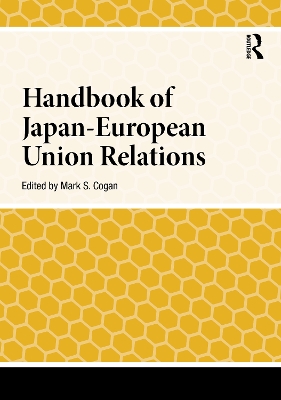
Handbook of Japan-European Union Relations [Kõva köide]

Edited by
  • Formaat: Hardback, 258 pages, kõrgus x laius: 246x174 mm, 3 Tables, black and white; 6 Line drawings, black and white; 1 Halftones, black and white; 7 Illustrations, black and white
  • Sari: Handbooks on Japanese Studies
  • Ilmumisaeg: 22-Jun-2026
  • Kirjastus: Routledge
  • ISBN-10: 1041278837
  • ISBN-13: 9781041278832
Teised raamatud teemal:
  • Kõva köide
  • Hind: 250,31 €*
  • * hind on lõplik, st. muud allahindlused enam ei rakendu
  • Tavahind: 333,75 €
  • Säästad 25%
  • See raamat ei ole veel ilmunud. Raamatu kohalejõudmiseks kulub orienteeruvalt 3-4 nädalat peale raamatu väljaandmist.
  • Kogus:
  • Lisa ostukorvi
  • Tasuta tarne
  • Tellimisaeg 2-4 nädalat
  • Lisa soovinimekirja
  • Formaat: Hardback, 258 pages, kõrgus x laius: 246x174 mm, 3 Tables, black and white; 6 Line drawings, black and white; 1 Halftones, black and white; 7 Illustrations, black and white
  • Sari: Handbooks on Japanese Studies
  • Ilmumisaeg: 22-Jun-2026
  • Kirjastus: Routledge
  • ISBN-10: 1041278837
  • ISBN-13: 9781041278832
Teised raamatud teemal:

This Handbook explores the relationship between Japan and the European Union (EU).

The book begins by outlining the political, cultural and historical context for the relationship, from the first encounter by Portuguese traders in the mid-16th century to the post-Cold War era highlighting how intellectual and cultural curiosity led to a genuine, mutual appreciation among Japanese and European societies. The contributions also explore the expansive areas of macroeconomics and trade relations between Japan and the EU, including larger developments such as the Japan-EU Economic Partnership Agreement (EPA) underscoring the significance of the Japanese-European trade relationship. In order to approach the broad topic of international relations between Japan and the EU, explorations of defence and foreign policy, as well as non-defence and security related joint cooperation, such as climate change adaptation and mitigation, are featured.

Examining the multi-faceted ways in which Europe and Japan have aligned on strategic interests resulting in dramatic changes to economic, environmental, energy, and foreign policy, this Handbook will be a valuable resource for students seeking an entry point into Japan-EU relations, as well as graduate students and scholars seeking a more intricate analysis of economics, trade, foreign policy, defence, environmental policy and areas of joint cooperation.


This Handbook explores the relationship between Japan and the European Union (EU).

Introduction Part 1: The Historical Context
1. The Ups and Downs of the
Japanese-European Relationship
2. Japan and Europe: A History of Mutual
Cultural Fascination Part 2: Economics and Trade Relations
3. Trade Relations
Between Japan and the European Union: From Coercive to Cooperative
Competition
4. Japan and International Trade
5. Similarities and Contrasts of
Japanese and European Firms in the Global Economy Part 3: International
Relations and Foreign Policy
6. Making the Case for an EU-India-Japan
Trilateral
7. Eu, Japan and ASEAN: An Axis of Convenience in the
Indo-Pacific?
8. Japan-EU Defense Cooperation in the Context of the
Indo-Pacific
9. The EU-Japan Strategic Partnership Agreement (SPA): Good but
far from Good Enough Part 4: Joint Cooperation
10. The EU-Japan Green
Alliance: Accelerating Environmental Cooperation Between Stable Democracies
11. Geopolitics of the EU-Japan Green Alliance: Between Countering Climate
Change and China
12. Climate and Energy Policy in the European Union and
Japan
13. Official Development Aid: Collaboration and Competition
14.
Challenges and Opportunities for Japan-EU Higher Education (HEI) Cooperation
Mark S. Cogan is an Associate Professor of Peace and Conflict Studies in the College of Foreign Studies at Kansai Gaidai University in Osaka, Japan and a Associated Senior Research Fellow at the Institute for Security and Development Policy (ISDP).