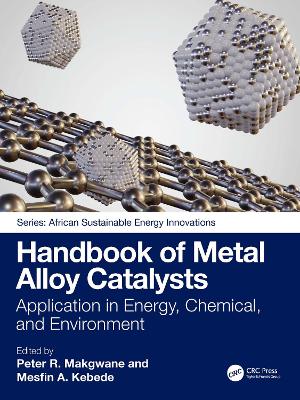
The Handbook of Metal Alloy Catalysts offers a thorough and up-to-date exploration of advancements in both traditional metal alloys and innovative high-entropy alloy catalytic materials. It highlights the tunable properties of these materials—achieved through nanoscale reduction, shape control, compositional adjustments, and interface engineering—that optimize electronic structures, electrical conductivity, optical characteristics, and surface adsorption energies, ultimately enhancing catalytic activity and selectivity. The book delves into key applications, including photocatalysis, electrocatalysis, and heterogeneous catalysis, while emphasizing material design, synthesis methodologies, and the critical interplay between structural features and catalytic performance.
Key Features:
- Introduces metal alloy catalytic materials from fundamental to design principles, synthesis, and structure characterization.
- Covers machine learning in the context of metal alloy catalytic materials design and applications.
- Presents metal alloy catalysts in the production of renewable solar fuels.
- Covers topics in chemical conversions, including fossil and biomass chemical derivatives.
- Includes energy conversion and storage such as batteries, supercapacitors, and solar cells.
- Discusses environmental remediation of organic, inorganic, and gaseous pollutants.
This book targets postgraduate students, academics, and industry professionals in advanced metal alloy composite catalysts, promoting sustainable technologies in crucial areas such as energy, chemical conversion, and environmental remediation.
The book offers a thorough and up-to-date exploration of advancements in both traditional metal alloys and innovative high-entropy alloy catalytic materials. It is useful for postgraduate students, academics, and industry professionals in advanced metal alloy composite catalysts.
Chapter
1. Introduction to Metal Alloys Catalysts and Their Interface
Phenomena Structure Properties.
Chapter 2 . Design and Synthesis Strategies
of Metal Alloy-Based Catalysts Control of Structure Interfaces.
Chapter
3.
Machine Learning in Metal Alloy Catalysts Design with Controlled Structure
Interfaces.
Chapter
4. Advances in Techniques for Characterizing Metal
Alloy-Based Catalysts.
Chapter
5. Metal Alloy Photocatalytic Water Splitting
for Hydrogen Generation.
Chapter
6. Metal Alloy-based Electrocatalysts for
Hydrogen Production.
Chapter
7. Metal Alloy Catalysts in Catalytic
Decomposition and Reforming of Methane.
Chapter
8. Metal Alloy Catalysts
Based Counter Electrodes for Dye-Sensitized Solar Cells.
Chapter
9. Plasmonic
Alloy Catalysts for Solar Fuels and Chemical Conversion.
Chapter
10. Metal
Alloy-based Electrodes for Supercapacitors Energy Storage.
Chapter
11. Metal
Alloy Cathode Materials for Battery Energy Storage.
Chapter
12. Metal Alloys
Anode Materials for Batteries Energy Storage.
Chapter
13. Metal Alloys-Based
Electrocatalysts in Fuel Cells Applications.
Chapter
14. Metal Alloy
Catalysts in Green Organic Coupling Synthesis Reactions Protocols.
Chapter
15. Metal Alloy Catalysts in Selective Oxidation Reactions.
Chapter
16. Metal
Alloy Catalysts in Valorisation of Biomass Lignin to Chemicals.
Chapter
17.
Metal Alloy Catalysts in Selective Conversion of Glycerol to Value-Added
Chemicals.
Chapter
18. Metal Alloy Electrocatalysts for Reduction of CO2 to
Chemicals.
Chapter
19. Metal Alloy Photocatalysts for Conversion of CO2 to
Chemicals.
Chapter
20. Metal Alloy Catalysts for Thermo-Catalytic
Hydrogenation of CO2 to Fuels and Chemicals.
Chapter
21. Metal Alloy
Electrocatalysts for Organic Chemical Transformations.
Chapter
22. Single
Atom Alloy Catalysts for Environmental Remediation.
Chapter
23. Metal Alloy
Photocatalysts for Detoxification of Organic Wastewater Pollutants.
Chapter
24. Metal Alloy Catalysts for Sensing and Detection of Environmental
Pollutants
Peter Ramashadi Makgwane is currently a Full Professor at the University of South Africa (UNISA) Institute of Catalysis and Energy Solutions (ICES). He previously worked as a Principal Scientist (2011-2023) at the Council for Scientific and Industrial Research (CSIR, South Africa), focusing on catalysis and advanced energy materials. He is a highly published scholar, contributing numerous articles and book chapters on heterogeneous catalysis, photocatalysis, and electrocatalysis, particularly focusing on renewable chemicals, energy, and environmental remediation.
Mesfin Abayneh Kebede is currently a full Professor at the University of South Africa (UNISA) Institute for Nanotechnology and Water Sustainability (iNanoWS). He obtained his Ph.D. in Materials Science and Engineering in 2009 from Inha University, South Korea. His research activities mainly focus on the development and characterization of nanostructured catalysts and electrode materials for energy storage, energy generation, and water treatment applications.