Muutke küpsiste eelistusi

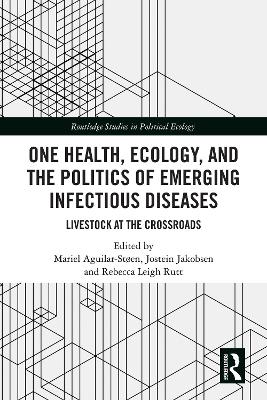
One Health, Ecology, and the Politics of Emerging Infectious Diseases: Livestock at the Crossroads [Kõva köide]

Edited by , Edited by (University of Oslo, Norway), Edited by
  • Formaat: Hardback, 240 pages, kõrgus x laius: 234x156 mm, kaal: 630 g, 3 Tables, black and white; 5 Line drawings, black and white; 6 Halftones, black and white; 11 Illustrations, black and white
  • Sari: Routledge Studies in Political Ecology
  • Ilmumisaeg: 09-Apr-2026
  • Kirjastus: Routledge
  • ISBN-10: 1032904674
  • ISBN-13: 9781032904672
  • Kõva köide
  • Hind: 174,04 €*
  • * hind on lõplik, st. muud allahindlused enam ei rakendu
  • Tavahind: 212,25 €
  • Säästad 18%
  • Raamatu kohalejõudmiseks kirjastusest kulub orienteeruvalt 3-4 nädalat
  • Kogus:
  • Lisa ostukorvi
  • Tasuta tarne
  • Tellimisaeg 2-4 nädalat
  • Lisa soovinimekirja
  • Formaat: Hardback, 240 pages, kõrgus x laius: 234x156 mm, kaal: 630 g, 3 Tables, black and white; 5 Line drawings, black and white; 6 Halftones, black and white; 11 Illustrations, black and white
  • Sari: Routledge Studies in Political Ecology
  • Ilmumisaeg: 09-Apr-2026
  • Kirjastus: Routledge
  • ISBN-10: 1032904674
  • ISBN-13: 9781032904672

This book explores the critical intersection of contemporary livestock production and some of today’s most urgent challenges: the spread of emerging infectious diseases, the sustainability of food systems, and the contested promises of One Health.


This book explores the critical intersection of contemporary livestock production and some of today’s most urgent challenges: the spread of emerging infectious diseases, the sustainability of food systems, and the contested promises of One Health.

It provides insights that cut across disciplines and geographies, from both the social and the natural sciences, reflecting the interdisciplinary aspirations of One Health. Yet, in foregrounding especially cutting edge contributions from ecology and the social sciences, this book addresses the persistent knowledge gap from these fields, which have frequently been neglected in favor of the veterinary sciences. By including contributions from across these fields, the book broadens and critically deepen the conversation around One Health.

The book is intended for a wide interdisciplinary audience of scholars, students, and practitioners concerned with livestock production, public health, and the future of food systems.

Arvustused

"This groundbreaking and accessible book provides an intensive examination into how the global livestock industry has reconfigured threats to the health of people and the planet. It deftly bridges critical gaps in understanding by integrating diverse disciplinary perspectives on the relationship between meat production, disease emergence, and antimicrobial resistance. It is an essential read for academics, policy makers and advocates involved in transforming food systems to secure healthy futures for all."

A. Haroon Akram-Lodhi, Professor Emeritus of Economics, Global Justice and Development, Trent University, Fellow, Stellenbosch Institute for Advanced Study, Professorial Research Associate, SOAS University of London

From poultry production in the Norwegian countryside to China's mega pig units in Argentina and the social movements emerging in response, this exciting collection brings together new empirical evidence, practical examples and conceptual tools to equip anyone, but especially multi and interdisciplinary university students, to understand urgent contemporary problems of global health, food systems and ecological sustainability, and organize to meet the challenges ahead.

Professor Melissa Leach, Executive Director, Cambridge Conservation Initiative (CCI), Honorary Professor, Department of Social Anthropology, Bye-Fellow, Pembroke College

Introduction
1. Global Capital and Big Livestock
2. Industrial Pig
Production and Health in the South: An Analysis of the Social Resistance to
China's Mega Pig Farms Project in Argentina
3. Logistical Supply Chains as
Capitalist Planning: The Case of the Norwegian Broiler Industry and Avian
Influenza
4. Cheap Meat, Infectious Disease, and the Externalization of
Incalculable Costs and Risks
5. Structural One Health? A Critical Geography
Perspective on Emerging Infectious Diseases and Livestock
6. Framing the
Pandemic Era: Different understandings of pathogenic landscapes in Norway
7.
In Search of Healthy Cattle. A History of Veterinary Advice in Denmark
8.
Care Dependencies in Times of Disease: How Avian Influenza Reshapes Welfare
in Organic Chicken Production
9. Virulence in the Anthropocene: How the
Evolutionary Drivers of Disease are Changed by Human Ecological Impacts
10.
Ecological Drivers for the Global Expansion of Highly Pathogenic Avian
Influenza and African Swine Fever
11. The Rise and Fall on One Health Policy
A Power Analysis
12. Governing Poultry and Pork Production Amid Emerging
Infectious Diseases: Lessons from Plant Agriculture and Aquaculture
Mariel Aguilar-Støen is professor of Human Geography at the Centre for Global Sustainability. Her work focuses on agrarian change related to industrial agriculture and extractive industries in Latin America and Scandinavia.

Jostein Jakobsen is a Researcher at the Centre for Global Sustainability, University of Oslo. His research is based in economic geography and agrarian studies, with a longstanding research interest in India. He has published on topics such as the global food regime, authoritarian populism, and agricultural supply chains.

Rebecca Leigh Rutt is an Associate Professor at the Department of Food and Resource Economics, University of Copenhagen. She contributes research and education inspired by feminist political ecology, justice perspectives, and by the pluriversal degrowth global movement.