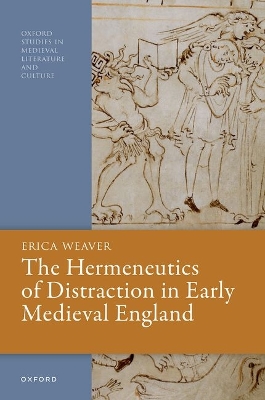
Distraction is now too easily and often considered a metonym for modern consciousness, but it was also a medieval concern, which posed a particular threat to religious life. Distraction opened the door to all other temptations, andmost disturbingly of all for the monastic communities at the heart of this bookit invalidated central devotional acts like reading, praying, and reciting the Psalms. Far from an innocuous sensation, distraction posed a significant spiritual danger. It also generated powerful countervailing responses in literature, pedagogy, and religious observance, profoundly shaping literary interpretation in the process.
The Hermeneutics of Distraction in Early Medieval England writes this cultural and intellectual history. It comes at the topic of distraction through the study of the affective practices of a particular community of writers and readers: the influential circle of Ęthelwold (Bishop of Winchester, 963-984). It also explores the implications of this focused study both for a larger historical context (Western monasticism from the fifth century to the twelfth) and for the history of a unifying concept (the experience of distraction). In doing so, this book reveals that the pervasive threat of distraction precipitated the development of several different tactics for reorienting attention, especially in the tenth-century monastic correction movement traditionally known as the Benedictine Reform, which reshaped monastic life across Europe. From the development of the 'hermeneutic style' to new textual and theatrical modes, these correctional projects make visible an enduring problem, present from the beginnings of monasticism and persisting throughout its long history.
Abbreviations Note on Sources Acknowledgements Prologue: Taking
Hold of Naked Thought Introduction: Histories Of Attention 1: Chanting
Lips and Wandering Minds: From Psalmic Overfamiliarity to Hermeneutic English
2: Living in enigmate: Aldhelm's Enigmata and Hermeneutic Latin 3:
Concentrated Poems: Late Old English and the Poetics of Attention 4: Lessons
in Distraction 5: Welcome (In)attention: Focusing on Absence Coda:
Distracting and Difficult Style Bibliography Index
Erica Weaver is Assistant Professor of English at the University of California, Los Angeles. She has published widely in New Literary History, Representations, Anglo-Saxon England, and elsewhere, and her article on the Old English Boethius was awarded the Paul E. Szarmach Prize. She is also co-editor, with A. Joseph McMullen, of The Legacy of Boethius in Medieval England: The Consolation and its Afterlives and, with Daniel C. Remein, of Dating Beowulf: Studies in Intimacy. She studied English and Medieval and Renaissance Studies at Columbia University, summa cum laude, before completing her PhD in English at Harvard.