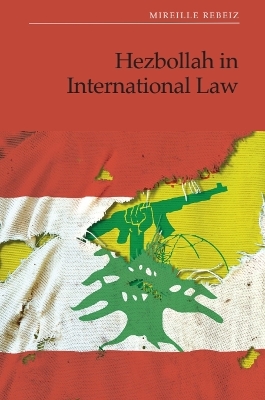
In the context of the 2005 attack that killed Prime Minister Rafic Hariri, the 2006 war with Israel, the 2008 internal armed conflict in Lebanon, the Syrian civil war and the current war in Gaza, this book studies the legal status of Hezbollah as a State or a non-State actor. There are important consequences to this distinction, ones that relate to international law, the qualification of an armed conflict and combatants as well as Lebanon’s responsibilities toward the international community for complicity in the wrongdoings of a State (Iran) and a non-State actor (Hezbollah). After exploring Hezbollah’s history and domestic law, the book argues that Lebanon legalised Hezbollah as an armed group and political party, and while Hezbollah acts at times as the State of Lebanon, it cannot be considered a State and subject of international law as it lacks State elements. As an alternative, Mireille Rebeiz proposes to adopt the theory of quasi-State, where a failed State co-exists with a non-State actor and shares its sovereignty. Following the 7th October attacks and the ongoing conflict with Israel, the question of the legal status of Hezbollah remains valid today.
Examines the legal status of Hezbollah as a State or a non-State actor.
Arvustused
This book [ is a] welcome addition to the literature on Lebanon and Hezbollah. The areas the author explores are under-researched with numerous gaps and superficialities. The authors theoretical and legal insights are especially noteworthy. -- James Breckenridge, Jomini Group This is a timely and critical work! Through an in-depth legal analysis, it reveals Hezbollahs ambiguous status and explores the complexities of its responsibility and that of Lebanon and Iran under international law. It is a unique work that links history, politics, and law, posing bold questions on sovereignty and accountability. -- Hilmi M. Zawati, Centre for International Accountability and Justice In this book, Professor Rebeiz, does a masterful job at retelling the sometimes-tragic history of Lebanon through the eyes of an accomplished Middle East scholar. She poses the question of whether Hezbollah is a state unto itself, a quasi-state or a non-state actor and considers the implications of each. Her careful, methodical exposition of Hezbollahs legal status examines both Lebanese law and international law to yield an important contribution to Middle East scholarship that will inform policymakers and scholars for years to come. -- Dermot Groome, Penn State Dickinson Law
Acknowledgements
Abbreviations
Transliteration
1. General Introduction
Rationale
Research Questions
Theoretical Frame
The Structure of this Study
Methodology & Challenges
Sources
Scope and Limits
Part I. Hezbollah in Domestic Laws
Introduction to Part I
2. The History of Lebanon and the Rise of Hezbollah
A History of the Lebanese Civil War
Hezbollahs Birth
3. Hezbollahs Legal Classification in Domestic Law
The 1909 Law on Associations
The Taif Agreement, the 1991 General Amnesty Law and Hezbollah
Conclusion to Part I
Part II. The Statehood of Hezbollah in International Law
Introduction to Part II
4. What is a State?
Origins of Statehood: The Westphalian Definition
Statehood as an Entity with Personality
State Recognition: Effectiveness versus Recognition Theories
State and Non-State Actor
5. Hezbollah: A State Actor in Times of Peace and War?
Hezbollah and the Lebanese State After 1992
Hezbollah in Armed Conflict
Conclusion to Part II
Part III. Hezbollah: A Non-State Actor
Introduction to Part III
6. General Comments on Non-State Actors
The Growing Role of Non-State Actors
Non-State Actors and the Use of Force
7. What Kind of Non-State Actor is Hezbollah?
Hezbollah: A National Liberation Movement or Insurgents?
Hezbollah: A Terrorist Non-State Actor
8. State and Non-State Actors Responsibility
General Definition of Complicity
Forms of Complicity
State Complicity in the Wrong-Doing of a Non-State Actor
State Complicity in the Wrong-Doing of Another State Actor
Conclusion to Part III
9. General Conclusion
Notes
Works Cited
Index
Mireille Rebeiz is the Chair of Middle East Studies and Associate Professor of Middle East Studies, Francophone Studies & Women's, Gender and Sexuality Studies at Dickinson College (USA). She is also Adjunct Professor of Law at Penn State Dickinson Law. She received her first Doctorate (PhD) in Francophone Studies from Florida State University and her second doctorate (SJD) in International Law from Penn State Dickinson Law. She also holds a Masters Degree in International Law and Human Rights from Université de Rouen in France, and a Bachelors Degree in Law from Saint-Joseph University in Lebanon. Her teaching and research are interdisciplinary and focus on the intersectionality of law, gender, sexuality, oral history, and trauma in the context of armed conflicts with a focus on the Middle East and North Africa. Her research interests include international law, terrorism, State and non-State actors, and memory laws. She has written and successfully published monographs, several peer-reviewed essays, and editorials in national and international presses. Her first book Gendering Civil War. Francophone Womens Writing in Lebanon (EUP, 2022) earned her the AAUW American Fellowship and was nominated for the John Leonard Prize.