Muutke küpsiste eelistusi

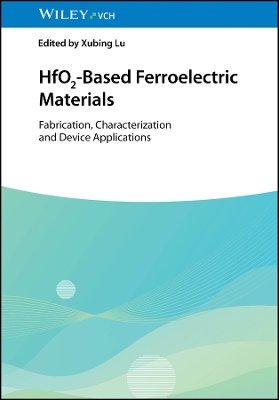
HfO2-Based Ferroelectric Materials: Fabrication, Characterization and Device Applications [Kõva köide]

Edited by (South China Normal University, China)
  • Formaat: Hardback, 480 pages, kõrgus x laius: 244x170 mm
  • Ilmumisaeg: 24-Jun-2026
  • Kirjastus: Blackwell Verlag GmbH
  • ISBN-10: 3527353186
  • ISBN-13: 9783527353187
Teised raamatud teemal:
  • Kõva köide
  • Hind: 138,94 €*
  • * hind on lõplik, st. muud allahindlused enam ei rakendu
  • Tavahind: 185,25 €
  • Säästad 25%
  • See raamat ei ole veel ilmunud. Raamatu kohalejõudmiseks kulub orienteeruvalt 3-4 nädalat peale raamatu väljaandmist.
  • Kogus:
  • Lisa ostukorvi
  • Tasuta tarne
  • Tellimisaeg 2-4 nädalat
  • Lisa soovinimekirja
  • Formaat: Hardback, 480 pages, kõrgus x laius: 244x170 mm
  • Ilmumisaeg: 24-Jun-2026
  • Kirjastus: Blackwell Verlag GmbH
  • ISBN-10: 3527353186
  • ISBN-13: 9783527353187
Teised raamatud teemal:
Explores HfO2-based ferroelectrics for memory, sensing, and advanced electronic applications

Ferroelectric hafnium oxide (HfO2)-based materials have transformed the field of electronic materials and device design, offering pathways to overcome long-standing barriers in scalability, compatibility, and reliability. The emergence of robust ferroelectricity in doped HfO2 has revolutionized both research and industry perspectives, providing a viable solution where conventional ferroelectrics often fell short.

With contributions from leading experts, HfO2-Based Ferroelectric Materials addresses the critical need for a consolidated reference on HfO2-based ferroelectrics, offering foundational knowledge as well as the latest insights into fabrication, material characterization, and device integration. The book opens with fundamentals of ferroelectricity and the mechanisms driving HfO2-based ferroelectric behavior, before progressing to detailed examinations of deposition techniques, superlattice structures, and reliability considerations. It further explores a broad spectrum of applications, including non-volatile memories, neuromorphic computing, compute-in-memory architectures, and negative capacitance transistors, alongside emerging roles in energy storage, microwave technologies, and piezoelectric systems. Special attention is given to persistent challengessuch as the wake-up effect, fatigue, and imprint issuesand the strategies developed to mitigate them.

An authoritative and well-structured resource for advancing the frontiers of electronic materials and device technologies, HfO2-Based Ferroelectric Materials:


Explains the origins of ferroelectricity in doped HfO2 and its unique material advantages Details deposition techniques and approaches to regulating ferroelectric behavior Examines device-level challenges, including wake-up effect, fatigue, and imprint reliability Highlights applications spanning non-volatile memories, neuromorphic computing, and energy-efficient devices Discusses advanced designs such as superlattice-like laminate structures and 3D ferroelectric memories Provides insight into the reliability of HfO2-based thin films, capacitors, and field-effect transistors

HfO2-Based Ferroelectric Materials: Fabrication, Characterization, and Device Applications is an essential resource for materials scientists, electronics engineers, semiconductor and solid-state physicists, and professionals in the semiconductor and sensor industries. It is also a valuable reference for graduate-level courses in electronic materials, semiconductor devices, and advanced nanotechnology within physics, materials science, and electrical engineering degree programs.
Foreword vii
Preface ix
Acknowledgments xi

1 Fundamentals of Ferroelectricity and Ferroelectric Materials 1
Yan Zhang, Xubing Lu, and Jun-ming Liu

2 Oxygen Vacancy-induced Ferroelectricity in HfO2 27
Chenxi Yu, Fei Liu, and Jinfeng Kang

3 Origin and Multiple Regulations of Ferroelectric Properties in HfO2-based
Materials 55
Tian-Ling Ren, Houfang Liu, Dapeng Huang, and Yi Yang

4 Design of HfO2 Ferroelectric Materials with Superlattice-like Laminate
Structure 103
Chunlai Luo, Ruiqiang Tao, and Wenwu Li

5 High-energy-efficiency Computing Applications for HfO2-based Ferroelectric
Materials 139
Xiao Yu, Peiyuan Du, Kechao Tang, Zhiyuan Fu, Jin Luo, Lin Chen, Tianyu Wang,
Xueqing Li, Chengji Jin, Jiajia Chen, Huan Liu, Yan Liu, and Genquan Han

6 1T1C HfO2 FeRAM Materials 177
Hitoshi Saito and Takashi Eshita

7 3D Ferroelectric Capacitor Memories for Data-centric Computing 223
Jiahui Duan and Kai Ni

8 Basic Mechanism of Si-channel HfO2-FeFET and Its Reliability 247
Reika Ichihara and Masumi Saitoh

9 Reliability of the Hafnia-based Ferroelectric Memory 269
Wei Wei, Xuedong Zhao, and Qing Luo

10 Reliability of HfO2-based Ferroelectric Thin Films and Field-effect
Transistors 291
Min Liao, Binjian Zeng, Shuaibing Gao, and Yichun Zhou

11 Hafnia-based Materials for Neuromorphic Devices 323
Hai Zhong, Kui-juan Jin, and Chen Ge

12 HfO2-based Ferroelectric Tunnel Junctions 367
Zheng Wen

13 HfO2-based Ferroelectric Materials for Energy Storage Applications 403
Wentao Shuai and Jiyan Dai

14 HfO2-based Ferroelectric Materials for Piezoelectric Applications 431
Guoliang Yuan, Guodong Zhang, and Xiao Xu

Index 459
Xubing Lu is Professor of Physics at South China Normal University, where his research focuses on dielectric and ferroelectric thin-film materials and their applications in non-volatile memory devices. He earned his PhD in Physics from Nanjing University, China in 2002 and subsequently held research positions as a postdoctoral researcher, JSPS research fellow, and Humboldt fellow across leading institutions in China and abroad. Professor Lu has published over 250 scientific papers and holds more than 20 Chinese patents.