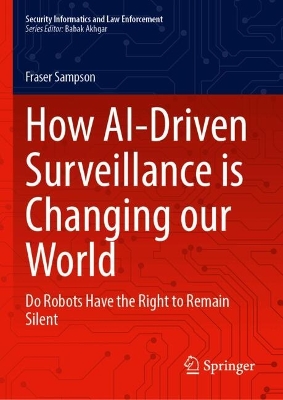
This book takes the complex and highly topical theme of AI-driven surveillance and reduces it to simple but important questions. Drawing upon the authors professional experience as UKs first joint Biometrics and Surveillance Camera Commissioner, the book provides a unique perspective of law enforcement, legal practice and government regulation. The book brings together a number of critical concepts from the rise of AI-driven surveillance in a collection of credible but readable and relatable essays expanding on the authors successful bi-monthly column in Biometric Update, a daily professional news hub with an annual readership of 3m+. Using real life examples to illustrate the key technical, legal and societal considerations, the book sets out the key elements from the tryptych of the technologically possible (what can be done), the legally permissible (what must/must not be done) and the societally acceptable (what the citizen supports/expects to be done). The book shows how this perspective affects the design, development, and deployment tools that address the challenges of accountability in law enforcement. The author studies these together with other projects looking at citizen behaviour, expectations and the legal and human rights considerations raised by the proliferation of sophisticated surveillance technology, not only in the hands of state agencies, but also the citizen themselves. The book is a unique addition to the field, tackling important and controversial areas of policy, law and practice in an informative and straightforward way.
Introduction.- The Changing Face of Surveillance Capability.- Are
AI-driven devices simply a question of evolution.- Why would China want to
hack your fridge.- How to duck ID fraud: An ABC for Beating Cyber-scammers.-
Why CCTV has no future.- Do the police ever forget a face.- Which came first,
convenience or security.- Emerging technology or emergency surveillance.- Why
cant we see the worlds most surveilled cities.- Where should the police
focus their AI-driven surveillance.- If you have done nothing wrong, what are
you worried about.- What is the policing privacy paradox.- Policing and
facial recognition: whats stopping them.- Do robots have the right to remain
silent.- Which policing tool has more hits-per-second than Instagram.- Who
watches the watchdogs AI.- Does the camera ever lie.- Do We Have a Right to
Go Missing.- What can we see in the Molka Mirror.- Welcome to Shrinkworld.-
Conclusion.
Dr. Fraser Sampson, LL.B. (Hons)., LL.M., MBA., PhD., Solicitor, is Professor of Governance and National Security at the Centre of Excellence in Terrorism, Resilience, Intelligence and Organised Crime Research, Sheffield Hallam University UK. He is the former UK Biometrics and Surveillance Camera Commissioner, is a qualified lawyer and former police officer with extensive C-suite experience in policing. He is a strategic advisor on biometrics to the Centre for Emerging Technology and Security at the Alan Turing Institute and a columnist for Biometric Update.