Muutke küpsiste eelistusi

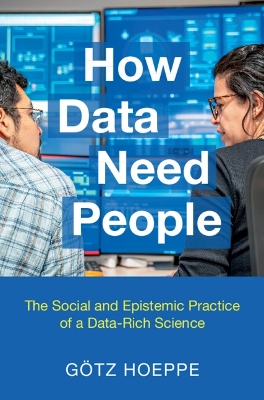
How Data Need People: The Social and Epistemic Practice of a Data-Rich Science [Kõva köide]

(University of Waterloo)
  • Formaat: Hardback, 304 pages, kaal: 500 g, Worked examples or Exercises
  • Ilmumisaeg: 31-May-2026
  • Kirjastus: Cambridge University Press
  • ISBN-10: 1009686720
  • ISBN-13: 9781009686723
Teised raamatud teemal:
  • Kõva köide
  • Hind: 93,38 €*
  • * hind on lõplik, st. muud allahindlused enam ei rakendu
  • Tavahind: 124,50 €
  • Säästad 25%
  • See raamat ei ole veel ilmunud. Raamatu kohalejõudmiseks kulub orienteeruvalt 3-4 nädalat peale raamatu väljaandmist.
  • Kogus:
  • Lisa ostukorvi
  • Tasuta tarne
  • Tellimisaeg 2-4 nädalat
  • Lisa soovinimekirja
  • Formaat: Hardback, 304 pages, kaal: 500 g, Worked examples or Exercises
  • Ilmumisaeg: 31-May-2026
  • Kirjastus: Cambridge University Press
  • ISBN-10: 1009686720
  • ISBN-13: 9781009686723
Teised raamatud teemal:
From genome sequencing to large sky surveys, digital technologies produce massive datasets that promise unprecedented scientific insights. But data, for being good to use and reuse, need people scientists, technicians, and administrators as embodied, evaluative, social humans. In this book, anthropologist Götz Hoeppe draws on an ethnography of astronomical research to examine the media and practices that scientists and technicians use to instruct graduate students, make diagrams for data calibration and discovery, organize collaborative work, negotiate the ethics of open access, encode their knowledge in datasets and undertake social inquiries along the way. This book offers a reflection on the sociality of data-rich research that will benefit attempts to integrate human and machine learning. It will be of interest for students and scholars in data science and science and technology studies, as well as in anthropology, sociology, history, and the philosophy of science. This book is also available Open Access on Cambridge Core.

Arvustused

'How Data Need People convincingly exemplifies why patient ethnographic studies are so needed today. I recommend the book as a model to everyone interested in practices of science.' Morana Ala, University of California, San Diego 'Hoeppe joins scientific teams and studies them from the inside. He convincingly argues that junior scientists also effectively become ethnographers when being trained in their work, in the implicit knowledge in their subfields, and in the expectations of their profession.' David W. Hogg, New York University 'This is the first long-term ethnographic study of how one of the oldest sciences we have, astronomy, lives a data-centric life today. A must-read not just for science and technology studies and the social sciences, but all data-focused fields and operations inside and outside the sciences.' Karin Knorr Cetina, University of Chicago 'Gotz Hoeppe has become a leading sociologist of science because he grounds his inquiries in real-world field research where he identifies the local details of scientific work. In this ethnographically rich study Hoeppe explains to us what it is scientists do with digital data in order to make it science.' Kenneth Liberman, University of Oregon

Muu info

This book reveals how scientific data do not only represent information, but are also implicated in social actions and accountabilities.
Preface; Acknowledgements; Introduction: making sense of data-centric
socialities;
1. Medium: digital affordances;
2. Evaluations: the ethical life
of data production;
3. Membership: learning to become a competent data user;
4. Diagrams: spaces for cultivating data and making discoveries;
5. World:
mundane reason and the relief from trust in data makers;
6. Organizing:
social, medial, and epistemic orders in data-centric collaboration;
7.
Normativity: inhabiting statuses in 'Open Science';
8. Encoding knowledge:
how to make data speak for themselves; Outlook: scientific data, artificial
intelligence, and people; Appendix: Transcription conventions; References;
Index.
Götz Hoeppe is Associate Professor of Sociology at the University of Waterloo, Canada. He is the author of Conversations on the Beach: Fishermen's Knowledge, Metaphor and Environmental Change in South India (2007) and Why the Sky is Blue: Discovering the Color of Life (2007), which received the American Meteorological Society's Louis J. Battan Author's Award.