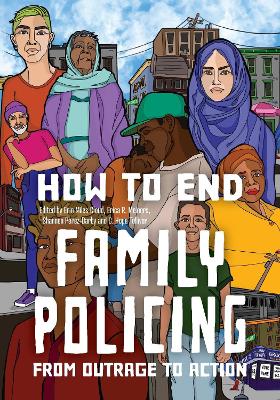
From leading abolitionist organizers, a much-needed intervention arguing that the systems that purport to protect children make themand our communitiesless safe.
Based on decades of shared organizing, study, and lived experience, the contributors to How to End Family Policing argue that the child welfare system cannot build genuine safety. Rather than the misleading language of child welfare and child protective services, scholars and activists use the term family policing to name the fact that these institutions and practices are neither neutral nor benign. Black, Indigenous, and Latinx parents do not mistreat their children at higher rates than white parents. Yet 53 percent of all Black children in the United States will experience a child protective services investigation before the age of eighteen.
Offering first-person testimony and laying out visions for alternatives to family policing, this book is an urgent call to build flourishing communities.
With contributions from Corey B. Best, Annie Chambers, Noran Elzarka, Brianna Harvey, Shira Hassan, Shawn Koyano, jaboa lake, Elizabeth Ling, Leah Plasse, Margaret Prescod, zara raven, Ignacio G. Hutķa Xeiti Rivera, Dorothy Roberts, Arneta Rogers, Lisa Sangoi, jasmine Sankofa, Kylee Sunderlin, Jasmine Wali, Amanda Wallace, Eleni Zimiles, and the editors.
Introduction: From Outrage to Action
1. Its Never Been about the Welfare of Children: The Origins of the Term
Family Police by Brianna Harvey and Jasmine Wali
2. Who is Safe? Who is Protected? by Corey B. Best
3. Prevention, Reparations, and Reunification Black Families and Healing the
Harms of Family Policing by jaboa lake
4. Young People Deserve Community Care by zara raven
5. Abolish the Family by Ignacio G. Hutķa Xeiti Rivera
6. Who Do You Tell? by Shannon Perez-Darby
7. The Community Dimensions of State Child Protection by Dorothy Roberts
8. Beyond Mandated Reporting: Organizing from the Inside Out by Leah Plasse,
LCSW, and E. Zimiles, LCSW
9. Im not an Organizer, I Just Organized by Amanda Wallace, Annie
Chambers, Charity Tolliver, Erin Cloud Miles, and Margaret Prescod
10. Change Everything? Notes on Abolitionist Strategies by Erica R. Meiners
11. What About Child Sexual Abuse? by Hope Tolliver
12. Bigger than Roe v. Wade by Arneta Rogers, jasmine Sankofa, Erin Miles
Cloud, Noran Elzarka, Elizabeth Ling, and Kylee Sunderlin
13. Relationships not Reporting: The Transformative Justice Help Desk
by Shira Hassan
14. Everyday People Build Extraordinary Possibilities: Parental Organizing as
Key to Ending Family Policing by Shawn Koyano
15. Movement Building and the Experiment of Movement for Family Power by Erin
Miles Cloud and Lisa Sangoi
Contributors
Acknowledgements
Appendix
Endnotes
Erin Miles Cloud is a mama, civil rights attorney, cofounder of Movement for Family Power, and a former family defense public defender.
Erica R. Meiners is a writer, organizer, and educator in Chicago. They are the coauthor of Abolition. Feminism. Now. and The Feminist and the Sex Offender: Confronting Sexual Harm and Ending State Violence.
Shannon Perez-Darby is a queer, mixed-race Latina, founding member of the Accountable Communities Consortium, and a core member of the Mandatory Reporting Is Not Neutral project.
C. Hope Tolliver is a Black poet, abolitionist, parent, and Chicago native who has been organizing for more than two decades.