Muutke küpsiste eelistusi

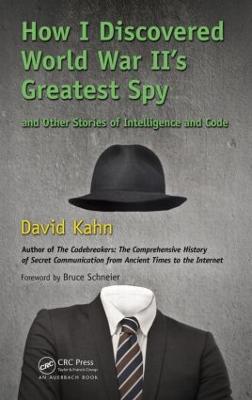
How I Discovered World War II's Greatest Spy and Other Stories of Intelligence and Code [Kõva köide]

(New York, New York, USA)
  • Formaat: Hardback, 489 pages, kõrgus x laius: 234x156 mm, kaal: 1070 g, 1 Tables, black and white; 40 Illustrations, black and white
  • Ilmumisaeg: 17-Jan-2014
  • Kirjastus: Auerbach
  • ISBN-10: 1466561998
  • ISBN-13: 9781466561991
  • Kõva köide
  • Hind: 47,80 €*
  • * hind on lõplik, st. muud allahindlused enam ei rakendu
  • Tavahind: 63,74 €
  • Säästad 25%
  • Raamatu kohalejõudmiseks kirjastusest kulub orienteeruvalt 3-4 nädalat
  • Kogus:
  • Lisa ostukorvi
  • Tasuta tarne
  • Tellimisaeg 2-4 nädalat
  • Lisa soovinimekirja
  • Formaat: Hardback, 489 pages, kõrgus x laius: 234x156 mm, kaal: 1070 g, 1 Tables, black and white; 40 Illustrations, black and white
  • Ilmumisaeg: 17-Jan-2014
  • Kirjastus: Auerbach
  • ISBN-10: 1466561998
  • ISBN-13: 9781466561991
Spies, secret messages, and military intelligence have fascinated readers for centuries but never more than today, when terrorists threaten America and society depends so heavily on communications. Much of what was known about communications intelligence came first from David Kahn's pathbreaking book, The Codebreakers. Kahn, considered the dean of intelligence historians, is also the author of Hitlers Spies: German Military Intelligence in World War II and Seizing the Enigma: The Race to Break the German U-Boat Codes, 1939-1943, among other books and articles.

Kahns latest book, How I Discovered World War II's Greatest Spy and Other Stories of Intelligence and Code, provides insights into the dark realm of intelligence and code that will fascinate cryptologists, intelligence personnel, and the millions interested in military history, espionage, and global affairs. It opens with Kahn telling how he discovered the identity of the man who sold key information about Germanys Enigma machine during World War II that enabled Polish and then British codebreakers to read secret messages.

Next Kahn addresses the question often asked about Pearl Harbor: since we were breaking Japans codes, did President Roosevelt know that Japan was going to attack and let it happen to bring a reluctant nation into the war? Kahn looks into why Nazi Germanys totalitarian intelligence was so poor, offers a theory of intelligence, explicates what Clausewitz said about intelligence, tellson the basis of an interview with a head of Soviet codebreakingsomething about Soviet Comint in the Cold War, and reveals how the Allies suppressed the second greatest secret of WWII.

Providing an inside look into the efforts to gather and exploit intelligence during the past century, this book presents powerful ideas that can help guide present and future intelligence efforts. Though stories of WWII spying and codebreaking may seem worlds apart from social media security, computer viruses, and Internet surveillance, this book offers timeless lessons that may help todays leaders avoid making the same mistakes that have helped bring at least one global power to its knees.

The book includes a Foreword written by Bruce Schneier.

Arvustused

When it comes to documenting the history of cryptography, David Kahn is singularly one of the finest, if not the finest writers in that domain. For anyone with an interest in the topic, Kahn's works are read in detail and anticipated. ... For those that have read some of Kahn's other works and are looking for more, How I Discovered World War IIs Greatest Spy and Other Stories of Intelligence and Code will be an enjoyable read. Ben Rothke, Information Security Manager, Wyndham Worldwide Corp., writing on Slashdot.orgHow I Discovered World War IIs Greatest Spy and Other Stories of Intelligence and Code is the latest book by the distinguished intelligence historian David Kahn. This volume is a collection of thirty articles by Kahn, all of which have been previously published in a variety of publications, but have been brought together here as they are viewed by Kahn as having enduring value to intelligence historians and complement his earlier books. ... Kahn offers students of intelligence history a context and useful starting point for their work. ... an interesting and worthwhile collection. Alan MacLeod, University of Leeds, writing in the Journal of Military History, July 2014

Foreword xi
Preface xiii
Part I Introduction
Chapter 1 How I Discovered World War It's Greatest Spy
3(16)
Part II American Stories
Chapter 2 Did Roosevelt Know?
19(8)
Chapter 3 Pearl Harbor and the Inadequacy of Cryptanalysis
27(24)
Chapter 4 How the United States Viewed Germany and Japan in 1941
51(28)
Chapter 5 Roosevelt, Magic, and Ultra
79(34)
Chapter 6 Edward Bell and His Zimmermann Telegram Memoranda
113(22)
Chapter 7 Cryptology and the Origins of Spread Spectrum
135(32)
Part III Cases
Chapter 8 The Rise of Intelligence
167(16)
Chapter 9 Intelligence in World War II: A Survey
183(24)
Chapter 10 Why Germany's Intelligence Failed in World War II
207(32)
Chapter 11 An Enigma Chronology
239(10)
Chapter 12 The Black Code
249(18)
Chapter 13 Nothing Sacred: The Allied Solution of Vatican Codes in World War II
267(6)
Chapter 14 Finland's Codebreaking in World War II
273(16)
Chapter 15 Soviet Comint in the Cold War
289(24)
Chapter 16 How the Allies Suppressed the Second Greatest Secret of World War II
313(20)
Part IV A Theory, Clausewitz, and More
Chapter 17 An Historical Theory of Intelligence
333(16)
Chapter 18 Clausewitz on Intelligence
349(12)
Chapter 19 Surprise and Secrecy: Two Thoughts
361(2)
Chapter 20 Intelligence Lessons in Macbeth
363(2)
Chapter 21 How Garbles Tickled History
365(8)
Chapter 22 The Cryptologic Origin of Braille
373(4)
Chapter 23 The Only False Message I Know
377(4)
Chapter 24 The Prehistory of the General Staff
381(10)
Part V Personalities
Chapter 25 Charles J. Mendelsohn and Why I Envy Him
391(16)
Chapter 26 The Man in the Iron Mask: Encore Et Enfin, Cryptologically
407(6)
Chapter 27 Students Better than a Pro (Bazeries) and an Author (Candela)
413(2)
Chapter 28 The Old Master of Austrian Cryptology
415(8)
Part VI A Counterfactual and the Future
Chapter 29 Enigma Uncracked: The Allies Fail to Break the German Cipher Machine
423(10)
Chapter 30 The Future of the Past: Questions in Cryptologic History
433(8)
Index 441
David Kahn is universally regarded as the dean of intelligence historians. He is the author of Seizing the Enigma: The Race to Break the German U-Boats Codes, 1939-1943. His pathbreaking book The Codebreakers, the classic history of codemaking and codebreaking remains in stalwart print 45 years after its publication (portions have been updated). He is also the co-founder of the Taylor & Francis journal, Cryptologia, which continues to attract new subscribers.