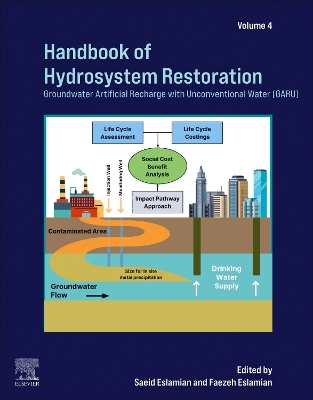
Hydrosystem Restoration Handbook, Groundwater Artificial Recharge with Unconventional Water (GARU), Volume Four covers the essentials of Groundwater Artificial Recharge with Unconventional Water (GARU). After introducing the reader to Groundwater Artificial Recharge with Conventional Water (GARC), the editors conclude with the application of various methods necessary to prevent contamination of the groundwater and offer key solutions to sustain best water practice in the current climate change.
1. An Introduction to Unconventional Water
2. Standard Guidelines for GARU
3. AGR with Reclaimed Municipal Wastewater
4. Geochemistry and Qualitative Aspects of GARU
5. Risk Assessment in GARU
6. Water Reuse and Groundwater Augmentation
7. Unconventional Water and Groundwater Vulnerability
8. Vitier Potential for Increasing GARC
9. Induced Infiltration and GARC
10. GARU: Global Opportunities and Challenges
11. Artificial Recharge of Groundwater with Reclaimed Municipal Wastewater
12. Public Consultation on using GARC
13. Farmland Drainage Water and Suitability Assessment for GARC
14. Microbiological Assessment and GARC
15. Overlook of GARC in a Changing Climate
Saeid Eslamian received his PhD in Civil and Environmental Engineering from University of New South Wales, Australia in 1998. Saeid was Visiting Professor in Princeton University and ETH Zurich in 2005 and 2008 respectively. He has contributed to more than 1K publications in journals, conferences, books. Eslamian has been appointed as 2-Percent Top Researcher by Stanford University for several years. Currently, he is full professor of Hydrology and Water Resources and Director of Excellence Center in Risk Management and Natural Hazards. Isfahan University of Technology, His scientific interests are Floods, Droughts, Water Reuse, Climate Change Adaptation, Sustainability and Resilience
Faezeh Eslamian is a PhD holder of bioresource engineering from McGill University. Her research focuses on the development of a novel lime-based product to mitigate phosphorus loss from agricultural fields. Faezeh completed her bachelors and masters degrees in civil and environmental engineering from Isfahan University of Technology, Iran, where she evaluated natural and low-cost absorb bents for the removal of pollutants such as textile dyes and heavy metals. Furthermore, she has conducted research on the worldwide water quality standards and wastewater reuse guidelines. Faezeh is an experienced multidisciplinary researcher with research interests in soil and water quality, environmental remediation, water reuse, and drought management.