Muutke küpsiste eelistusi

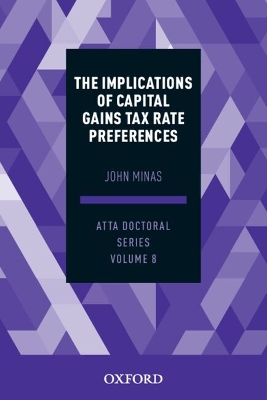
Implications of Capital Gains Tax Rate Preferences: ATTA Doctoral Series: Volume 8 [Pehme köide]

  • Formaat: Paperback / softback, 260 pages, kaal: 300 g
  • Ilmumisaeg: 07-Nov-2019
  • Kirjastus: OUP Australia and New Zealand
  • ISBN-10: 0190324376
  • ISBN-13: 9780190324377
Teised raamatud teemal:
  • Pehme köide
  • Hind: 86,98 €*
  • * hind on lõplik, st. muud allahindlused enam ei rakendu
  • Tavahind: 108,73 €
  • Säästad 20%
  • Raamatu kohalejõudmiseks kirjastusest kulub orienteeruvalt 3-4 nädalat
  • Kogus:
  • Lisa ostukorvi
  • Tasuta tarne
  • Tellimisaeg 2-4 nädalat
  • Lisa soovinimekirja
  • Formaat: Paperback / softback, 260 pages, kaal: 300 g
  • Ilmumisaeg: 07-Nov-2019
  • Kirjastus: OUP Australia and New Zealand
  • ISBN-10: 0190324376
  • ISBN-13: 9780190324377
Teised raamatud teemal:
The Implications of Capital Gains Tax Rate Preferences explores key aspects of one of the more controversial questions in tax policy what is the appropriate way to tax capital gains? The book examines whether the 50% Capital Gains Tax (CGT) discount for personal taxpayers in Australia has been successful in achieving its original objective of revenue neutrality.

The Implications of Capital Gains Tax Rate Preferences presents policy options and recommendations that are informed by in-depth interviews with CGT experts in Australia, Canada, and the United States, as well as by a quantitative study estimating the capital gains realisations response for personal taxpayers in Australia. It is proposed in the book that the CGT regime for personal taxpayers in Australia would be improved by taxing net capital gains at normal marginal tax rates, and by the introduction of an annual exempt amount for net capital gains.

The Implications of Capital Gains Tax Rate Preferences is the eighth volume in the Australasian Tax Teachers' Association (ATTA) Doctoral Series.
Abstract iii
Acknowledgments iv
List of Tables
vii
List of Figures
viii
Publications ix
List of Acronyms and Abbreviations
x
Chapter 1 Introduction
1(14)
1.1 Overview
1(3)
1.2 Aims of the Research
4(3)
1.3 Significance of the Research
7(2)
1.4 Scope of the Research
9(2)
1.5 Research Design
11(1)
1.6 Structure
12(3)
Chapter 2 A Review of the Literature on Taxing Capital Gains
15(60)
2.1 Introduction
15(1)
2.2 Taxing Capital Gains: The Definition and Base
15(2)
2.3 A Critique of Preferential Rates for the Taxation of Capital Gains
17(13)
2.4 Elasticity and Capital Gains
30(7)
2.5 Review of Capital Gains Realisations Response Studies
37(28)
2.6 Conclusions on the Review of the Capital Gains Realisations Response Studies
65(8)
2.7 Research Questions and Hypotheses
73(2)
Chapter 3 Methodology and Research Design
75(26)
3.1 Introduction
75(1)
3.2 Research Frameworks and Approaches
75(3)
3.3 Application of Research Paradigms to the Research Question and the Hypotheses
78(22)
3.4 Conclusions on Methodology and Research Design
100(1)
Chapter 4 Qualitative Results--the Voice of the Experts
101(26)
4.1 Introduction
101(1)
4.2 Research Findings
101(22)
4.3 Conclusions on the Interview Study
123(4)
Chapter 5 Quantitative Results--Capital Gains Realisations Response Study
127(20)
5.1 Purpose of the Quantitative Study
127(2)
5.2 Estimation Results
129(7)
5.3 Additional Analyses--Alternative Sample Periods
136(1)
5.4 The Capital Gains Realisations of Companies
137(4)
5.5 Conclusions on the Capital Gains Realisations Response Study
141(6)
Chapter 6 Policy Options for Taxing Capital Gains in Australia
147(14)
6.1 Introduction
147(2)
6.2 Taxing Capital Gains at Full Marginal Tax Rates
149(2)
6.3 Reducing the Rate of the CGT Discount
151(1)
6.4 Taper Relief
152(1)
6.5 Annual Exempt Amount
153(6)
6.6 Summary
159(2)
Chapter 7 Conclusions
161(8)
7.1 Summary and Key Findings
161(1)
7.2 Contribution
162(1)
7.3 Limitations
163(3)
7.4 Opportunities for Future Research
166(1)
7.5 Final Comments
167(2)
References 169(10)
Appendix: Interview Questions Used in the
Chapter 4 Qualitative Study
179
John Minas is a Senior Lecturer in Taxation in the Tasmanian School of Business and Economics at the University of Tasmania, and an Adjunct Research Fellow in the Griffith Law Futures Centre at Griffith University.