Muutke küpsiste eelistusi

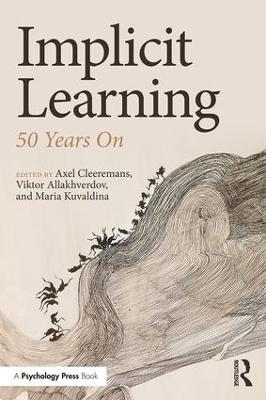
Implicit Learning: 50 Years On [Pehme köide]

Edited by (University Libre de Bruxelles), Edited by (St. Petersburg State University, Russia), Edited by (Saint Petersburg State University, Russia)
  • Formaat: Paperback / softback, 262 pages, kõrgus x laius: 234x156 mm, kaal: 422 g, 21 Tables, black and white; 4 Line drawings, color; 15 Line drawings, black and white; 2 Halftones, black and white
  • Ilmumisaeg: 01-Apr-2019
  • Kirjastus: Routledge
  • ISBN-10: 1138644307
  • ISBN-13: 9781138644304
Teised raamatud teemal:
  • Pehme köide
  • Hind: 44,76 €*
  • * hind on lõplik, st. muud allahindlused enam ei rakendu
  • Tavahind: 59,69 €
  • Säästad 25%
  • Raamatu kohalejõudmiseks kirjastusest kulub orienteeruvalt 3-4 nädalat
  • Kogus:
  • Lisa ostukorvi
  • Tasuta tarne
  • Tellimisaeg 2-4 nädalat
  • Lisa soovinimekirja
  • Formaat: Paperback / softback, 262 pages, kõrgus x laius: 234x156 mm, kaal: 422 g, 21 Tables, black and white; 4 Line drawings, color; 15 Line drawings, black and white; 2 Halftones, black and white
  • Ilmumisaeg: 01-Apr-2019
  • Kirjastus: Routledge
  • ISBN-10: 1138644307
  • ISBN-13: 9781138644304
Teised raamatud teemal:
Can we learn without knowing we are learning? To what extent is our behavior influenced by things we fail to perceive? What is the relationship between conscious and unconscious cognition? Implicit Learning: 50 Years On tackles these key questions, fifty years after the publication of Arthur Reber’s seminal text. Providing an overview of recent developments in the field, the volume considers questions about the computational foundations of learning, alongside phenomena including conditioning, memory formation and consolidation, associative learning, cognitive development, and language learning.Featuring contributions from international researchers, the book uniquely integrates ‘western’ thinking on implicit learning with insights from a rich Russian research tradition. This approach offers an excellent opportunity to contrast perspectives, to introduce new experimental paradigms, and to contribute to ongoing debates about the very nature of implicit learning. Implicit Learning: 50 Years On is essential reading for students and researchers of consciousness, specifically those interested in implicit learning.
Acknowledgements vii
List of contributors
viii
Foreword xi
Introduction 1(15)
Axel Cleeremans
Viktor Allakhverdov
Maria Kuvaldina
1 Implicit learning: history and applications
16(22)
Paul J. Reber
Laura J. Batterink
Kelsey R. Thompson
Ben Reuveni
2 The mind is deep
38(33)
Axel Cleeremans
3 Consciousness, learning, and control: on the path to a theory
71(37)
Viktor Allakhverdov
Margarita G. Filippova
Valeria A. Gershkovich
Valeriia Yu. Karpinskaia
Tanya V. Scott
Natalia P. Vladykina
4 Implicit learning from one's mistakes: the negative choice aftereffect
108(25)
Maria Kuvaldina
Andrey A. Chetverikov
Alexandr S. Odainic
Margarita G. Filippova
Natalia V. Andriyanova
5 Can we play Space Invaders unconsciously? (A: probably not)
133(26)
Estibaliz San Anton
Axel Cleeremans
Arnand Destrebecqz
6 Can unconscious structural knowledge be strategically controlled?
159(15)
Elisabeth Norman
Ryan B. Scott
Mark C. Price
Einnui Jones
Zoltan Dienes
7 Abstraction in sequence learning
174(15)
Ferenc Kemeny
Agnes Lukacs
8 The verbalization effect on implicit learning
189(19)
Nadezhda V. Moroshkina
Ivan I. Ivanchei
Anatolii D. Karpov
Irina Ovchinnikova
9 Focusing on goal relevance is it crucial to artificial grammar learning?
208(24)
Agnieszka Popiawska Boruc
Radosfaw Sterczynski
Marta Roczniewska
10 Implicit learning under attentional load
232(20)
Michal Wierzchon
Monika Derda
Index 252
Axel Cleeremans is a research director with the Fund for Scientific Research (F.R.S.-FNRS), Belgium, and a professor of Cognitive Psychology at the Université libre de Bruxelles, where he directs the Center for Research in Cognition & Neuroscience and the ULB Neuroscience Institute.

Viktor Allakhverdov is a prominent Russian psychologist and chairperson of the division of General Psychology, St. Petersburg State University. He is the author of more than 5 books on consciousness and the head of a research group that investigates implicit learning and unconscious cognition.

Maria Kuvaldina is a postdoctoral researcher. She received her doctorate in cognitive psychology from St. Petersburg State University. Her research interests include mechanisms of attention and cognitive control.