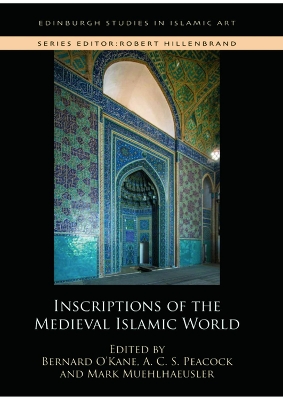
Showcases the best recent research on epigraphy across the medieval Islamic world
This volume offers an overview of the state of the field, and shows the importance of Islamic inscriptions for disciplines such as art history, history and literature. The chapters range from surveys to detailed exploration of individual topics, providing an insight to some of the most recent cutting-edge work on Islamic inscriptions. It focuses on the period from the rise of Islam to the fifteenth century, ranging across the Islamic world from the Maghreb to India and Central Asia, and inscriptions in Arabic, Persian and Turkish.
The five sections of the book draw together some of the principal themes: ‘Royal Power’ investigates the role of sultanic patronage in epigraphy, and the use of inscriptions for projecting royal power. ‘Piety’ examines the relationship between epigraphy and religious practice. ‘Epigraphic Style and Function’ explores the relationship between the use of specific epigraphic styles and scripts and the function of a monument. ‘Inscribed Objects’ moves from monumental inscriptions to those on objects such as ceramics and pen-cases. The final section considers the interplay between inscriptions and historical sources as well as the utility of inscriptions as historical sources.
Arvustused
Inscriptions of the Medieval Islamic World explores the importance of epigraphic languages stretching from Spain to the Crimea between the 7th and 16th century CE. This landmark volume offers fresh interdisciplinary insights on the significance of the written word, prompting renewed attention on one the Islamic worlds most pivotal art forms. -- Christiane Gruber, University of Michigan This anthology alerts to the diversity of visual and textual themes in epigraphic cultures of medieval Islam. It demonstrates what we gain from seeing inscriptions in their context of a specific time, place, and function. And it shows the relevance of discussing epigraphy as a historically distinct product across its general taxonomic categories in philology and art history. -- Markus Ritter, University of Vienna
1. Introduction Bernard OKane and A. C. S. Peacock
Part I: Inscriptions and Royal Power
2. The Fatimid Public Text Revisited Jonathan M. Bloom
3. Micro and Macro Power Projection in the Medieval Islamic World: The
Architectural and Numismatic Epigraphic Evidence Richard P. McClary
4. The Monumental Inscriptions of the Great Seljuqs Malikshåh and Tutush.
Observations on Texts, Protocols and Writing Styles Roberta Giunta
5. New Epigraphic Data from a Ghurid Monument at Chisht-i Sharif: Expressing
Power and Piety in Sixth/Twelfth-Century Afghanistan Viola Allegranzi
Part II: Inscriptions and Piety
6. Stars and Symmetry: The Name of the Prophet Muhammad in Architectural
Inscriptions Bernard OKane
7. Barakat Muhammad. Notes on Square Kufic Epigraphy in the History of
Morocco Umberto Bongianino and Péter T. Nagy
8. Islamic Supplications of the Funerary Architecture of Medieval Castile
Razan Francis
9. The Shaykh and the Amir: Reflections on the non-Quranic Epigraphic
Programme in the Buildings of Shaykhi al-Umari al-NasiriNoha Abou-Khatwa
Part III: Inscriptions, History and Society
10. Tombstones from Aswan in the British Museum Venetia Porter
11. Marwanid Inscriptions Carole Hillenbrand
12. The Rise of New Epigraphic Languages in the Medieval Islamic East. The
Interplay of Persian, Turkish and Arabic on Inscriptions A. C. S. Peacock
13. Inscriptions from the Golden Horde Period and the Crimean Khanate in
Crimea: a Body of Hitherto Neglected Material within the Study of the
Inscriptions of Islamic Lands Nicole Kanēal-Ferrari and Fatma M. en
Part IV: Inscribed Objects
14. The Epigraphic Samarra Horizon: Blue-on-White Ceramics Rebecca Wrightson
15. Art with Poetry: Inscriptions on Mamluk Metalwork Doris Behrens-Abouseif
16. The Calligrapher is an Ape! Arabic Epigrams on Pen Boxes
(Sixth/TwelfthNinth/Fifteenth Centuries) Frédéric Bauden
17. Between the Artist and the Patron: Painted Inscriptions of the Khamsa of
Shah Tahmasb Selin Ünlüönen
Part V: Epigraphic Style and Function
18. The Influence of Aesthetics on Orthographic Decisions in the Early
Islamic Graffiti of Wadi al-Khirqa, Northern Hijaz Risa Tokunaga
19. The Here and the Hereafter: Rounded and AngularInscriptions in Medieval
Syria, Anatolia and the Jazira Scott Redford
20. Luted Letters: The Relief Inscriptions on Kashan Lustre Mihrabs Sheila
Blair
21. Carved Letters, Designs and Ornaments: Ilkhanid Stuccos and Signatures
of their Craftsmen Ana Marija Grbanovic
22. The Qutb Minar: Epigraphic Notes Robert Hillenbrand
Index
Bernard OKane is Professor of Islamic Art and Architecture at the American University in Cairo. He is the author of Timurid Architecture in Khurasan (1987), Studies in Persian Art and Architecture (1996) and Early Persian Painting (2003); and the editor of Treasures of Islamic Art in the Museums of Cairo (2006). A.C.S. Peacock is Professor of Middle Eastern and Islamic History at the University of St Andrews, and holds a PhD from the University of Cambridge. His previous publications include The Great Seljuk Empire (2015) and Early Seljuq History (2010). Mark Muehlhaeusler is a Senior Instructor at the American University in Cairo.