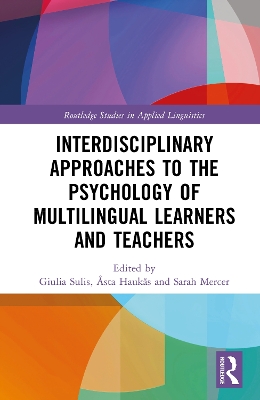
This volume explores the connections between multilingualism and the psychology of language learning and teaching. It provides new insights into the relationship between these two areas and the complex realities of multilingual individuals.
The book seeks to advance scholarship in both multilingualism and psychology by extending existing studies in PLLT beyond the study of one language at a time and focusing on both learners and teachers. Collectively, the chapters make the case for bringing together multilingualism and PLLT for a more holistic view into issues impacting learners and teachers, reflecting on areas including Willingness to Communicate (WTC), wellbeing, emotions, motivation, identities, self-efficacy, and agency. In turning the focus on multilingual learners and teachers and their respective experiences, practices, and beliefs, the book offers directions for researchers and stakeholders to foster learner and teacher success in the language classroom and beyond.
This volume will be of interest to students and scholars in multilingualism, psycholinguistics, language teacher education, language learning and teaching, and applied linguistics.
This volume explores the connections between multilingualism and the psychology of language learning and teaching. It provides new insights into the relationship between these two areas and the complex realities of multilingual individuals.
Interdisciplinary approaches to multilingualism and language learner and
teacher psychology: An introduction, Giulia Sulis, Sarah Mercer and Åsta
Haukås; Part 1: Multilingualism and learner psychology;
2. Willingness to
Communicate and multilingualism: Concept extension and ontological
underpinnings, Alastair Henry and Peter MacIntyre;
3. Negotiating identities,
navigating speaking: A longitudinal study of Japanese students' multilingual
fluctuations during a European study abroad, Simon Humphries, Jim King,
Jean-Marc Dewaele and Tomoko Yashima;
4. The more, the merrier? Comparing
conceptualizations of self-report multilingualism as a predictor of
individual differences, Nazila Fattahi, Faramarz Ebn-Abbasi and Elouise
Botes;
5. Psychotypology-guided strategy development and multilingual learner
emotions when learning a linguistically distant language, Yan-Yi Lee and
Karen Forbes;
6. Just about the language? Relating vision to multilingual
learners' Mandarin learning engagement, Siying Shen and Martin Lamb;
7.
Learners' multilingual selves: A cross-country comparison of students' LOTE
motivation in Estonia and Hungary, Bochra Kouraichi;
8. Motivation and
attitudes of Modern Greek FL learners in the multilingual context of
Catalonia, Spain, Maria Andria;
9. Exploring Finnish high school students'
multilingual repertoires: Self-efficacy in reading in L1 and various L2s,
Mareen Patzelt, Judi Rose and Leena Maria Heikkola;
10. Multilingual
identity, metalinguistic abilities and their complex interaction in
education, Valentina Carbonara, Jacopo Torregrossa and Silvia Melo-Pfeifer;
Part 2: Multilingualism and teacher psychology;
11. Language teachers'
self-efficacy beliefs, agency, and students' engagement in multilingual
digital storytelling, Camilla Spaliviero;
12. Well-being challenges and
growth: Insights from Australian pre-service language teachers, Gary Bonar,
Ruth Fielding and Melhul Wang;
13. Flow as a mediator of the wellbeing of
teachers of multiple languages and multilingual teachers, Agata
Sowik-Krogulec and Anna Mystkowska-Wiertelak;
14. Multilingual language
teacher psychology: Interactions between emotional resonance, self-efficacy,
and metalinguistic knowledge, Raees Calafato;
15. Breaking the boundaries:
Integrating PLLT and multilingualism, Giulia Sulis, Sarah Mercer and Åsta
Haukås; Index.
Giulia Sulis is a senior postdoc at the University of Graz, Austria
Åsta Haukås is a Professor of foreign language eduaction at the University of Bergen, Norway
Sarah Mercer is a Professor at the University of Graz, Austria.